


A bad RV mattress has a way of announcing itself at 3 a.m. Your hip goes numb, your lower back tightens, and every turn from your partner travels across the bed. This RV hybrid review looks at whether a coil-and-foam mattress is the right answer for travelers who are done accepting thin, heat-trapping factory bedding.
For many RV owners, the answer is yes - but only when the hybrid is built for the realities of an RV. The best option is not simply a residential mattress squeezed into a camper. It needs the right dimensions, a manageable profile, durable support, and comfort that still performs after long travel days.
RV Hybrid Review: What a Hybrid Mattress Changes
A hybrid mattress combines two systems: a supportive coil unit and comfort foams near the surface. The coils carry most of the load and promote airflow. The foam layers cushion pressure points at the shoulders, hips, and knees. Done well, the result feels more substantial and responsive than a basic foam mattress without the overly springy feel of an old-fashioned innerspring.
That construction matters in an RV because stock mattresses are often designed to meet a price target, not to support nightly sleep. They may be thin, low-density, and prone to holding heat. A quality RV hybrid is a meaningful step up for couples, side sleepers, people with back discomfort, and full-time RVers who use their rig as a primary home rather than an occasional weekend cabin.
The coil system is usually the biggest difference you will feel. Individually wrapped pocket coils move independently, so they can contour more closely to the body than a connected coil grid. They also reduce the transfer of movement from one sleeper to the other. If one person gets up early for a hike or moves around during the night, that isolation can make a real difference.
Foam still matters, but it should not be the entire story. Gel memory foam can relieve pressure and add contouring comfort, while more responsive transition foam keeps you from feeling stuck. Cooling materials can help as well, particularly for travelers who camp in warm climates or sleep under a roof that absorbs afternoon sun.
Where RV Hybrid Mattresses Perform Best
A hybrid is especially strong for sleepers who want both cushioning and support. Side sleepers often benefit from the pressure relief at the shoulder and hip. Back sleepers typically appreciate the more even, stable support created by coils beneath the comfort layers. Combination sleepers tend to like how easily a hybrid allows them to change positions.
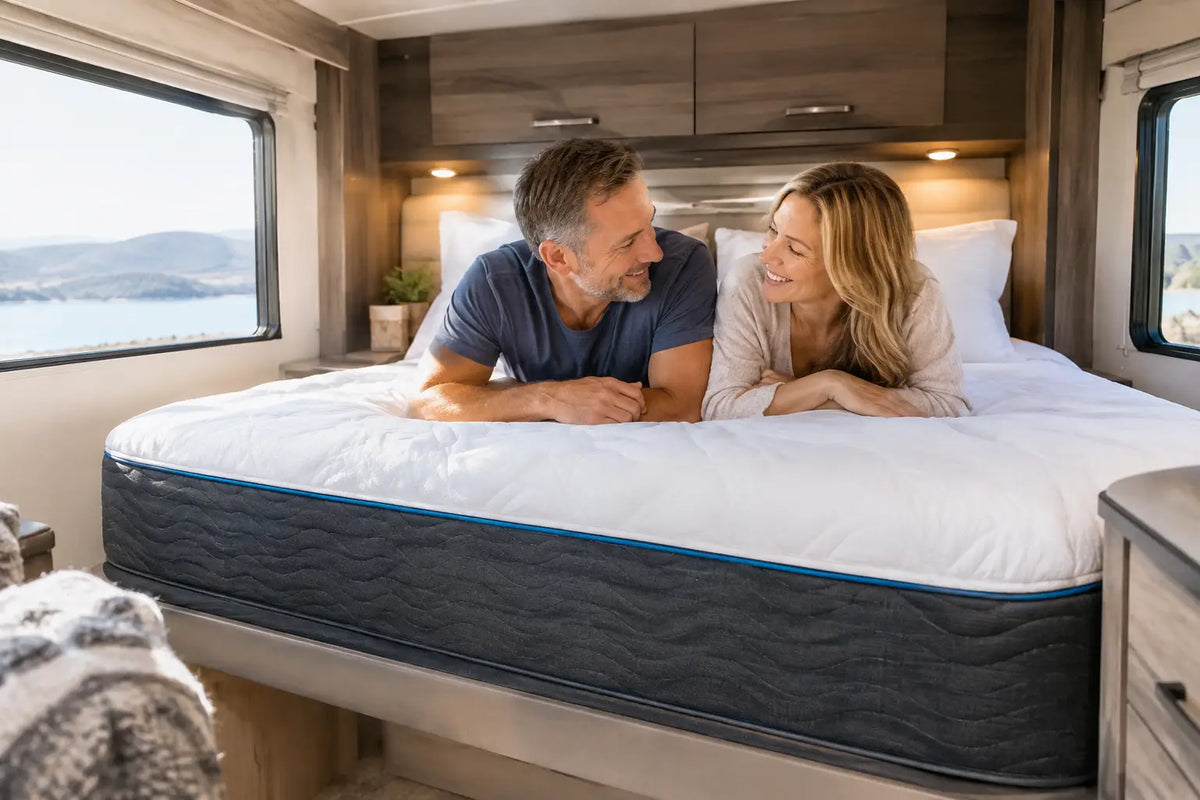
Couples are another natural fit. A decent coil system gives each person more individualized support than a thin slab of foam, and pocketed coils can limit the bounce and motion that make smaller RV beds feel even smaller. Stronger edge support also matters when two adults share an RV Queen or RV King. It gives you more usable sleeping surface and makes sitting on the side of the bed more comfortable while getting dressed.
Temperature is another reason travelers consider hybrid construction. Coils create open space through the mattress, allowing more air movement than dense all-foam designs. That does not make every hybrid automatically cool. A thick, heat-retaining foam top can still sleep warm. But a hybrid with breathable layers and conductive cooling materials has a better foundation for temperature regulation than most budget RV mattresses.
There is a practical benefit, too. A supportive mattress can help you recover after driving, towing, setting up camp, hiking, or simply spending a long day on the road. Better sleep does not change the weather or shorten a drive, but it can make mornings in the RV feel far less compromised.
The Trade-Offs to Consider Before You Buy
A hybrid mattress is not the automatic best choice for every RV owner. It is usually heavier than an all-foam model because of the steel coils. Weight is worth considering if you are close to your cargo capacity or need to lift the mattress frequently to access under-bed storage. Before ordering, check the product weight and think about how often you use that storage area.
Height is equally important. A taller mattress can improve comfort, but it can also interfere with overhead cabinets, bed lifts, slide-outs, or the ability to make the bed in a tight space. Measure from the platform to any obstruction, then leave enough room for bedding. In many RVs, a mattress that is too tall becomes annoying long before it becomes comfortable.
Price is the other clear trade-off. A well-built hybrid costs more than a basic foam replacement. The question is whether you are replacing a mattress for a few vacation nights each year or sleeping on it for months at a time. For frequent travelers, the cost should be weighed against durability, pressure relief, and the number of nights you expect to use it.
Firmness is personal, and no RV hybrid review can make that decision for you. A medium feel is often the most versatile choice for couples and mixed sleeping positions. Lighter side sleepers may need more surface cushioning, while larger sleepers and dedicated back or stomach sleepers may prefer a firmer support system. Construction quality matters more than a firmness label alone.
Fit Is the Part Most Mattress Reviews Miss
The mattress can feel excellent in theory and still fail if it does not fit your RV correctly. RV bed sizes are not always identical to residential sizes. An RV Queen, for example, is commonly shorter than a standard Queen, while RV King dimensions can vary by manufacturer and floor plan. Measuring the existing mattress is useful, but measuring the platform is better.
Take the length and width at the base, not just at the top edge. Check for wheel wells, angled corners, wall trim, slides, and cabinets that reduce usable space. If the bed has a rounded or cut corner, a standard rectangular mattress may not work without modification. Also measure the maximum height available, especially on bunks and beds under cabinets.
This is where RV-specific mattress companies have an advantage. Polar RV Mattress, for example, focuses on RV dimensions rather than asking customers to force a conventional residential size into a nonstandard platform. The right fit prevents gaps, pinched corners, and the frustrating discovery that a new mattress blocks a drawer or keeps a slide from operating properly.
What to Look for in a Quality RV Hybrid
Start with the coil unit. Pocketed coils are generally the better choice for individualized support and motion control. Zoned support can be even better, with firmer reinforcement through the center third of the mattress where the body carries more weight. Quality steel and a well-designed perimeter help preserve shape and edge support over time.
Then look at the comfort layers. You want enough foam to relieve pressure without creating a deep, sinking feel that makes position changes difficult. If you sleep hot, prioritize breathable covers, gel-infused or conductive cooling materials, and a coil system that encourages airflow. Cooling claims should be viewed realistically: no mattress can replace proper RV ventilation or air conditioning in extreme heat, but the right materials can keep the bed from adding to the problem.
Pay attention to the trial period, shipping process, warranty, and access to real support. Buying a mattress online requires confidence that you can get help with sizing and that you have adequate time to judge the mattress in your own RV. A 365-night satisfaction guarantee is especially valuable because sleep comfort can take more than a few nights to evaluate.
Finally, think about your actual travel style. A lightweight couple taking short trips may prioritize a lower profile and easy lifting. Full-timers may place more value on zoned support, cooling, and long-term durability. Families outfitting bunks may need a thinner mattress with enough comfort for growing kids but enough clearance to preserve safety rails.
Is an RV Hybrid Worth It?
For RV owners replacing a worn-out stock mattress, a hybrid is often worth the upgrade because it addresses several problems at once: weak support, pressure points, heat buildup, and partner disturbance. It is particularly compelling when your RV is used for extended travel or full-time living.
Still, the best RV hybrid is not necessarily the thickest or most expensive model. It is the one that fits your platform precisely, matches your sleeping position, stays within your weight and height limits, and uses materials designed to hold up to regular use. Measure first, choose support before surface feel, and give yourself enough time to decide how the mattress performs after real nights on the road. Your next campground morning should begin with coffee and a view, not a sore back.
Share:
How a Couple Upgraded Their Fifth Wheel Mattress