

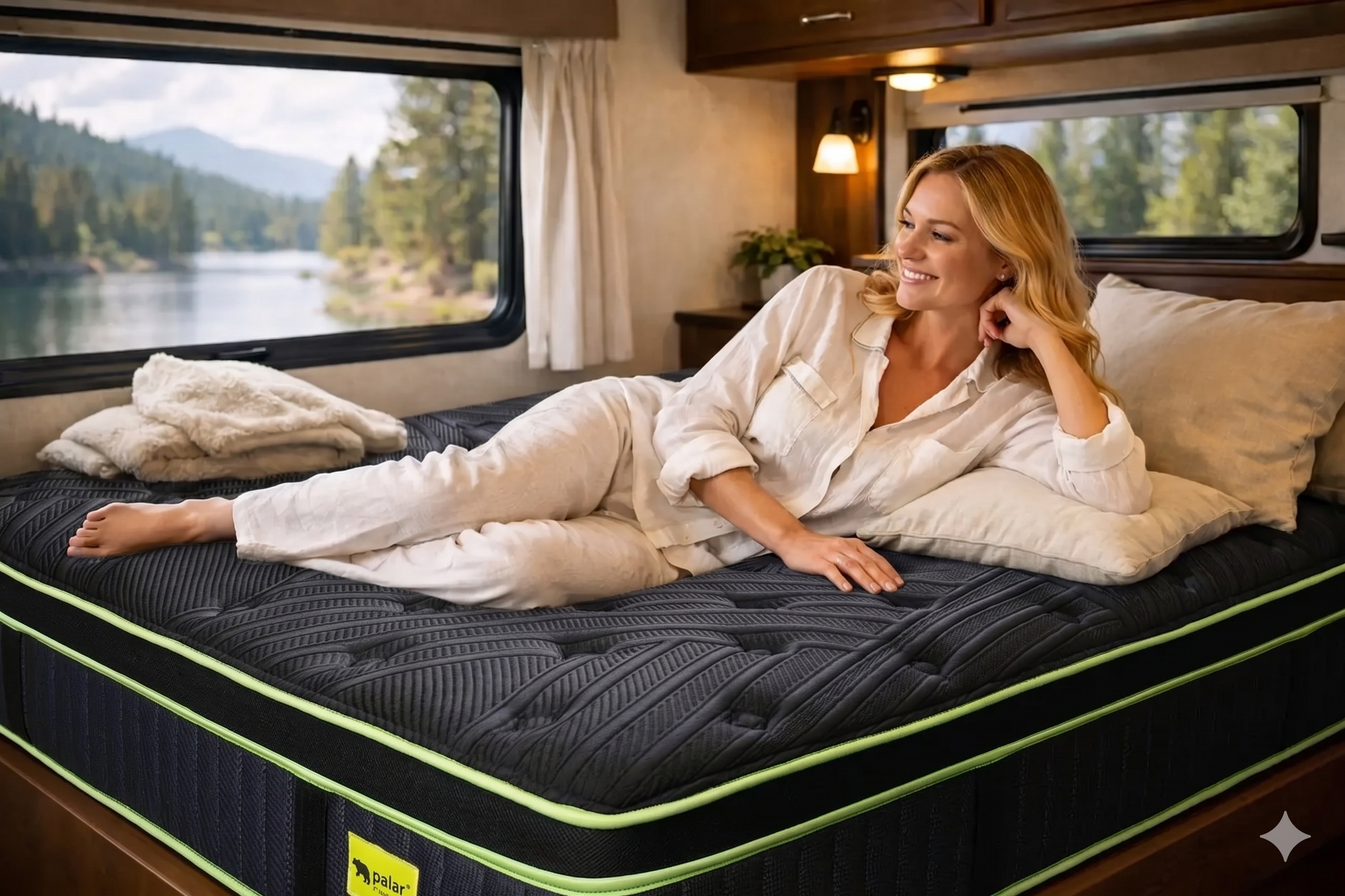
If your current bed hangs over the platform, blocks a cabinet, or leaves you sleeping diagonally just to get comfortable, size is the problem before comfort ever enters the conversation. This RV king mattress size guide is built to help you get the fit right the first time, because in an RV, a mattress that is even a few inches off can create daily frustration.
A residential king is not automatically an RV king, and that distinction matters more than most buyers expect. RV manufacturers work around slide-outs, wardrobes, curved walls, corner cutouts, lift-up storage, and narrow walkways. The result is a sleep space that often looks king-sized at a glance but does not match standard bedroom dimensions. If you want better cooling, pressure relief, and support, you still have to start with accurate sizing.

What is an RV king mattress size?
In most cases, an RV king mattress measures 72 inches wide by 80 inches long. That makes it narrower than a standard residential king, which is typically 76 inches wide by 80 inches long. Those four inches sound minor on paper, but inside an RV they can be the difference between a clean fit and a mattress that rubs cabinetry or crowds the aisle.
That said, not every RV labeled "king" uses the same footprint. Some floorplans are designed around an eastern king, some around a western king, and some around a custom platform that falls somewhere in between. There are also rigs with rounded corners or trimmed edges to accommodate tight layouts. This is where many shoppers get tripped up. They shop by label instead of exact dimensions.
The safest approach is to treat "RV king" as a category, not a universal measurement. The label points you in the right direction, but the tape measure confirms what will actually fit.
RV king mattress size guide: common dimensions to know
The most common comparison starts with three sizes. A standard king is usually 76 x 80. An RV king is commonly 72 x 80. A California king is usually 72 x 84. If your platform is narrower than a residential king but keeps the full 80-inch length, you are likely looking at an RV king. If it is 72 inches wide and longer than 80 inches, it may be closer to a California king profile, though that still does not guarantee a perfect RV fit.
Length is often overlooked because shoppers focus on width first. But RV bedrooms can be tight at the foot of the bed, especially in slide-outs. An extra four inches in length can reduce walking space, interfere with drawers, or keep a door from opening fully. Width matters for partner comfort and motion isolation. Length matters for layout function.
Thickness also deserves attention. Size guides usually focus on width and length, but height can affect how your RV bedroom works. A thicker mattress may feel more luxurious, but it can also create problems if it presses against overhead cabinets, makes it harder to climb into bed, or adds too much weight for a lift-up platform. The right profile depends on your RV design, not just your preference.
Why RV king sizing causes so many mistakes
Most fit problems happen for one of three reasons. First, owners measure the old mattress instead of the bed platform. Old mattresses can bow, compress, or overhang, so they are not always reliable references. Second, they assume the manufacturer spec is exact, even though actual usable space may be reduced by trim, wall contour, or hardware. Third, they forget to account for bedding clearance, especially around slide walls and nightstands.
There is also a comfort trade-off that is easy to miss. Some RV owners want the widest mattress possible because they are upgrading from a cramped factory bed. That makes sense. But if adding width pinches off bedside access, the room can feel less livable even if the mattress itself feels bigger. Better sleep should improve the whole RV experience, not make the bedroom harder to use.
How to measure for an RV king mattress
Start with the platform itself, not the mattress currently sitting on it. Measure the maximum usable width from side to side at the widest point. Then measure the usable length from the head of the platform to the foot, checking for trim pieces, wall angles, or cabinetry that might reduce true clearance.
Next, measure in more than one place. RV platforms are not always perfectly square. Take width measurements at the head, center, and foot. Then do the same for length on both sides and in the middle if needed. If one area is tighter than the others, that narrower number is the one that matters.
After that, check vertical space. Measure from the platform to any cabinet doors, windowsills, or shelf edges above the mattress area. If your bed lifts for storage, consider how mattress weight and thickness will affect that mechanism. A premium mattress should improve support and cooling, but it still needs to work with the structure of the RV.
Finally, look for shape details. Some RV beds use radius corners, angled foot ends, or custom cutouts. If your mattress platform is not a perfect rectangle, document every variation clearly. A few photos and a simple sketch with dimensions can prevent an expensive mistake.

RV king vs standard king: which one should you buy?
If your RV platform is built for a true RV king, buying a standard king is usually the wrong move. Yes, a standard king gives you more sleeping surface, but that extra width has to go somewhere. In an RV, it often steals space from the walkway, presses against cabinetry, or creates an awkward overhang that shortens mattress life.
A correctly sized RV king usually delivers the better outcome because it is built for the room you actually have. You keep king-length sleep space while preserving function around the bed. That is especially important for couples, taller sleepers, and full-time RVers who need residential-style comfort without compromising the layout.
There are edge cases. If your coach truly accommodates a residential king and you have verified the platform dimensions and surrounding clearance, then a standard king may fit. But that should be confirmed with measurements, not assumed from a sales brochure or floorplan label.
Comfort still matters after size
Once the dimensions are right, construction becomes the next decision. Many stock RV mattresses feel thin, sleep hot, and break down quickly because they are built to hit a cost target, not deliver long-term support. That is why serious RV mattress shoppers typically move beyond basic foam slabs and look for stronger support systems, pressure relief, and better cooling materials.
For side sleepers, pressure relief around the shoulders and hips is a major factor. For back and stomach sleepers, stronger support through the center of the mattress usually matters more. Couples often need motion isolation so one person can move without waking the other. And in an RV, cooling performance is a bigger deal than many buyers expect, especially in warmer climates or rigs that hold heat overnight.
This is where specialized RV mattresses stand apart from generic replacements. A properly sized mattress with premium cooling, more durable support, and better responsiveness can change how you feel on the road. The right fit solves the space problem. The right build solves the sleep problem.
When custom sizing makes sense
Not every RV king platform matches a standard 72 x 80 profile. If your space includes corner cutouts, rounded edges, or a dimension that falls outside common sizing, custom sizing may be the smartest route. It is often the best answer for older RVs, remodeled coaches, and floorplans with unusual bed platforms.
Custom does not always mean complicated. It simply means matching the mattress to the platform instead of forcing the platform to accept the mattress. For RV owners investing in a serious comfort upgrade, that is usually the right mindset. Better support and cooling only pay off if the mattress actually fits the room.
If you are comparing options, look for a brand that understands RV-specific sizes, offers real guidance, and builds for both sleep performance and fit. That is where a specialist like Polar RV Mattress can make the process much easier, especially if you want premium comfort without the guesswork.
The smartest way to shop an RV king
Treat sizing as the first filter, not the last. Confirm the exact platform dimensions, account for the surrounding space, and only then compare mattress materials and features. That order matters. A mattress can be excellent on paper and still be the wrong choice for your RV if the fit is off.
A good night of sleep in an RV is not about chasing the biggest bed label. It is about getting the right dimensions, the right support, and the right cooling for the way you travel. Measure carefully, buy precisely, and your bedroom will start working like a real place to rest instead of a space you tolerate.


Share:
Cooling RV Mattress: What Actually Works
RV Queen Mattress Dimensions Explained