

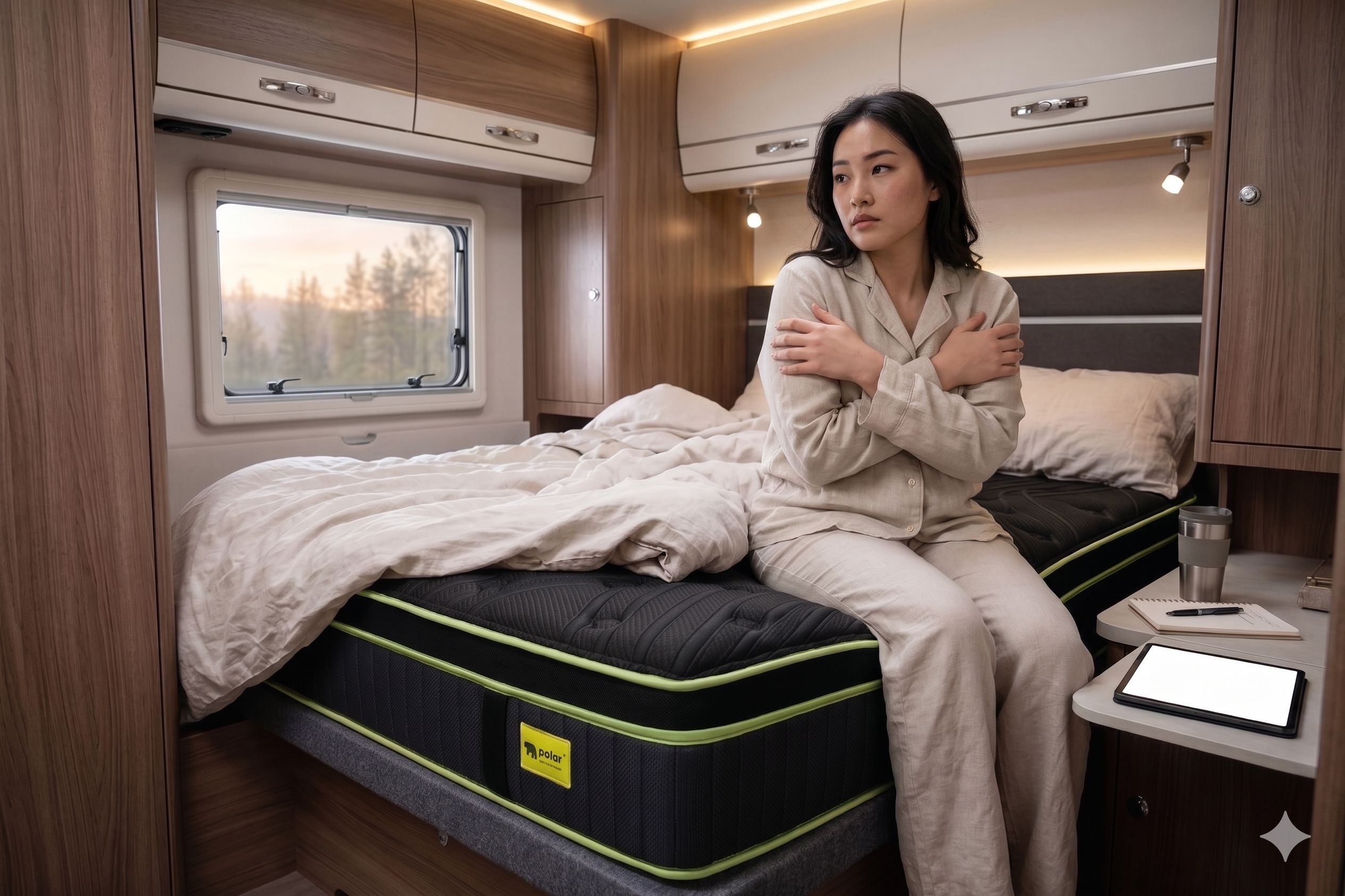
A hot, sticky RV bed can ruin a trip faster than bad weather. If you wake up sweaty, toss off the blanket at 2 a.m., or feel heat building under your back and hips, the problem usually is not your thermostat - it is your cooling rv mattress, or more often, the lack of one. Most factory RV mattresses trap heat, compress too quickly, and turn a small sleeping space into a warmer one.
That matters more in an RV than it does at home. Sleeping areas are tighter, airflow is limited, and many rigs hold heat overnight even when daytime temperatures drop. A mattress that sleeps hot in a house often feels worse in a camper, fifth wheel, or motorhome. If you want a real upgrade, you need to know what actually cools a mattress and what is just marketing.

Why a cooling RV mattress matters more on the road
RV owners deal with a different sleep environment than residential shoppers. Bedrooms are compact. Rooflines and slide layouts can limit ventilation. In many rigs, the bed platform itself reduces airflow under the mattress, which allows heat and moisture to build up.
Then there is the mattress itself. Stock RV beds are usually built to hit a price point, not to deliver temperature control, pressure relief, or support over time. That is why so many RVers describe the same set of problems - waking up hot, feeling shoulder and hip pressure, and noticing every movement from a partner.
A true cooling mattress is not just about feeling colder at first touch. It should help regulate heat through the night while still supporting the body. If the bed starts cool but collapses under you, your body sinks deeper into heat-trapping foam and the benefit disappears fast.
What actually makes a cooling RV mattress sleep cooler
The biggest factor is airflow. Mattresses with coil support cores generally sleep cooler than all-foam builds because air can move through the center of the mattress instead of getting trapped. That does not automatically make every hybrid cool, but it gives the mattress a major advantage before you even get into top-layer materials.
The next factor is the foam itself. Traditional memory foam is known for heat retention, especially in lower-quality beds. Better cooling mattresses use gel-infused foams, open-cell structures, or conductive materials designed to move heat away from the sleeper instead of holding it near the surface.
Cover fabric also matters, though not as much as brands sometimes suggest. A cool-to-the-touch cover can improve the first few minutes in bed, but it cannot overcome a heat-trapping core. Think of the cover as the finishing layer, not the whole cooling system.
Construction matters just as much as material choice. A mattress that combines responsive support, breathable comfort layers, and stable pressure relief usually performs better than one built around thick, dense foam alone. That is why premium RV mattresses often use features like zoned pocketed coils, gel memory foam, and conductive cooling layers instead of relying on a single foam block.

The cooling trade-off most shoppers miss
A cooler mattress should not come at the cost of support. This is where many RV owners get stuck. They shop for cooling, end up with something too soft, and then deal with lower back pain or poor alignment after a few nights.
Cooling and comfort are not opposites, but they do need to be balanced. Softer foams can feel plush at first, yet if they let the hips sink too deeply, heat builds around the body and pressure relief becomes inconsistent. Firmer, more supportive designs often sleep cooler because they keep you more lifted on the mattress instead of letting you settle into a warm pocket.
That is especially important for side sleepers, couples, and full-time RVers. Side sleepers need enough contouring to relieve pressure at the shoulders and hips. Couples need motion isolation without turning the whole bed into a heat trap. Full-timers need a mattress that performs night after night, not just on weekend trips.
Best materials for a cooling RV mattress
If cooling is your priority, hybrid construction usually gives you the best overall result. Pocketed coils promote airflow and provide stronger support than basic foam cores. When those coils are paired with gel memory foam or conductive cooling layers, you get a more complete sleep system instead of a mattress that only solves one problem.
Zoned support systems are another major advantage. A zoned coil unit can add reinforcement where the body carries more weight, usually through the lumbar and hips, while still allowing enough give at the shoulders. That means better alignment, less sink, and less heat buildup.
Coil-on-coil systems take that support further. They create a more stable foundation and can improve durability, which matters in an RV where mattress performance is tested by travel, storage conditions, and repeated use in a compact space.
All-foam mattresses can still work for some RV owners, especially if weight is a concern or if a specific bed platform has height limitations. But if you sleep hot and want the strongest cooling performance, all-foam is usually the harder path. It depends on the quality of the foam, the density, and how much actual airflow the mattress can generate.
How to shop for a cooling RV mattress without guessing
Start with size, because RV sizing is not the same as standard residential sizing. RV King, RV Queen, RV Full/3/4, and RV Twin or bunk sizes vary by model and manufacturer. A mattress can be excellent on paper and still be the wrong choice if it does not fit your rig correctly. Poor fit can reduce comfort, create overhang, or leave unsupported gaps.
Next, look at the support system before you get impressed by surface cooling claims. Ask what is underneath the top layer. Is it a dense foam block, a pocketed coil system, or a more advanced coil design? If the answer is vague, that usually tells you something.
Then consider your sleep style. If you are a back sleeper who runs warm, a medium-firm hybrid is often the safest choice. If you are a side sleeper, you may want a mattress with more pressure relief on top, but not so much softness that you sink and overheat. If you share the bed, motion isolation matters almost as much as cooling.
It is also worth thinking about how often you use your RV. Occasional campers can sometimes tolerate a mattress with modest performance. Full-time RVers and long-trip travelers usually cannot. If you sleep on it for months at a time, durability, support retention, and temperature control need to hold up well beyond the showroom feel.
Cooling RV mattress features worth paying for
Some features are worth the premium because they affect nightly sleep in a real way. Conductive cooling technology is one of them when it is built into the comfort system rather than used as a thin cosmetic layer. Zoned pocketed coils are worth it for better alignment and airflow. Higher-grade gel memory foam can also be worth it if it is used in moderation and paired with a breathable support core.
On the other hand, not every cooling claim deserves extra money. A flashy cover alone is not enough. Neither is generic "cooling foam" without any detail about density, structure, or support below it. If the mattress does not clearly explain how it manages heat, pressure relief, and support together, be cautious.
This is one reason specialized RV brands tend to outperform generic mattress sellers in this category. A company focused on RV sleep is more likely to understand non-standard sizes, bed platform limitations, and the specific comfort issues RV owners are trying to solve. Polar RV Mattress is a strong example of that specialized approach, pairing true RV sizing with premium cooling and support features instead of asking buyers to adapt a house mattress to a mobile space.

When a cooling RV mattress may not be the only fix
A better mattress solves a large part of the problem, but not every part of it. If your rig has poor ventilation, a heat-retaining mattress topper, or moisture buildup under the bed, those factors can still affect sleep temperature.
Sheets matter too. Heavy microfiber can sleep hotter than breathable cotton or performance fabrics. Bed foundations also play a role. If your mattress sits on a solid platform with no airflow, heat and condensation can get trapped underneath. In those cases, improving airflow around the bed helps the mattress do its job.
Still, the mattress remains the biggest variable. If the bed itself is built from low-grade foam that stores heat and loses support, better bedding can only do so much.
What a real upgrade should feel like
A quality cooling RV mattress should feel more stable, less swampy, and more consistent through the night. You should notice less heat concentration under your torso, fewer pressure points at the shoulders and hips, and better motion control when your partner moves.
You should also notice the difference the next morning. Better cooling helps, but the bigger win is that it usually comes packaged with better support and pressure relief. That means fewer aches, less tossing and turning, and a better chance of waking up ready to drive, hike, fish, or just enjoy where you parked.
A good RV trip asks a lot of your body. Your mattress should give something back. If your current bed sleeps hot, sags early, or feels like a compromise you keep tolerating, that is your sign to stop settling for factory-grade sleep.


Share:
Best RV Mattress for Back Pain: What to Buy
RV King Mattress Size Guide