

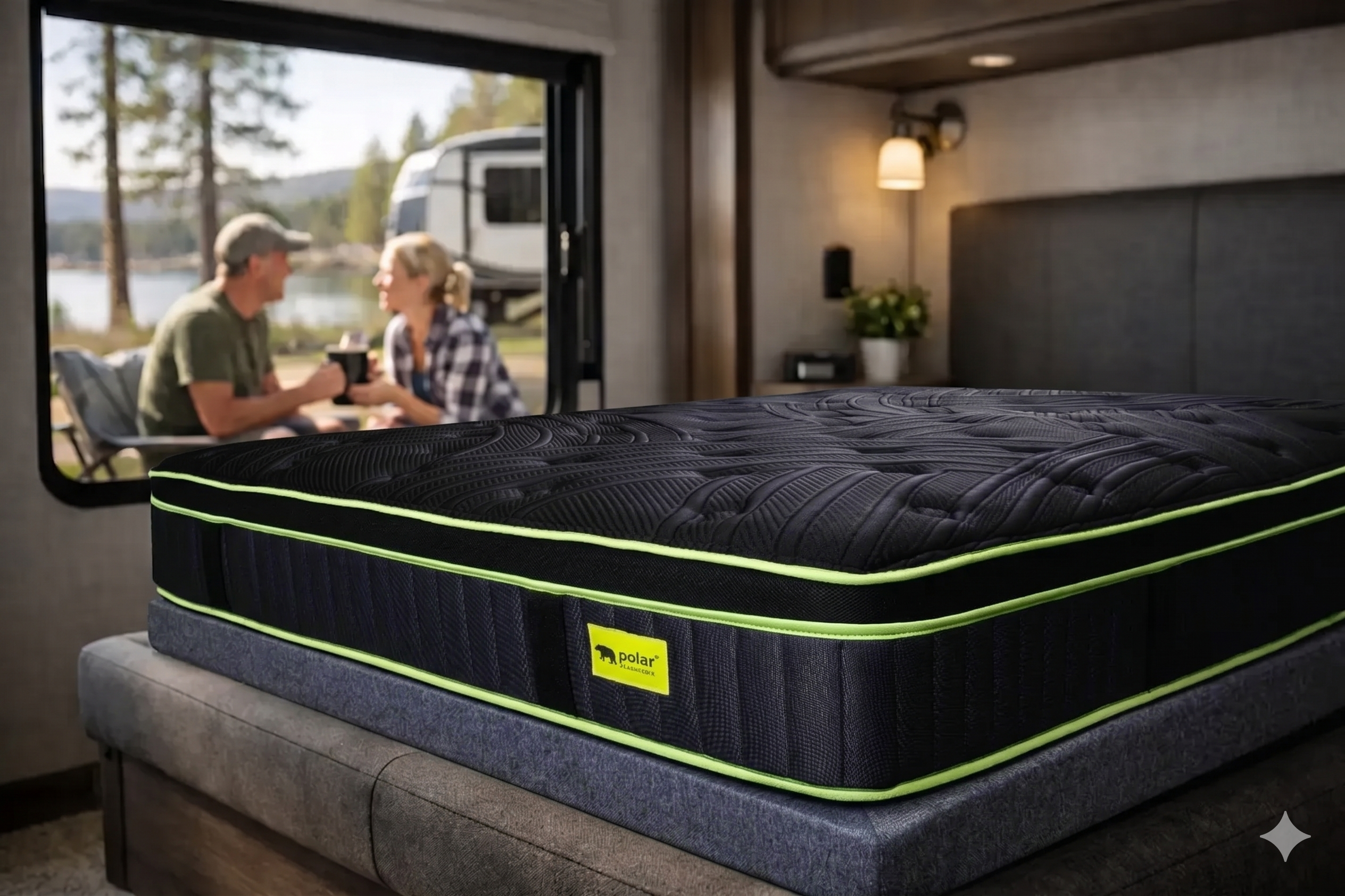
The first time you sleep a full week on a factory RV mattress, the problem gets obvious fast. Hips start aching, your lower back feels unsupported, and the bed that seemed acceptable for a weekend suddenly feels like the weakest part of your setup. If you're searching for the best mattress for full time RV living, you're not looking for a minor upgrade. You're looking for real sleep performance that can hold up every night, in every season, mile after mile.
Full-time RV living changes what a mattress has to do. In a house, a mattress stays in one climate-controlled room and rarely moves. In an RV, it deals with temperature swings, tighter sleeping spaces, odd bed platforms, weight considerations, and the constant reality that poor sleep follows you everywhere. That means the right choice is usually not the cheapest replacement or the closest standard size. It needs to fit the RV correctly, regulate heat better than stock foam, reduce motion transfer, and keep its support over time.
What makes the best mattress for full time RV living different?
The biggest difference is consistency. A full-timer doesn't need a mattress that feels fine in the showroom or works for a few vacation weekends. It has to perform night after night without sagging early, sleeping hot, or creating pressure points that build into real discomfort.
Support matters more than most RV owners realize. Many stock RV mattresses are thin, basic foam builds designed to meet a price point, not to protect your spine. For full-time use, that usually means a mattress with stronger structural support, better weight distribution, and enough comfort layers to relieve pressure without letting your body sink too far.
Cooling is another major divider. RV bedrooms often run warmer than traditional bedrooms, especially in summer or in rigs with limited airflow. Dense memory foam can trap heat if the mattress isn't designed to move air or pull heat away from the body. For full-timers, cooling isn't a luxury feature. It's part of sleeping through the night.
Then there's fit. RVs often use short queens, RV kings, three-quarter sizes, bunks, and other non-standard dimensions. Even a good residential mattress becomes a bad purchase if it overhangs the platform, blocks storage access, or doesn't allow slide-outs and doors to function correctly.
How to judge RV mattress quality without getting distracted by marketing
A lot of mattress descriptions sound impressive until you narrow them down to what actually improves sleep. For full-time RV living, construction matters more than hype.
Start with support core design. Hybrid mattresses with pocketed coils usually outperform low-density all-foam beds when it comes to edge support, motion isolation, airflow, and long-term stability. Better coil systems also help the mattress keep its shape, which matters when the bed gets used every single night.
Comfort layers come next. Gel memory foam and premium pressure-relief foams can make a major difference for side sleepers, couples, and anyone waking up sore. But thicker and softer isn't always better. If the top layers are too plush without enough pushback underneath, you may get that soft first impression and then pay for it with back pain later.
Cover materials also deserve attention. Conductive cooling fabrics and breathable quilted covers help with surface temperature regulation, especially in warmer climates. That won't fix a badly built mattress, but it can noticeably improve comfort in an RV bedroom where heat tends to linger.
Durability is the final filter. If you're living in the RV full time, your mattress is not seeing occasional use. It is your primary bed. Weak foam, minimal support layers, and basic stitched covers usually wear out faster under that kind of use.
The best mattress type for full time RV living
For most full-timers, a premium hybrid is the strongest overall choice. It gives you a more residential sleep feel while solving common RV pain points like heat buildup, weak support, and excessive motion transfer.
An all-foam mattress can still work, especially if you prefer a more cushioned feel or need a lighter option for your setup. But the foam quality has to be high, and cooling has to be built into the design. Otherwise, it's easy to end up with a mattress that sleeps hot and softens too quickly.
Innerspring-only designs are usually less compelling unless they're exceptionally well built. Basic springs with thin comfort layers tend to feel bouncy, less pressure-relieving, and less refined over time. For full-time RVers who want genuine comfort, that trade-off rarely makes sense.
If you're shopping for the best mattress for full time RV living, hybrid construction tends to hit the sweet spot. You get stronger support, better airflow, and a more balanced feel for different sleep positions.
What firmness works best in an RV?
This depends on body type, sleep position, and whether one or two people share the bed. There is no single firmness that works for everyone, but there is a practical range that fits most full-time RVers.
Medium to medium-firm is usually the safest choice. It gives enough contouring for shoulders and hips while still keeping the spine aligned. That's especially useful for couples, combination sleepers, and anyone dealing with occasional back discomfort.
If you sleep mostly on your side, lean slightly softer as long as the support underneath is strong. If you sleep on your back or stomach, or if you need more lumbar support, medium-firm usually performs better. Heavier sleepers generally need stronger support and may find softer foams break down comfort faster.
The key is not just firmness on paper. It's how the mattress distributes weight and resists sagging in the areas that matter most.
Size matters more in RVs than in homes
One of the most common buying mistakes is assuming a standard queen or king will fit because the label sounds familiar. RV sizing is different, and small measurement errors create big problems in tight spaces.
Before buying, measure the platform length, width, corner shape, and available height clearance. Check whether bedding lift access, surrounding cabinetry, or slide mechanisms limit what the mattress can do. In many rigs, an inch or two makes the difference between a clean fit and daily frustration.
This is where RV-specific brands have a real advantage. They build for RV queen, RV king, RV full or three-quarter, and bunk dimensions instead of forcing a residential mattress into a space it wasn't designed for. For full-time living, that specialized fit is not a small detail. It directly affects comfort, usability, and how finished your sleep setup feels.

Features worth paying for and features you can ignore
Cooling is worth paying for. Stronger support is worth paying for. Pressure relief, motion isolation, and durable construction are also worth paying for because you feel those every single night.
On the other hand, exaggerated claims about miracle materials or overly complicated layer diagrams are usually less important than the fundamentals. A mattress doesn't need flashy terminology to be good. It needs a proven support system, breathable comfort layers, and the right dimensions for your RV.
A trial period matters too. Mattress comfort is personal, and full-time RV living puts a mattress under real-world conditions fast. A long trial lowers the risk, especially if you're upgrading from a poor stock bed and want time to confirm the new one truly solves the problem.
This is one reason specialized brands like Polar RV Mattress stand out. A focused RV lineup, premium cooling and support features, correct sizing, and a 365-night satisfaction guarantee answer the biggest concerns full-time RVers actually have.
Who needs the firmest support and who needs more cushioning?
Not every full-timer should buy the same mattress. Retirees with joint sensitivity often need deeper pressure relief and easier movement across the surface. Couples usually benefit from better motion isolation and edge support so one person isn't disturbed every time the other shifts. Families outfitting bunks may care more about fit, weight, and durability.
If you already wake up with numb shoulders, sore hips, or lower-back tightness, don't assume a softer mattress is always the answer. Sometimes the issue is lack of support, not lack of cushioning. A balanced hybrid often corrects both by adding contouring on top of a more stable base.
If you sleep hot, move often, or spend months in warm-weather destinations, cooling should move to the top of your priority list. Full-time RV living exposes weak temperature regulation quickly.
How to know you've found the right one
The right mattress should make your RV feel more livable within the first few nights. You should fall asleep easier, wake up with less stiffness, and stop planning your mornings around whatever hurts. It should fit the platform properly, feel stable when you sit or roll near the edge, and stay comfortable even when the weather changes.
Most of all, it should stop feeling like an RV compromise. Full-time life on the road already asks for flexibility in enough areas. Your mattress shouldn't be one of them.
A better RV mattress does more than improve sleep. It protects energy, patience, recovery, and how much you actually enjoy where you've chosen to live. If you're upgrading for full-time travel, buy the mattress like it matters - because it does.
Share:
Memory Foam vs Hybrid RV Mattress
RV Queen vs Residential Queen