

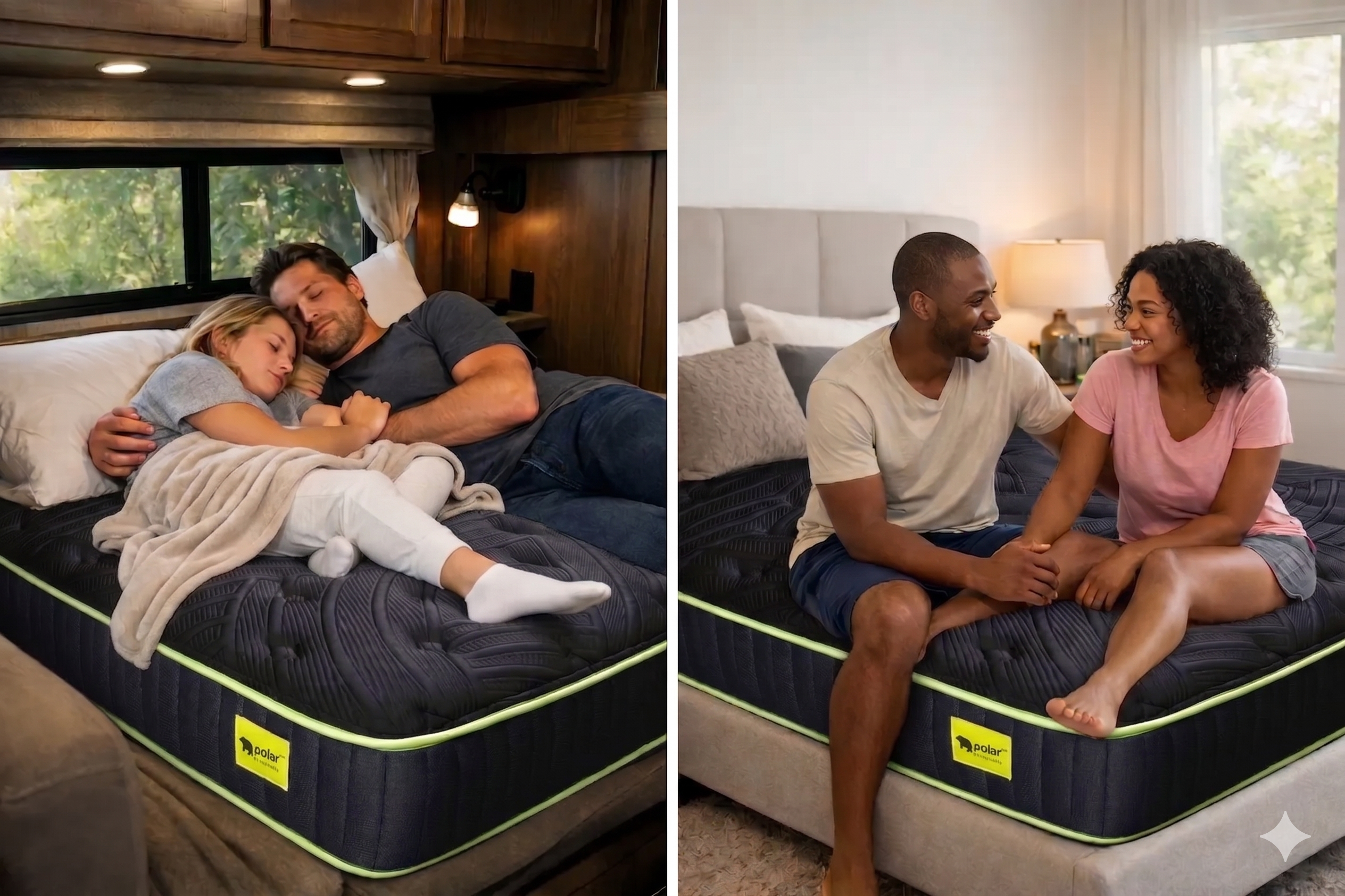
You usually find out the difference between an RV queen and a residential queen the hard way - after a mattress gets wedged in a doorway, hangs over a platform, or leaves you squeezing sideways through the bedroom. When shoppers search rv queen vs residential queen, they are usually asking a practical question: will a standard queen fit my RV, and if it does, is it actually the right choice?
The short answer is no, not always. A residential queen and an RV queen are not the same size, and that size difference affects far more than whether the mattress sits on the bed frame. It can change how easily you move around the room, how much storage you can access, how much weight your rig carries, and how well you actually sleep on the road.
RV queen vs residential queen: the size difference
A standard residential queen mattress typically measures 60 inches wide by 80 inches long. An RV queen is usually 60 inches wide by 75 inches long. That means the width is often the same, but the RV queen is commonly 5 inches shorter.
Those 5 inches matter more in an RV than they do in a house. In a residential bedroom, losing a few inches at the foot of the bed may not change much. In an RV, every inch affects walk-around space, door clearance, nightstand access, and how easily you can make the bed or open under-bed storage.
Not every RV labeled "queen" uses the exact same dimensions, which is where many buying mistakes happen. Some RVs are built around a true 60 by 75 RV queen. Others may have corner cuts, rounded edges, platform lips, tight slide clearances, or slight size variations that make a standard mattress a poor fit even if the raw dimensions look close enough on paper.
Why RV mattresses are shorter in the first place
RV manufacturers do not shorten mattresses just to make life difficult. They do it because RV floor plans are built around tight spatial trade-offs. A shorter mattress creates more usable room in a compact bedroom, especially in travel trailers, fifth wheels, and motorhomes where every dimension has to justify itself.
That extra floor space can improve movement around the bed, make wardrobes easier to reach, and reduce the cramped feeling that turns a bedroom into a squeeze point. For couples, that can be the difference between a space that feels functional and one that feels irritating every single night.
The other factor is vehicle design. Weight distribution, slide-out clearances, cabinetry, and bed-lift mechanisms all influence what mattress size makes sense. Residential sizing is built for homes. RV sizing is built for mobile living.
Can you use a residential queen in an RV?
Sometimes, yes. But "can it fit" is not the same as "should you do it."
If your RV bedroom has enough length, a residential queen may physically fit on the platform. Some owners choose one because residential mattresses are easy to shop for locally and there are more mainstream model options. If you are tall and want the full 80-inch length, that extra legroom can be appealing.
The problem is that fit issues rarely show up as a simple yes-or-no measurement. A mattress that technically fits can still create daily frustration. It may block drawers, press into walls, interfere with a slide, reduce walking space, or make fitted bedding harder to manage. In some RVs, a residential queen can also make it much harder to lift the platform for storage access.
There is also the question of how the mattress handles RV conditions. A heavy residential model built for a stationary bedroom may not be the best match for road vibration, temperature swings, limited ventilation, and the tighter support systems common in RV bed platforms.
Comfort is not just about dimensions
Some shoppers assume an RV queen automatically means compromised comfort because it is shorter. That is only true if the mattress itself is low quality.
What most RV owners are really trying to escape is the factory mattress problem: poor support, weak edge stability, trapped heat, shallow comfort layers, and pressure points that show up fast after a long driving day. Swapping to a better-built RV queen can feel far more comfortable than forcing a generic residential queen into the space.
A quality RV mattress should bring real sleep performance into an RV-sized footprint. That means better pressure relief for shoulders and hips, stronger support through the lumbar area, better motion isolation for couples, and cooling materials that do not sleep hot in confined spaces. Premium RV-specific construction matters because your mattress is not just filling a rectangle. It is doing the job your body feels every night.
RV queen vs residential queen for taller sleepers
This is where the decision gets more personal. If you are over six feet tall, the shorter length of a typical RV queen may be noticeable. Some sleepers do fine with it, especially if they sleep curled slightly or mostly on their side. Others immediately feel their feet too close to the edge.
If height is your main concern, start with actual sleep position, not just your standing height. Back sleepers and stomach sleepers tend to notice missing length more than side sleepers. Couples also need to factor in how much they shift during the night. If one or both of you need more length, it may be worth exploring whether your RV can accommodate a longer size without sacrificing usability.
That said, many RV owners still choose the RV queen because the bedroom works better overall. Better support, cooler sleep, and easier movement around the bed often outweigh the appeal of five extra inches if those inches create daily hassle.
Weight, support, and mattress construction
Residential mattresses can be significantly heavier than RV mattresses, especially thick hybrids and all-foam models with dense layers. Weight matters in an RV. It affects handling, cargo capacity, and how easily you can maneuver the mattress during delivery or installation.
It also matters for the platform underneath. RV bed bases are not always built like residential foundations. Some rely on slats, plywood decks, lift-assist hinges, or compact framing systems that benefit from a mattress designed with RV use in mind.
This is where construction quality becomes more important than broad category labels. A premium RV mattress can deliver serious comfort and support without the oversized bulk of a residential model. Features like zoned pocketed coils, high-quality foams, cooling covers, and durable support systems make a real difference for travelers dealing with back pain, overheating, and partner motion.
Bedding and sheets are another part of the decision
An RV queen can create some sheet-fitting challenges if you shop only in big-box residential bedding aisles. Standard queen sheets are made for an 80-inch mattress, so they may fit loosely on a 75-inch RV queen. That is manageable for some people, but it is not ideal if you want a cleaner fit.
The good news is that RV-specific bedding is much easier to find than it used to be. If proper fit matters to you, matching the mattress to the space usually produces fewer headaches than trying to force residential dimensions into an RV bedroom and then compensating with oversized sheets and awkward corners.
How to choose the right one for your RV
Start with exact measurements, not assumptions. Measure the width and length of the bed platform, then measure the available clearance around the bed. Check the walking space at the foot and sides, any nearby drawers or closet doors, and whether the bed lifts for storage. If your RV has slides, verify the mattress will not interfere when they are retracted.
Next, think about your actual sleep priorities. If your top issue is fit, maneuverability, and preserving bedroom space, an RV queen is usually the better answer. If your rig clearly has room for a residential queen and you strongly need the extra length, then a residential mattress may work - provided the weight, thickness, and surrounding clearances still make sense.
Finally, do not treat all RV mattresses as if they are thin replacements for stock beds. That is outdated thinking. The best RV mattress options are built to solve the real reasons people replace their original mattress in the first place: heat retention, soreness, poor support, motion transfer, and short lifespan. Brands that specialize in RV sleep, including Polar RV Mattress, build around those pain points instead of asking you to settle for a smaller version of a mediocre bed.
The real answer to rv queen vs residential queen
If your goal is simply to put the largest possible mattress into the room, a residential queen may seem attractive. If your goal is to sleep better without compromising how your RV functions, an RV queen is often the smarter choice.
That is the key distinction. This is not just a length comparison. It is a fit, comfort, weight, and usability decision. The right mattress should support your body and your floor plan at the same time.
Before you buy, measure twice and picture how the room works on an ordinary morning, not just how the bed looks in a product photo. Better RV sleep starts with a mattress that fits your space as well as it fits your body.
Share:
Best Mattress for Full Time RV Living
How to Choose a Camper Bunk Mattress