


You notice it on the first trip when your back feels tight by morning, your shoulders are sore, or you wake up hot and restless. If you have been asking why are RV mattresses uncomfortable, the short answer is simple: most factory RV mattresses are built to meet a price point, not to deliver serious sleep performance.
That does not mean every RV bed has to feel bad. It does mean many stock mattresses are thin, low-density, poorly ventilated, and built in odd sizes that limit your replacement options. Once you understand what is causing the discomfort, it becomes much easier to choose an upgrade that actually solves it.
Why are RV mattresses uncomfortable in the first place?
Most RV manufacturers are balancing weight, cost, and floorplan constraints. Sleep quality often ends up lower on the list. The mattress that comes with the RV is usually designed to be light, affordable, and easy to install, not to provide the kind of support and pressure relief you would expect from a strong residential mattress.
That shows up in a few predictable ways. The foam may be too soft and too thin, so you feel the platform underneath. Or it may feel firm at first but still fail to support your hips and shoulders because the materials compress unevenly. In many cases, the mattress also traps heat, transfers motion, and starts breaking down faster than expected.
For occasional weekend campers, that may feel tolerable for a while. For full-time RVers, longer road trips, retirees, or couples who already know they need better support, it becomes a real quality-of-life problem fast.
The biggest reasons RV mattresses feel so bad
They are usually too thin
Thickness matters, but not just for softness. A mattress needs enough depth to absorb pressure and support heavier parts of the body without bottoming out. Many stock RV mattresses are simply too shallow to do that well.
If you sleep on your side, thin mattresses often create pressure points at the shoulder and hip. If you sleep on your back, they may let your lower body sink without properly supporting the lumbar area. If you sleep on your stomach, you can end up with uncomfortable midsection sagging. The result is the same - you wake up feeling like you never fully settled into the bed.
The materials are built for cost, not durability
This is one of the least talked-about reasons discomfort gets worse over time. Lower-quality foam can feel passable in the showroom or on the first few nights, but it tends to soften, compress, and lose shape quickly. Once that happens, support becomes inconsistent.
You may notice a dip where you sleep most often, edges that collapse when you sit down, or an overall flat, tired feel. That is not just a comfort issue. Poor material integrity changes your alignment and can turn a minor annoyance into regular morning pain.
They trap heat
RV sleeping environments are already challenging. Small spaces, variable temperatures, limited airflow, and seasonal travel can make temperature regulation harder than it is at home. A heat-retaining mattress makes that problem worse.
Traditional low-grade foam often holds onto body heat, especially when there is not much internal airflow through the mattress. If you sleep warm, camp in hotter climates, or share the bed with a partner, that can lead to tossing, turning, and shallow sleep. Cooling performance is not a luxury in an RV mattress. For many owners, it is a requirement.
Support is often too basic for real pressure relief
A mattress can feel soft and still be unsupportive. That is where many RV mattresses miss the mark. They may have enough surface cushioning to avoid feeling hard, but not enough structure underneath to keep the spine aligned.
Better support systems use more intentional design - zoned support, stronger coil systems, or denser transition layers that keep the body from sagging in the wrong places. Stock mattresses rarely go that far. They are usually generic in feel because they are made to work acceptably for a broad range of sleepers, not exceptionally well for anyone.
Motion transfer is worse than many people expect
In an RV, the sleep surface is often smaller than what you use at home. That means couples feel each other’s movement more easily. If the mattress lacks good motion isolation, one person changing position can wake the other up repeatedly.
This matters even more for light sleepers, older adults, and anyone dealing with joint pain or frequent nighttime wakeups. A mattress that reduces motion transfer can make a surprising difference, especially on longer trips when sleep debt starts adding up.
Size and fit problems make discomfort worse
One of the most frustrating parts of RV mattress shopping is that RV sizes are not always standard. An RV queen is often shorter or narrower than a residential queen. Bunk spaces, corner beds, and custom layouts create even more variation.
That matters because many owners try to solve the comfort issue with a residential mattress topper or standard mattress that does not fit properly. Sometimes it hangs over the platform. Sometimes it leaves gaps. Sometimes it blocks storage access, interferes with slides, or bends awkwardly into a corner.
Even if the comfort materials are better, a bad fit creates its own problems. The mattress may shift, wear unevenly, or feel unstable. In a compact sleep space, exact sizing is not a minor detail. It is part of what makes the bed comfortable.
Why discomfort feels more intense in an RV than at home
An average home mattress has a stable room environment, a solid foundation, and more space around it. RV sleep setups are different. Bed platforms can be more rigid. Ventilation can be limited. Temperatures swing more. People also tend to be more physically active while traveling, which makes pressure relief and recovery more important at night.
That is why a mattress that seems acceptable in theory can feel much worse in real RV use. Your body is asking more from it. If it cannot provide cooling, support, and enough cushioning, you feel every weakness sooner.
What to look for instead
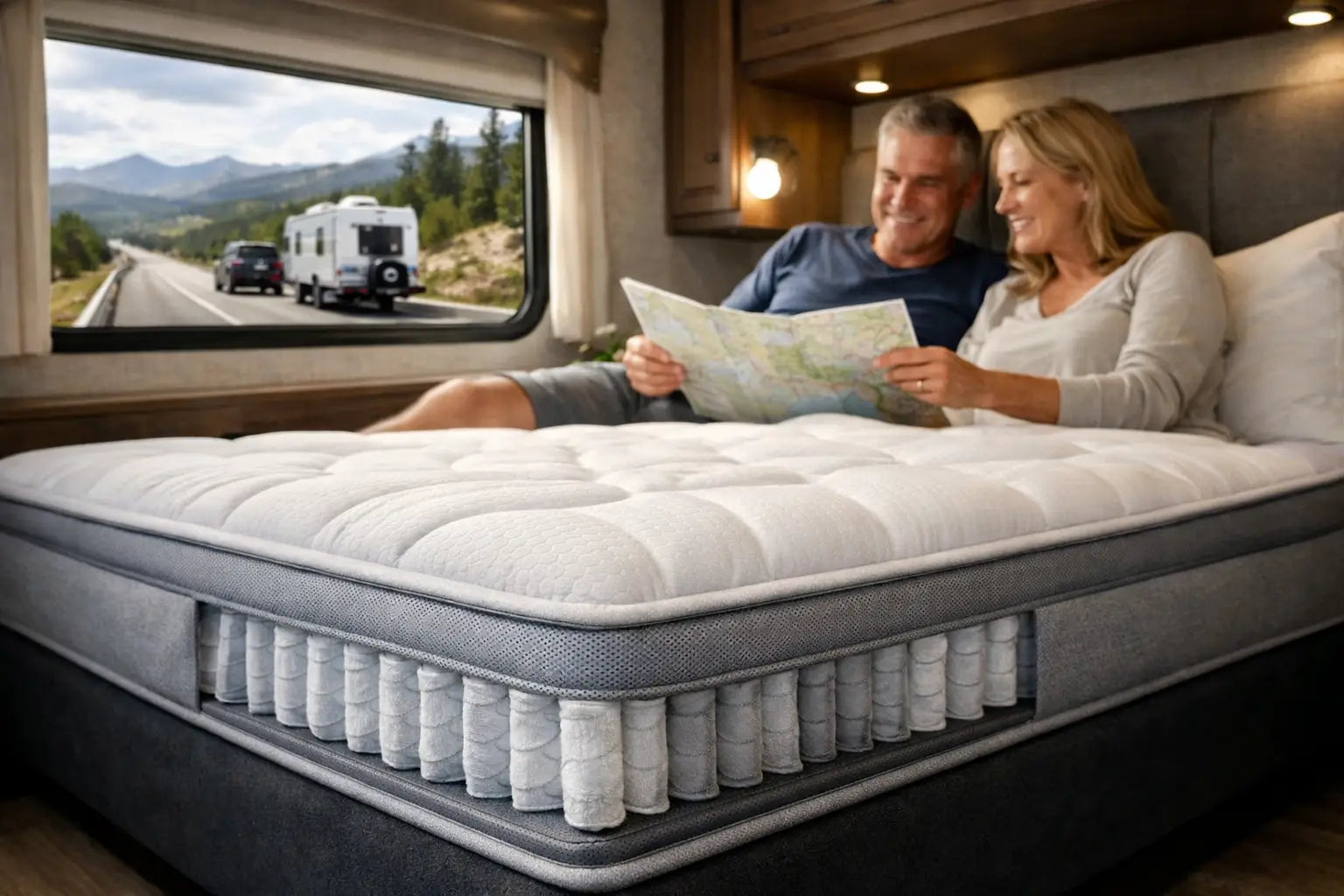
If your current RV mattress is uncomfortable, the fix is not just buying something thicker and hoping for the best. You want a mattress built specifically for RV use, with construction that addresses the real causes of poor sleep.
Start with support. That means looking for a mattress with enough structure to keep your spine aligned, especially through the center third where most body weight lands. Zoned support or quality pocketed coils usually outperform basic foam slabs because they do more than just compress under pressure.
Then look at pressure relief. Side sleepers usually need more contouring at the shoulders and hips, while back and stomach sleepers need enough comfort material to avoid pressure without losing alignment. This is where better foams and smarter layer design matter.
Cooling should also be high on the list. Gel memory foam, breathable coil systems, and conductive cooling materials can all help, though not every cooling claim performs the same in real use. If you sleep hot, it makes sense to prioritize mattresses that combine breathable construction with active cooling features rather than relying on a cool-to-the-touch cover alone.
Finally, get the size right. An RV mattress should fit the platform correctly without forcing compromises on comfort or usability. This is one area where specialized RV mattress brands have a clear advantage over general mattress retailers. They understand the dimensions, the corner cuts, the bunk layouts, and the practical limitations of mobile living.
Is a topper enough?
Sometimes, but usually only as a temporary fix. A topper can add softness and help with surface pressure, especially if your mattress is too firm. But if the real problem is sagging support, heat retention, poor fit, or weak underlying materials, a topper can only do so much.
In some RVs, adding a topper also creates clearance issues or makes fitted bedding harder to manage. It is a reasonable short-term option, but it is rarely the best long-term answer if the base mattress is fundamentally underbuilt.
The real issue is that stock RV mattresses are made to be adequate
Adequate is fine for a dinette cushion. It is not fine for the bed you rely on night after night. When an RV mattress is too thin, too hot, too generic, or the wrong size, you feel it in your sleep quality, your recovery, and your willingness to enjoy the trip.
That is exactly why more RV owners are replacing factory mattresses earlier instead of waiting until the discomfort becomes impossible to ignore. A true RV-specific upgrade can deliver residential-level comfort without sacrificing fit, airflow, or support. Brands that focus only on this category, including Polar RV Mattress, build for the actual demands of RV life instead of treating the mattress like an afterthought.
If your bed is the one part of the RV you use every single night, it should work as hard as the rest of your setup. Better sleep on the road is not unrealistic. It usually starts with refusing to accept a mattress that was never designed to do more than get by.


Share:
When to Replace a Camper Mattress
Olympic Queen Mattress 66" x 80" Explained