

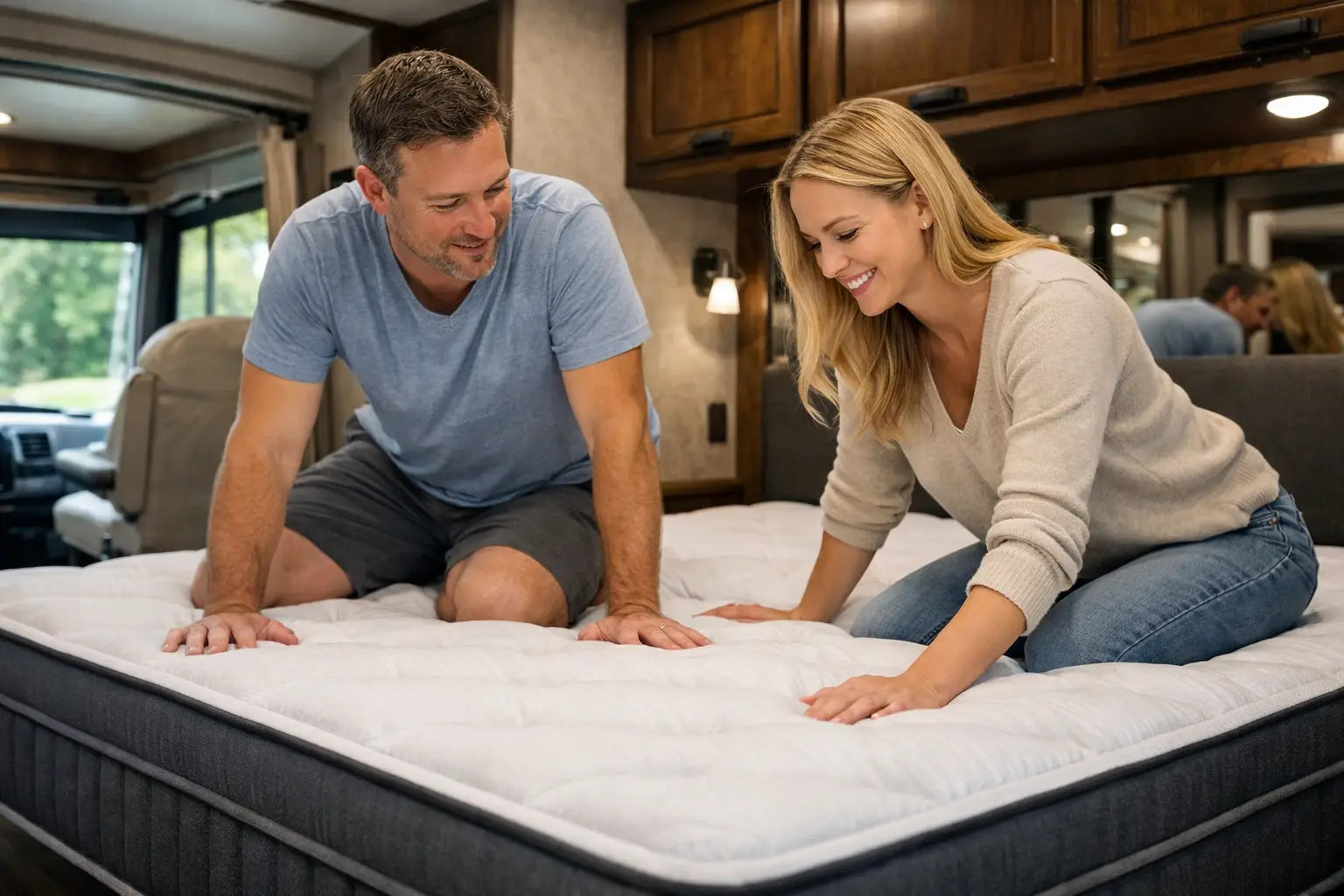
That tempting idea usually starts the same way: you find a regular mattress on sale, measure your RV bed platform once, and think, close enough. If you are wondering, can you use regular mattress in an RV, the honest answer is yes - sometimes. But whether you should depends on fit, weight, height, airflow, and how much comfort you are willing to give up just to make a standard size work.
This is where many RV owners get stuck. A residential mattress can look like a quick upgrade from a thin factory bed, but RV sleeping spaces are not built like bedrooms in a house. Corners are tighter, platforms are often shorter or narrower, access is limited, and every extra inch matters.
Can you use regular mattress in an RV without problems?
In some RVs, yes. If your bed platform matches a standard residential size closely enough, and you have enough clearance around the bed, a regular mattress may physically fit. Some larger fifth wheels and motorhomes can accommodate a standard queen or king with minimal issues.
But that is not the norm. Many RVs use shortened or non-standard sizes like RV Queen, RV King, RV Full, or bunk dimensions that do not match a standard mattress exactly. A regular queen, for example, is typically 60 by 80 inches. An RV Queen is often 60 by 75. Those extra five inches do not sound dramatic until they block a walkway, jam into cabinetry, or force the mattress to bend against a wall.
Fit is only the first issue. The second is whether the mattress performs well in an RV environment. A bed that works in a house can feel completely different on a plywood platform inside a smaller space with variable temperatures and less ventilation.
Why a regular mattress often falls short in an RV
The biggest problem is sizing. RV manufacturers build around compact floorplans, not residential mattress standards. That means your trailer or motorhome may need a shorter mattress, a narrower one, a rounded corner, or a custom cut to allow doors, closets, or slide-outs to function properly.
Then there is weight. Residential mattresses, especially thicker hybrids and pillow tops, can be heavy. In an RV, added weight matters more. It affects storage access, bed lift mechanisms, and overall cargo planning. If your mattress sits on a platform that lifts to access under-bed storage, a much heavier replacement can turn a simple daily task into a hassle.
Height also gets overlooked. A mattress that is too tall can make it harder to sit up in bed, block windows, reduce overhead clearance, or interfere with nearby cabinets. In a home, a 14-inch mattress may feel luxurious. In an RV bedroom, it can feel oversized fast.
Airflow is another real factor. Many RV bed decks are solid platforms with less ventilation than a box spring or slatted foundation in a house. Some regular mattresses trap heat or hold moisture more easily in that setup. If you already sleep warm, that can become a nightly frustration.
The situations where a regular mattress can work
If you have a larger RV with a true residential bed platform, a regular mattress can be a practical option. This is more common in upgraded fifth wheels, toy haulers, and some Class A motorhomes where space constraints are less severe.
It can also work if you have measured carefully and confirmed three things: the platform length and width match the mattress, the surrounding space allows for full clearance, and the mattress weight will not create problems for storage access or bed support.
Some RV owners choose a regular mattress for occasional weekend use and decide the compromise is acceptable. If you camp a few times a year and your current setup is simple, making a standard mattress fit may be enough.
The trouble starts when that occasional compromise becomes a long-term sleep setup. Full-time RVers, extended travelers, and anyone dealing with back pain, pressure points, or overheating usually notice the limitations much faster.
What to check before buying a regular mattress
Start with exact measurements, not assumptions. Measure the sleeping platform at the widest and longest points, then measure the available walking space around the bed. Check cabinet clearance, window clearance, and whether the bed sits in a slide or near a curved wall.
Next, check the mattress thickness your RV can handle comfortably. This matters more than most buyers expect. A mattress that technically fits the platform can still make the room feel cramped or awkward.
Then look at support underneath. Some mattresses are designed for specific foundation types. An RV bed platform may not match what the manufacturer recommends. If the base is solid plywood, partially slatted, or hinged, that can affect comfort, durability, and warranty coverage.
Finally, consider how you use your RV. If this is your second home, your mattress should perform like one. Sleep is not where most travelers want to settle for good enough.
Regular mattress vs RV mattress
The real difference is not just the label. A true RV mattress is built around RV constraints and RV sleep problems.
A regular mattress is designed for standard bedroom sizes and stable home use. An RV mattress is designed to fit shorter, narrower, and harder-to-find dimensions while still delivering residential-level comfort. That matters because many RV owners are not simply replacing a mattress. They are trying to fix poor support, motion transfer, heat retention, and pressure buildup from the stock bed that came with the rig.
A strong RV mattress should address those issues directly. Better cooling helps in warmer climates and enclosed sleeping spaces. Better pressure relief matters after long driving days, hiking, or climbing in and out of the RV repeatedly. Better motion isolation matters when your partner turns over in the middle of the night and the whole bed no longer needs to react.
That is where specialized construction earns its place. Features like gel memory foam, zoned support, quality coils, and cooling materials are not marketing extras when you are sleeping in a compact mobile space. They are the difference between waking up restored and waking up ready to replace the mattress again.
When an RV-specific mattress is the smarter choice
If your RV uses a non-standard size, the answer is simple: a regular mattress is usually the wrong tool for the job. Forcing the fit often leads to wasted money, cramped layouts, or sleep quality that still falls short.
If you are upgrading from a stock mattress because of discomfort, choosing another mattress that is only convenient on paper rarely solves the real problem. You want proper support, cooling that actually works, and a build designed for the way RV beds are used.
This is especially true for couples, side sleepers, hot sleepers, and anyone with back or hip pain. In those cases, fit and comfort are not separate decisions. A mattress that fits your RV but does not support your body is still a bad purchase.
A specialized RV mattress brand has an advantage here because the sizing is already built for the space. You are not trying to reverse-engineer a residential product into an RV layout. You are buying something designed for it from the start.
The cost question most buyers ask
A regular mattress can look cheaper at first, especially during big retail promotions. But the lowest upfront price is not always the lower-cost decision.
If the mattress does not fit correctly, needs to be altered, blocks storage, sleeps hot, or wears out quickly on an RV platform, the value disappears fast. Add the hassle of returns, delivery issues, or replacing it again after a season, and the bargain starts looking expensive.
An RV-specific mattress often costs more because it solves more. It matches the footprint, supports the body better, and avoids the common mistakes that come from trying to make a residential size work where it was never meant to.
For shoppers who care about cooling, comfort, support, and long-term durability, that is usually the smarter buy. Brands focused on RV sleep, including Polar RV Mattress, are built around that exact problem.
So, can you use regular mattress and still sleep well?
Yes, but only if your RV truly accommodates it and your comfort needs are modest. For many RV owners, the better question is not can you use regular mattress. It is whether a regular mattress gives you the fit and sleep quality you actually want.
If your goal is simply to place something on the platform, a standard mattress may work. If your goal is better sleep on the road, a mattress built for RV sizing and RV conditions is usually the stronger choice.
A good night in your RV should feel like an upgrade, not a compromise you keep explaining away.
Share:
What Mattress Fits a Travel Trailer?