

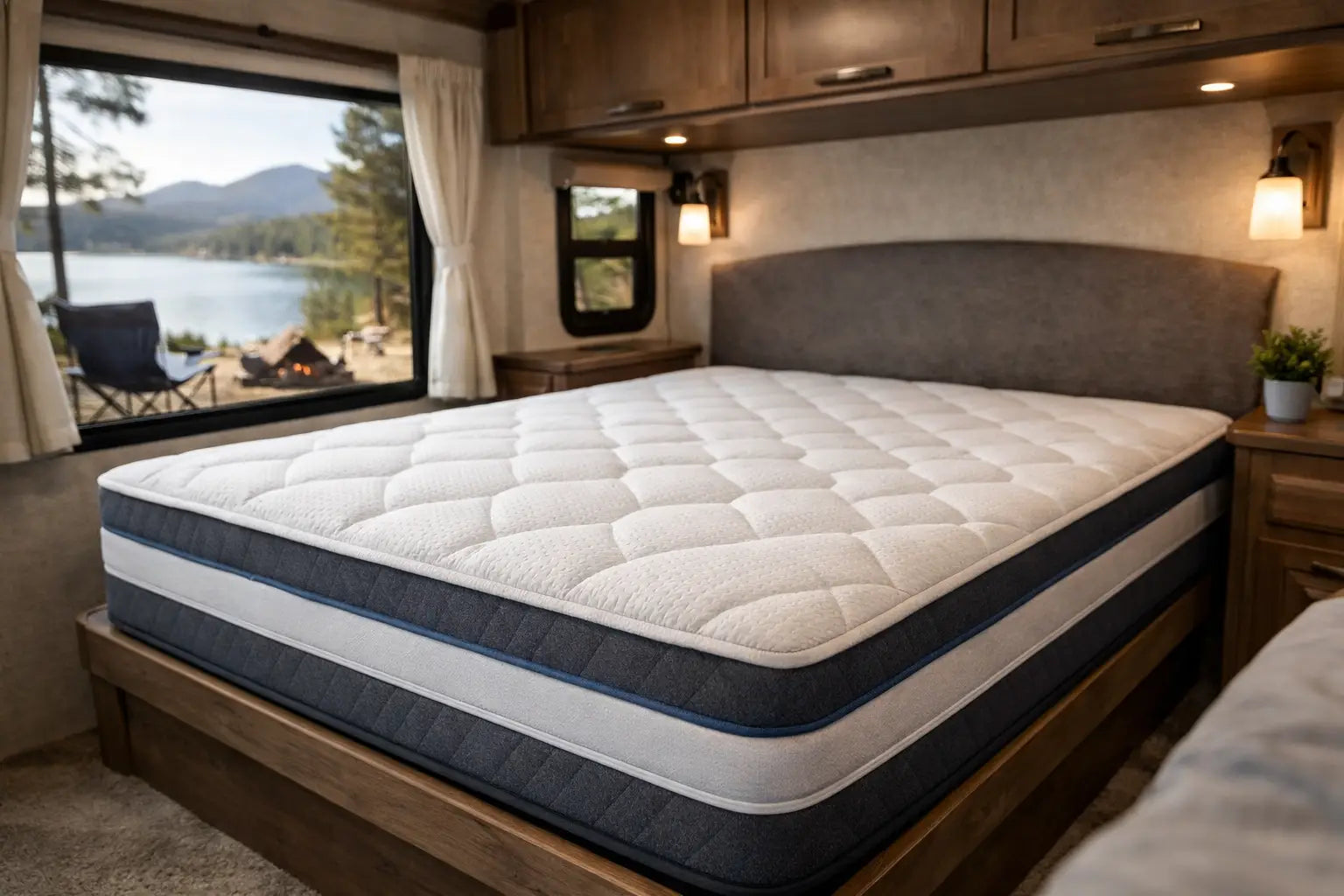
You usually find out what mattress fits travel trailer sleep spaces the hard way - when a standard queen hangs over the platform, the corner radius blocks a cabinet, or the mattress folds awkwardly when the slide comes in. Travel trailers rarely follow residential mattress standards exactly, which is why buying by label alone is where most people go wrong.
If you want a real upgrade, start with fit before you think about foam, coils, or cooling. A better mattress only performs if it actually matches the dimensions and layout of your trailer. The right answer is not always “queen” or “short queen.” It depends on the bed platform, walk-around space, nose cap shape, slide clearance, and how your trailer is used.
What mattress fits travel trailer layouts most often?
In many travel trailers, the mattress is some version of an RV Queen, RV King, RV Full, or RV bunk size rather than a standard residential size. That matters because RV manufacturers often shorten the length, trim the width, or round off corners to make the bed work inside a tighter footprint.
An RV Queen is one of the most common sizes in travel trailers, and it is typically narrower, shorter, or both compared with a standard queen. A standard queen is 60 by 80 inches. Many RV Queens come in at 60 by 75, though not all do. That 5-inch difference is exactly why so many trailer owners order the wrong mattress the first time.
RV King sizes also vary more than shoppers expect. In residential bedding, a king is usually 76 by 80. In travel trailers and fifth wheels, you may see 72 by 80, 70 by 80, or other RV-specific versions. The same pattern shows up with full and bunk mattresses. The label sounds familiar, but the actual dimensions can be different enough to create fit problems.
Why standard mattresses often fail in a travel trailer
The biggest issue is that travel trailers are built around space constraints, not mattress industry standards. Cabinet placement, wheel wells, bed lifts, and front cap contours all affect the shape and size of the sleeping area.
That means two trailers advertised with a “queen bed” may need two different mattresses. One may fit a standard queen. Another may need a short queen. A third may need a custom cut corner to allow the bedroom door to close properly.
Height is another overlooked problem. Even if the length and width are correct, a residential mattress can be too tall for an overhead cabinet, too heavy for an under-bed storage lift, or too thick for a Murphy bed setup. In a travel trailer, fit is three-dimensional.
How to measure before you buy
If you are asking what mattress fits travel trailer sleeping areas, the only reliable answer starts with a tape measure. Measure the bed platform itself, not the old mattress tag. Factory mattresses are often mislabeled, compressed, or worn enough to give you bad numbers.
Measure the width at the widest point, then measure the full length. After that, check for anything unusual: rounded corners, angled cutoffs, side notches, or curves at the front of the trailer. If the mattress sits inside a frame, measure the interior opening. If it rests on top of a platform, measure the platform edges and note any obstructions.
Then measure available height. Open nearby cabinets. Bring in the slide if the bed is close to one. Check whether bedding bunches up against the wall or if the mattress needs to flex for storage access. These details matter just as much as the footprint.
Common travel trailer mattress sizes
Most travel trailers use one of a handful of mattress categories, but the exact dimensions can still vary by manufacturer. RV Queen is the common choice for front bedrooms. RV King appears more often in larger units. RV Full or three-quarter mattresses show up in compact floorplans, and RV twin or bunk sizes are common in bunkhouses and smaller sleeping zones.
Short queen is especially common because it preserves bedroom walking space without giving up full queen width. For many couples, that is the best compromise. You keep enough width for comfort while freeing up room at the foot or side of the bed.
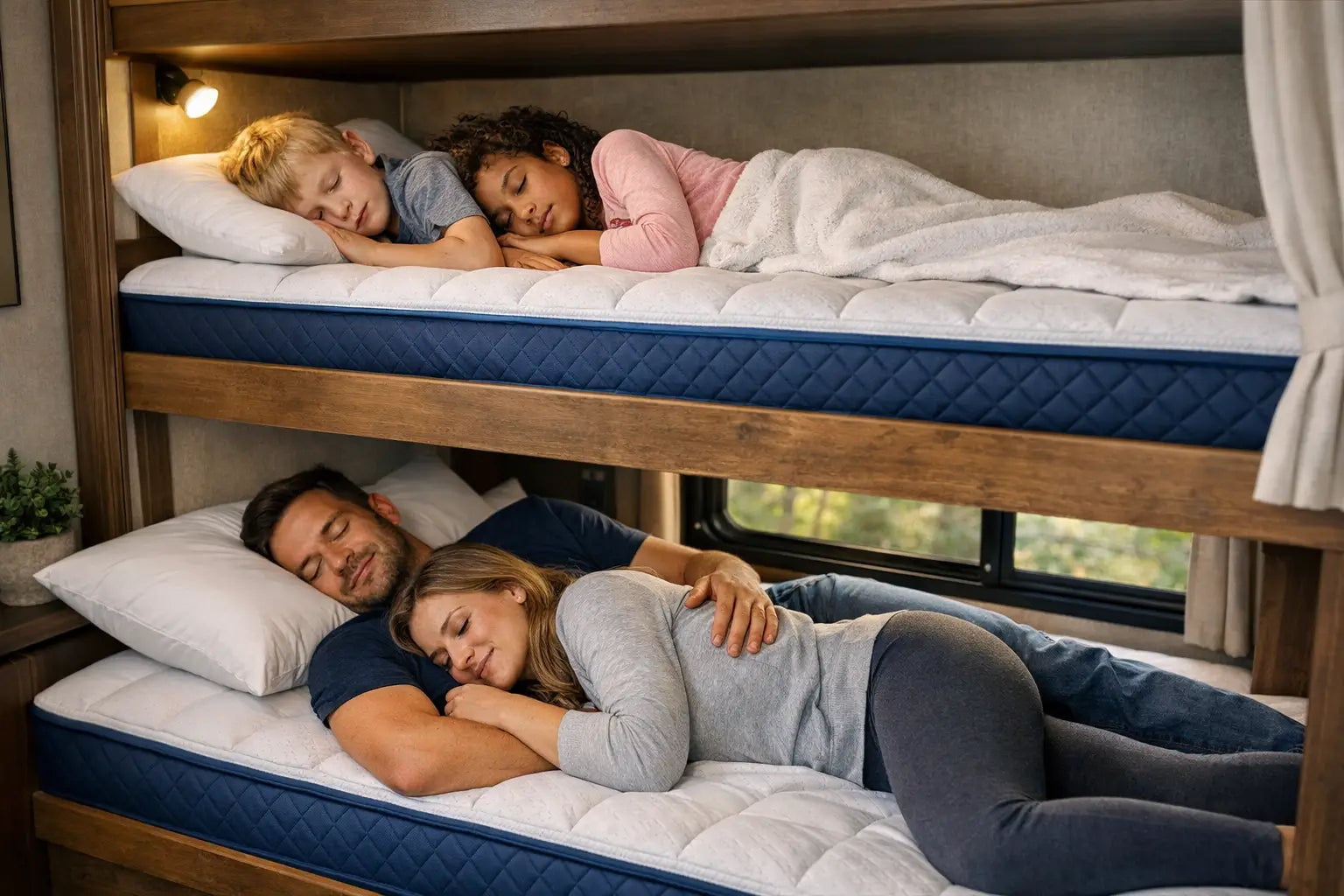
Bunk mattresses need extra scrutiny. Bunks are frequently narrower and thinner than shoppers expect, and guardrail height matters. A mattress that is too thick can reduce rail safety and make the bunk feel cramped.
Fit matters, but comfort matters just as much
Once the size is right, the next question is construction. A lot of stock RV mattresses feel flat, trap heat, and wear out fast because they are built to meet a price point, not to deliver consistent support night after night.
For most travel trailer owners, the real upgrade comes from choosing a mattress designed for RV use with residential-level comfort. That usually means better pressure relief, stronger support, and materials that handle temperature swings better than basic foam.
If you sleep hot, cooling should be near the top of your list. Travel trailers can hold heat, especially in summer campgrounds and shoulder-season climates where temperature swings hit hard. Gel memory foam, conductive cooling covers, and breathable coil systems generally perform better than dense conventional foam.
If you wake up sore, support matters more than simple softness. Zoned support, high-quality foam layers, and pocketed coils can do a much better job keeping your hips, shoulders, and lower back aligned. For couples, motion isolation matters too. One person turning over should not wake the other every time the trailer shifts or the mattress compresses unevenly.
Choosing the right thickness for a travel trailer
Thicker is not always better in an RV. In a house, a tall mattress often feels more premium. In a travel trailer, too much thickness can create practical problems.
A mattress that is too tall may interfere with cabinetry, reduce headroom, or make it harder to climb into bed in a tight room. It may also be heavier than your lift platform or storage hinges were designed to handle. On the other hand, a mattress that is too thin usually brings back the same pressure-point issues people are trying to escape.
For many travel trailers, the sweet spot is a profile that feels substantial without overwhelming the space. The best choice depends on the platform design and the sleeper’s body type, but this is one area where RV-specific products tend to outperform generic residential replacements.
When a custom RV mattress makes sense
If your trailer has a nose cap curve, angled corner, odd width, or a hard-to-match bunk footprint, custom sizing is often the smartest move. Trying to force a standard mattress into a non-standard space usually leads to poor airflow, damaged corners, blocked storage, or a bed that simply does not sit flat.
Custom sizing is also worth considering if your current mattress technically fits but wastes usable space. A better-sized mattress can improve bedroom clearance and make the room feel easier to live in, especially for full-time RVers and extended travelers.
This is where a specialized RV mattress brand has a real advantage. Companies focused on RV sleep understand that fit, cooling, support, and fast delivery all matter together. Polar RV Mattress, for example, builds specifically for RV dimensions rather than asking buyers to make residential sizes work in mobile spaces they were never designed for.
The best buying mindset for travel trailer owners
Do not shop by name alone, and do not assume your trailer uses the same dimensions as your last RV. Shop by exact measurements, room constraints, and sleep priorities.
If you travel in hot climates, prioritize cooling. If you have back pain, prioritize support design. If you share the bed, look closely at motion control. If your trailer bedroom is tight, thickness and edge shape may matter more than you think.
The best mattress for a travel trailer is the one that fits the platform correctly, supports your body consistently, and holds up to real RV use. That is a much higher standard than “close enough,” and it is exactly why so many RV owners replace the original mattress long before they replace the trailer itself.
A good trailer can take you almost anywhere. A mattress that actually fits should let you wake up ready to enjoy it.
Share:
Why Are RV Mattresses Shorter?