

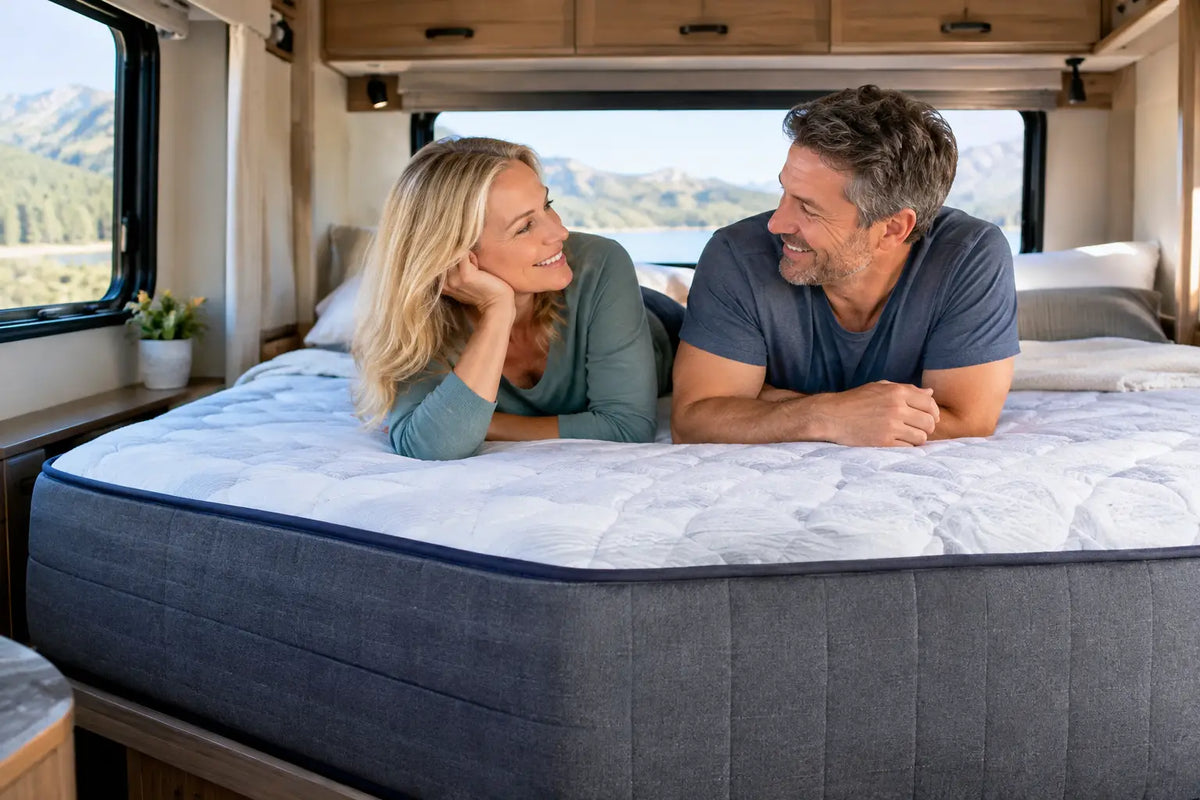
A full time RVer sleep upgrade example usually starts the same way: a couple has spent months trying to make the factory mattress work. They add a foam topper, rotate the mattress, crack a window to fight the heat, and still wake up stiff or tired. The problem is rarely one bad night. It is that the bed in an RV becomes your bed every night, often in a space where temperature, movement, and mattress fit are harder to ignore.
Consider a full-time couple traveling in a fifth wheel with an RV King bed. Their original mattress is thin, overly firm at the shoulders, and soft enough at the hips that neither sleeper feels properly supported. One partner sleeps hot. The other wakes whenever the first gets up early to walk the dog. They do not need a cheap replacement. They need a mattress built for the way they actually live.
The Full Time RVer Sleep Upgrade Example
Their first instinct is to buy a standard residential king mattress. That can be a costly mistake. RV King dimensions are often different from a household king, and slide-out rooms, narrow halls, low ceilings, and tight turns can make delivery and installation difficult. A mattress that is close enough on paper can leave gaps, bind against cabinetry, or simply not fit through the RV.
The better starting point is to measure the existing sleep platform, not just the old mattress label. Measure length and width at the base, then check the available clearance around the bed. If there are hinged storage compartments beneath the platform, mattress weight matters too. If the bed sits in a slide, confirm that a taller mattress will not interfere when the slide retracts.
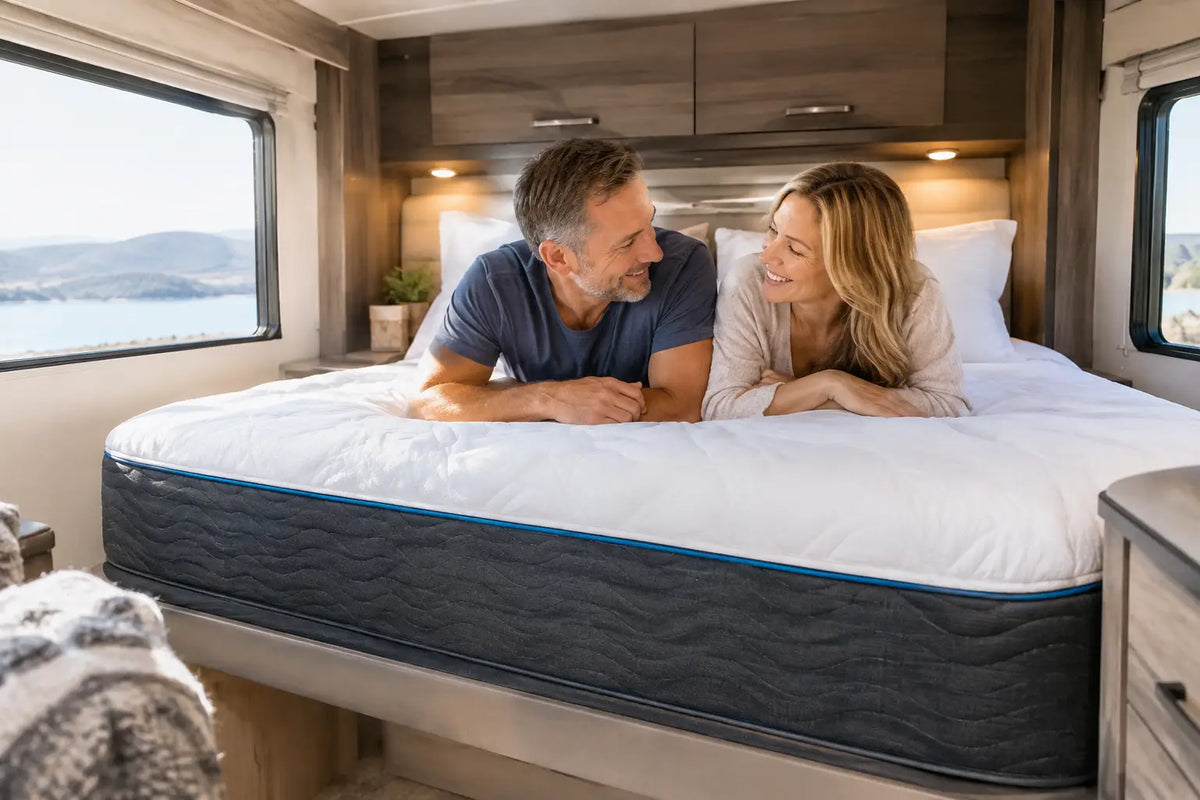
For this couple, the correct RV King size eliminates the most basic source of frustration: poor fit. The mattress sits squarely on the platform, the bedding fits predictably, and neither person loses usable sleep space to a mattress that was never designed for the coach.
The real change is support, not just softness
Many stock RV mattresses are built to meet a price point. They can feel hard and flat when new, then lose support quickly under nightly use. A topper may soften the surface, but it cannot repair a weak support core underneath it. In some cases, a thick topper makes movement and heat retention worse.
The couple chooses a premium RV mattress with zoned pocketed coils and pressure-relieving foam. Zoned support matters because bodies do not apply weight evenly. The shoulders need room to settle in for side sleeping, while the lumbar area and hips need stronger reinforcement to keep the spine from dipping out of alignment.
That difference shows up in ordinary moments. The partner with lower-back stiffness no longer starts the morning by stretching for ten minutes beside the dinette. The side sleeper no longer wakes with a numb shoulder. Those are not luxury details when you are driving, hiking, working remotely, and setting up camp repeatedly. Restorative sleep affects the entire travel day.
Cooling Makes RV Sleep More Livable
RV bedrooms can hold heat long after sunset. Even with air conditioning, a mattress that traps body heat can leave a sleeper kicking off blankets at 2 a.m. This is especially common with basic all-foam mattresses and dense toppers that have limited airflow.
In this full time RVer sleep upgrade example, cooling is not an add-on feature. It is a decision point. The couple looks for a mattress that combines breathable coil construction with gel memory foam and conductive cooling materials at the sleep surface. Coils allow more air to move through the mattress than a solid foam block, while cooling layers help move heat away from the body rather than holding it at the surface.
There is a trade-off to understand. No mattress can make an unventilated RV bedroom cold during a summer night in Arizona or Florida. Cooling construction works best alongside practical habits: use the RV's ventilation, manage humidity, shade the coach during the day, and choose breathable sheets. But a cooling mattress removes one major heat source from the equation - the bed itself.
For the couple, the benefit is simple. They stop treating bedtime like another climate-control problem to solve. The mattress feels less stuffy when they lie down and more comfortable through the night.
Motion Isolation Protects Both Sleep Schedules
Full-time RV life rarely means matching schedules perfectly. One person may wake early for work, take the dog outside before sunrise, or get up during the night without wanting to disturb the other. In a compact RV bedroom, even minor movement can feel amplified on a poor mattress.
Pocketed coils help here because each coil responds more independently than a traditional connected innerspring system. Pair that with memory foam designed to absorb movement, and the result is less transfer across the bed. The mattress still has responsive support, but it does not send a wave across the surface every time someone rolls over.
This is one area where couples should be realistic about their needs. If one partner is an exceptionally light sleeper and the other moves frequently, the goal is reduced motion, not total stillness. A quality mattress creates a meaningful improvement, but a stable bed base and a properly leveled RV also matter.
In the example, the early riser can get dressed and leave the bed with far less disruption. The other partner gets another hour of uninterrupted sleep. That is a small change with an outsized effect after weeks of travel.
Choosing the Right Upgrade for Your RV
A serious RV mattress upgrade should be based on more than the words “memory foam” or “luxury.” Start with the sleep problems you want to fix. If you wake hot, prioritize conductive cooling and airflow. If you wake sore, focus on pressure relief and a support system that keeps your spine level. If you share the bed, look for motion isolation. If your existing mattress sags or feels unstable, inspect the platform as well as the mattress.
Height is another practical consideration. A taller mattress can feel more substantial, but the best choice depends on the room. In a bunk, extra thickness may reduce safety clearance. In a motorhome bedroom with overhead cabinets, it can make sitting up less comfortable. In a fifth wheel with generous space, a deeper mattress may be exactly what turns the room into a real bedroom.
Do not assume your RV uses a standard size. RV Queen, RV King, RV Full/3/4, and RV Twin/Bunk dimensions can differ from residential sizes. Measuring first avoids the return process, the installation headache, and the disappointment of a mattress that almost fits.
Polar RV Mattress is built around that specific problem: premium sleep performance in RV-specific sizing. For full-time travelers, the value is not just better materials. It is getting cooling, support, pressure relief, and fit without trying to force a household mattress into a mobile home.
What the Upgrade Looks Like After 30 Nights
The strongest mattress upgrades do not always announce themselves on night one. A new bed may feel noticeably more comfortable immediately, but the real proof comes after a month of ordinary use. After long drive days. During warm nights. When one sleeper is restless. When the weather keeps both people inside longer than planned.
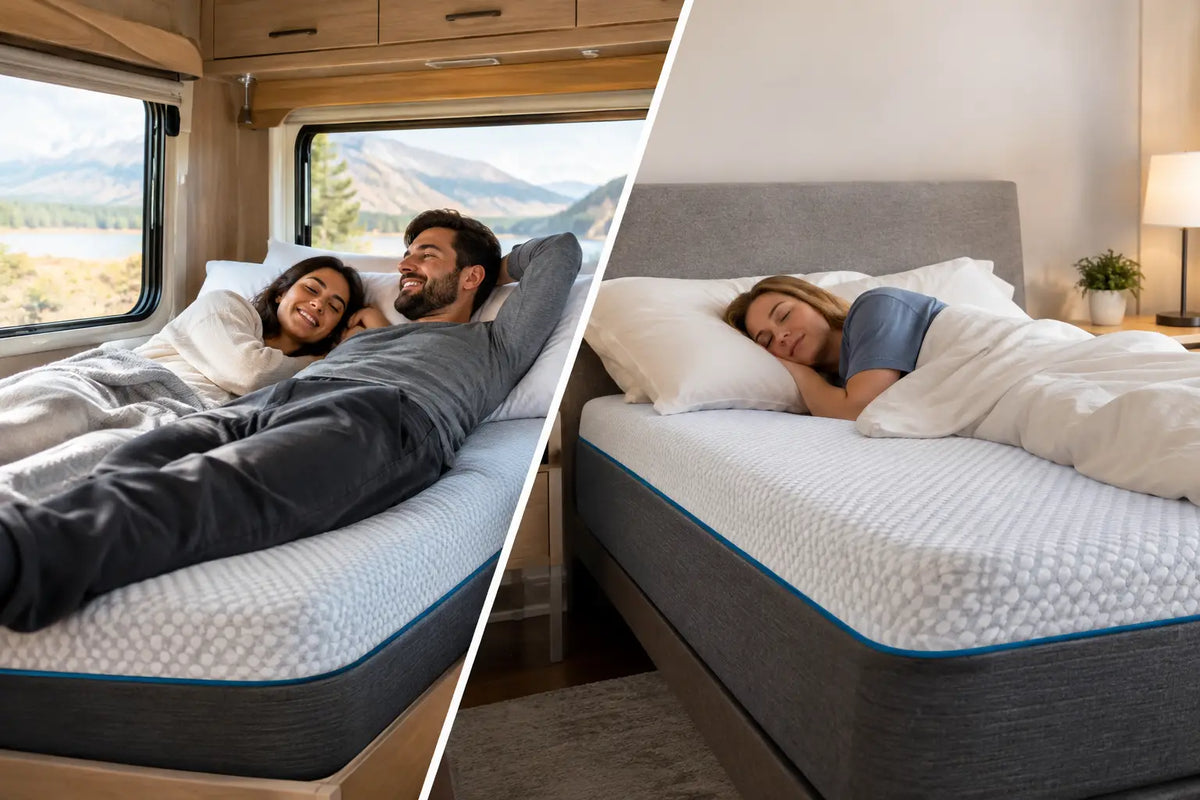
For this couple, the upgrade means they no longer plan around a bad bed. They do not pack an extra topper, search for a workaround at every stop, or accept morning soreness as part of RV ownership. Their bedroom becomes a place to recover, not another compromise built into the rig.
That is the standard worth using when you choose an RV mattress. A full-time home on wheels should ask a lot from its bed - and the right one should be ready to deliver night after night.
Share:
RV Mattress Warranty Comparison That Protects You
Can RV Mattresses Be Folded? What to Know