

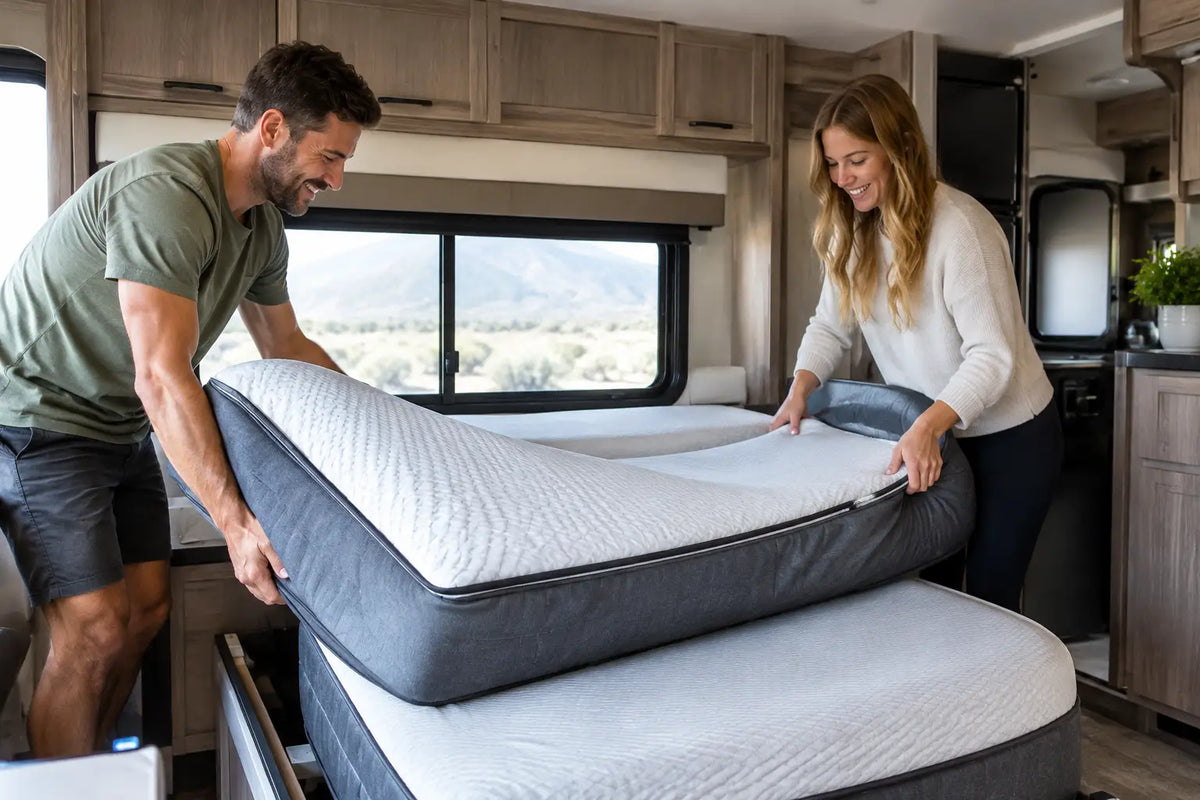
That replacement mattress may fit your RV bed platform perfectly and still look impossible to get through the entry door. So, can RV mattresses be folded? Sometimes - but whether it is safe depends on the mattress construction, thickness, and how long it stays bent.
A mattress designed for an RV has to solve more than one problem. It needs to fit a nonstandard space, support real sleep, and make it through a narrow door, hallway, or slide-out opening without sacrificing the materials that make it comfortable. Folding the wrong mattress can permanently damage foam, bend coil units, and shorten its usable life. The goal is not simply getting it inside. It is getting it inside without turning a premium sleep upgrade into a compromised mattress.
Can RV Mattresses Be Folded Without Damage?
Some RV mattresses can be folded temporarily for moving, but not all of them should be. Flexible all-foam mattresses are generally the most forgiving. Thin foam models can usually bend or fold briefly to navigate a tight corner, provided they are not sharply creased or left folded for an extended period.
Hybrid and innerspring mattresses require much more caution. Their coils, edge support, and layered construction are designed to work flat. A gentle bend may be possible during installation, particularly with a flexible pocketed-coil design, but a hard fold can distort coils, damage border rods, crack foam layers, or weaken the adhesive that holds the comfort system together.
The practical answer is this: a brief, controlled bend is often safer than a true fold. If you must fold a mattress, make it a temporary move-in maneuver, not a storage method or a regular routine.
What “folding” really means
People use the word folding for several different actions. These are not equal.
A gentle taco-style bend, where two long edges move toward each other without creating a sharp crease, puts less stress on the mattress than folding it in half like a sheet of cardboard. Rolling is usually appropriate only for a mattress that was professionally compressed and rolled for shipping. Trying to tightly roll a finished mattress at home can damage its internal structure.
A true 180-degree fold is the riskiest option, especially for thick hybrids and coil-on-coil mattresses. The more substantial the comfort layers and support system, the less you should force the mattress into a sharp angle.
Mattress Type Makes the Difference
Before moving your mattress, identify what is inside it. The label, product specifications, or manufacturer can usually tell you whether it is foam, hybrid, traditional innerspring, latex, or an air mattress.
Memory foam and polyfoam mattresses
All-foam RV mattresses are typically the easiest to maneuver. Foam is naturally flexible, and a thinner profile bends more easily than a 10- to 14-inch mattress. Gel memory foam can handle a moderate bend during installation, but cold temperatures make foam firmer and less flexible. If your mattress has been sitting in an unheated garage or arrives on a cold day, let it warm up indoors before attempting to bend it.
Do not crease foam sharply. A deep crease can leave a weak point, affect the way the surface recovers, and create an uneven feel over time.
Hybrid RV mattresses
Hybrid mattresses pair foam comfort layers with pocketed coils or another coil support system. They deliver stronger support, better airflow, and more residential-style comfort than many basic RV mattresses. That construction also means they need more careful handling.
Some pocketed-coil hybrids can flex enough to get through an RV doorway when carried on edge and gently curved. Still, avoid folding them completely in half. Coils are individually wrapped, but they are not intended to be forced into a hard crease. Heavy-duty edge support is particularly vulnerable because it is built to reinforce the perimeter when the mattress lies flat.
Traditional innerspring mattresses
A conventional connected-coil innerspring should generally not be folded. The wire system is less flexible than individually pocketed coils, and forcing it can bend the frame or create permanent unevenness. If your RV requires an extreme turn to reach the bedroom, measure first and consider a mattress designed to ship compressed rather than trying to force a rigid spring mattress through the opening.
Latex mattresses
Latex is durable and responsive, but it is heavy. A latex mattress may bend, yet its weight can make handling difficult and increase the risk of tearing a cover or dropping it against a doorframe. Never drag it across rough surfaces, and use extra hands. If the latex layer is thick or paired with coils, treat it like a hybrid rather than assuming it can fold safely.
How to Get an RV Mattress Through a Tight Door
The best move is planned before the mattress arrives. RV door openings, interior hallways, and bedroom entrances can be dramatically narrower than the sleeping space itself. A queen-size mattress may fit the platform with room to spare while the route to that platform becomes the real challenge.
Start by measuring the narrowest point of the path: the entry door, the space between the driver and passenger seats in a motorhome, the hallway, and the bedroom door. Measure height as well as width. Then compare those numbers with the mattress dimensions and thickness.
Remove obstacles that create avoidable trouble. Take off bedding, open or remove the screen door if practical, secure cabinet doors, and move loose furniture. In some RVs, removing a bedroom door or trim piece can create the few extra inches needed for a clean installation. That is far better than aggressively folding a mattress that should remain flat.
Carry the mattress in a protective bag or its original packaging whenever possible. Two people should control the move, with one guiding the leading end and another supporting the weight. Keep it upright or on its side until you reach the tight turn. If a bend is necessary, use a gradual curve and release the pressure as soon as the mattress clears the obstruction.
For heavier premium mattresses, a third person is not excessive. Better support during the move protects the mattress, your RV interior, and your back.
When You Should Not Fold an RV Mattress
Do not fold the mattress if the manufacturer specifically says not to, if it contains a rigid coil system, or if the fold would need to stay in place for more than a few minutes. A mattress may survive a short controlled bend, but storing it folded for days, weeks, or an off-season can cause permanent damage.
You should also stop if you hear popping, snapping, or unusually loud coil noise while bending it. Foam should not tear, and the quilted cover should not pull tightly enough to strain seams. These are clear signs that the mattress is being pushed beyond what its construction can tolerate.
A sharp bend is especially risky with a thick luxury hybrid. Advanced cooling foams, zoned support layers, and reinforced coil systems deliver a better night’s sleep because they are engineered as a complete system. Forcing that system into a severe fold works against the very performance you paid for.
Better Alternatives to Folding
If access is the issue, choose the installation method before choosing the mattress. A bed-in-a-box mattress that arrives compressed is often the cleanest solution for a difficult RV layout. While it is still factory-compressed, it is far easier to carry through narrow doors and around corners. Once unboxed and expanded, it should remain flat.
Custom sizing can also eliminate needless maneuvering. RV beds often have rounded corners, shortened lengths, wheel-well cutouts, or unusual platform dimensions. A mattress that matches the platform correctly may be easier to route into place than an oversized residential mattress you have to force, trim, or cram through the coach.
For owners replacing an old mattress, use the outgoing mattress as a test. Note the angle that got it into the RV and measure it before disposal. If it had to be bent sharply to enter, a thicker replacement may require a compressed delivery format or a different construction.
Protect Your Warranty and Your Sleep
Mattress warranties commonly cover manufacturing defects, not damage caused by improper handling. Folding a mattress against the manufacturer’s instructions can make a later claim difficult, particularly if the coil system, foam, or border support shows obvious signs of abuse.
That does not mean you need to settle for a thin, uncomfortable factory RV mattress just because your entry door is tight. It means choosing a mattress with the right delivery method, construction, and dimensions for your specific coach. A quality RV mattress should give you pressure relief, temperature control, stable support, and less partner disturbance after it is installed - not ask you to compromise those benefits to get it through the door.
If you are considering a higher-performance RV mattress, ask about its compressed shipping format and safe handling guidance before ordering. Polar RV Mattress is built around RV-specific fit and serious sleep performance, so the right size and construction can be matched to the realities of your rig.
A tight doorway is a temporary problem. The mattress you sleep on after a long driving day is a decision you will feel every night. Measure the route, handle the mattress carefully, and choose comfort that is built to last flat.

Share:
A Real Full Time RVer Sleep Upgrade Example
Top Mattresses for Camper Families That Fit