

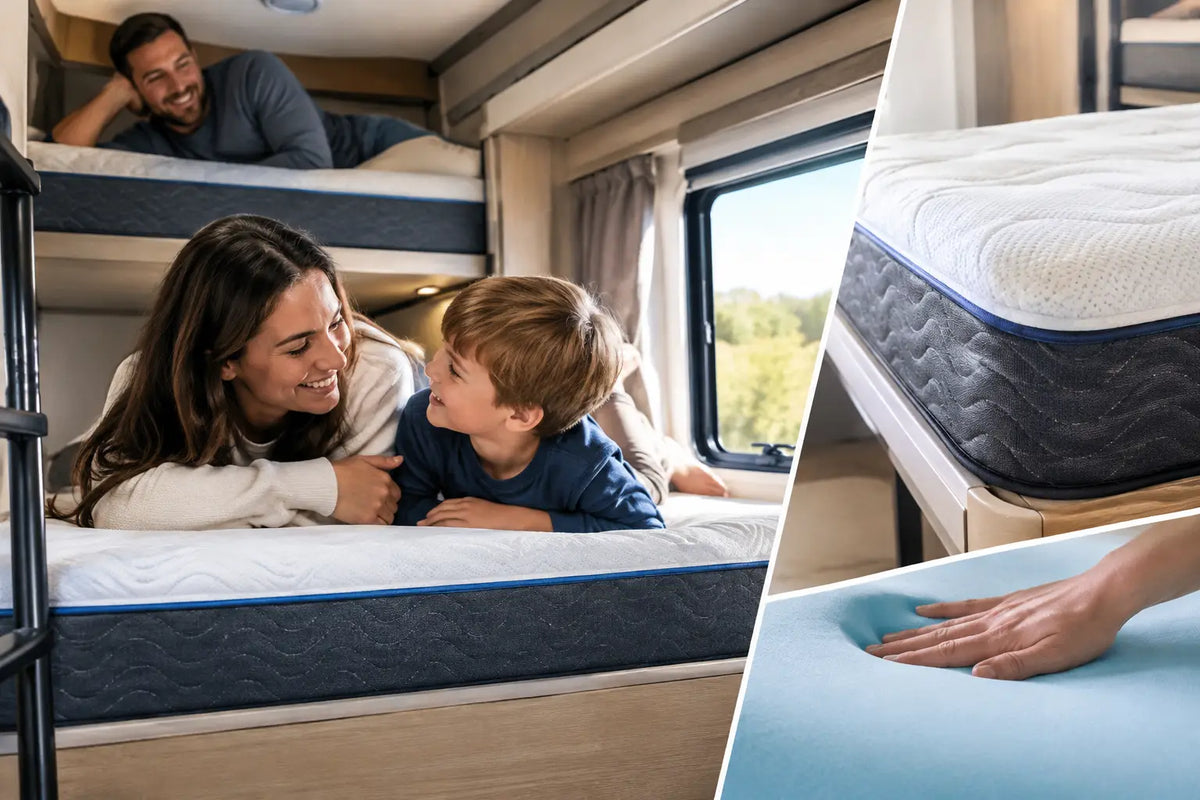
That thin bunk pad that came with your RV was designed to fill a space, not deliver a good night’s sleep. When shoppers search for rv bunk mattress vs foam, they are often comparing two things that are not actually opposites. A bunk mattress describes the size and purpose of the mattress. Foam describes one possible construction inside it.
The better question is this: what kind of RV bunk mattress gives the sleeper proper support, pressure relief, cooling, and a secure fit in a limited space? For a child who sleeps in the bunk a few weekends a year, the answer may be different than it is for a grandchild, a full-time RVer, or an adult using the bunk every night.
RV Bunk Mattress vs Foam: It Is Not a Straight Comparison
An RV bunk mattress is made to fit the narrow, short, and often nonstandard sleeping spaces found in RVs. RV Twin/Bunk sizes vary by manufacturer, and even two bunks labeled “twin” may have different widths, lengths, corner shapes, or clearance limits.
Foam is a material category. It can mean basic polyurethane foam, memory foam, gel memory foam, high-density support foam, or several layers combined into one mattress. Many quality RV bunk mattresses use foam. Others use hybrid constructions with coils and foam, provided the bunk platform and safety rail clearance allow it.
A basic all-foam mattress may be the right choice when low profile, light weight, and flexible maneuvering matter most. But not all foam performs the same way. Soft, low-density foam can flatten quickly, trap heat, and leave a sleeper feeling the hard platform below. A better bunk mattress uses purposeful comfort and support layers, not simply more foam.
Start With the RV Bunk Space, Not a Mattress Label
Before deciding on foam, coils, or a hybrid design, measure the space. This prevents the most frustrating replacement-mattress problem: a mattress that feels promising but does not fit through the RV, sit properly on the platform, or leave enough clearance for the safety rail.
Measure the inside width and length of the platform, then check for walls that taper, rounded corners, cabinet overhangs, ladders, and window ledges. Measure the available height as well. A thicker mattress can improve comfort, but it should not make an upper bunk unsafe or difficult to access.
Thickness affects more than comfort
Stock bunk mattresses are frequently around 4 to 5 inches thick. That profile saves space, but it often provides too little material to cushion shoulders, hips, and knees. For occasional child use, a well-built 5- or 6-inch mattress may be enough. Adults and side sleepers typically benefit from more pressure relief, which may call for a thicker profile if the bunk’s rail and headroom permit it.
There is no universal “best” thickness. A 7-inch mattress with dense support foam and a responsive comfort layer can feel more supportive than a thicker mattress made from low-quality materials. The goal is enough depth to prevent bottoming out without compromising safe clearance.
What Foam Can Do Well in an RV Bunk
Foam has real advantages in RV sleeping spaces. It is generally easier to maneuver through a narrow RV entry and around tight hallways than a traditional innerspring mattress. It can also be an efficient choice for upper bunks, where minimizing weight may matter.
Memory foam is especially effective at reducing pressure points. It contours around the body, which can be welcome for side sleepers with sore shoulders or hips after a long day of driving, hiking, or setting up camp. A quality foam construction also absorbs motion well, though that benefit matters more in larger shared beds than in a single bunk.
The trade-off is heat and response. Traditional memory foam can retain warmth and may feel slow when a sleeper changes positions. In a compact RV, where airflow can already be limited, this is not a minor concern. Gel-infused or conductive cooling materials can help pull heat away from the body, while breathable covers and thoughtful layer design help prevent the mattress from feeling stuffy overnight.
Support is the other major variable. Foam should not be judged by softness alone. A mattress can feel plush at first and still lack the dense support needed to maintain healthy alignment. For an adult sleeper, especially one with back discomfort, the base layer must resist compression so the hips do not sink too far below the shoulders.
When a Dedicated Bunk Mattress Is the Better Upgrade
A dedicated RV bunk mattress is built around the realities of mobile living: unusual dimensions, limited height, temperature swings, and frequent use in close quarters. That does not automatically mean it needs coils. It means every part of the mattress should serve the space and sleeper.
For example, a camper family may need a durable, easy-to-move foam bunk mattress that gives kids better cushioning than the factory pad. A couple traveling with an adult child or friend may need a more substantial design with stronger edge support, better cooling, and enough support for an adult body. Full-time RVers may need the bunk to function as a primary bed, not an occasional crash pad.
A premium foam bunk mattress can meet those needs when it combines cooling comfort materials with a dense support core. If the RV has adequate platform strength and rail clearance, a hybrid or coil-supported design can add extra responsiveness and structural support. Zoned coils can be particularly useful for sleepers who need better lumbar support, but a low-profile foam design is often the more practical fit for upper bunks.
Polar RV Mattress focuses on RV-specific sizing because fit and sleep performance should not be competing priorities. The right mattress should feel like a serious sleep upgrade while still fitting the bunk space correctly the first time.
Choose Based on Who Sleeps There
The best choice depends on use, not just material. For younger children and occasional guests, prioritize correct dimensions, a supportive feel, and a durable cover over extra thickness. The mattress should be comfortable enough for a full night without taking away valuable bunk clearance.
For teenagers, adults, and frequent guests, prioritize pressure relief and support. A higher-quality foam construction with cooling features is often a strong choice, particularly when the bunk cannot accommodate a taller hybrid mattress. If the sleeper is over roughly average adult weight or has recurring back pain, avoid ultra-thin mattresses that compress quickly against the platform.
For hot sleepers, do not assume every gel foam mattress will sleep cool. Look for a construction that addresses heat from more than one angle: cooling materials near the surface, breathable fabric, and a support core that does not hold the body in a deep heat-trapping cradle.
Do Not Overlook the Details That Determine Longevity
A mattress that fits today should still provide support after repeated trips. That is why construction quality matters more than a mattress’s initial softness. Weak foam can develop permanent impressions, especially when used by adults. A quality support core should maintain its shape and keep the sleeper from feeling the hard bunk base.
Also consider the mattress cover and your RV environment. Campgrounds bring humidity, dust, pets, kids, and frequent loading and unloading. A breathable, durable cover and a properly fitted protector can help keep the sleep surface cleaner and extend its usable life. Allow ventilation beneath the mattress when possible, since moisture can build up under a mattress resting on a solid platform.
Finally, account for installation. Confirm that the mattress can be delivered into the RV or carried inside without damaging walls, furniture, or the mattress itself. A mattress made for a residential bedroom may be hard to maneuver through an RV, even when its final dimensions appear close.
A bunk should not be the bed everyone hopes to avoid. Measure the space carefully, match the construction to the real sleeper, and choose enough support to make tomorrow’s drive, hike, or campground morning feel better than the one before.

Share:
RV Hybrid Review: Is It Worth the Upgrade?