

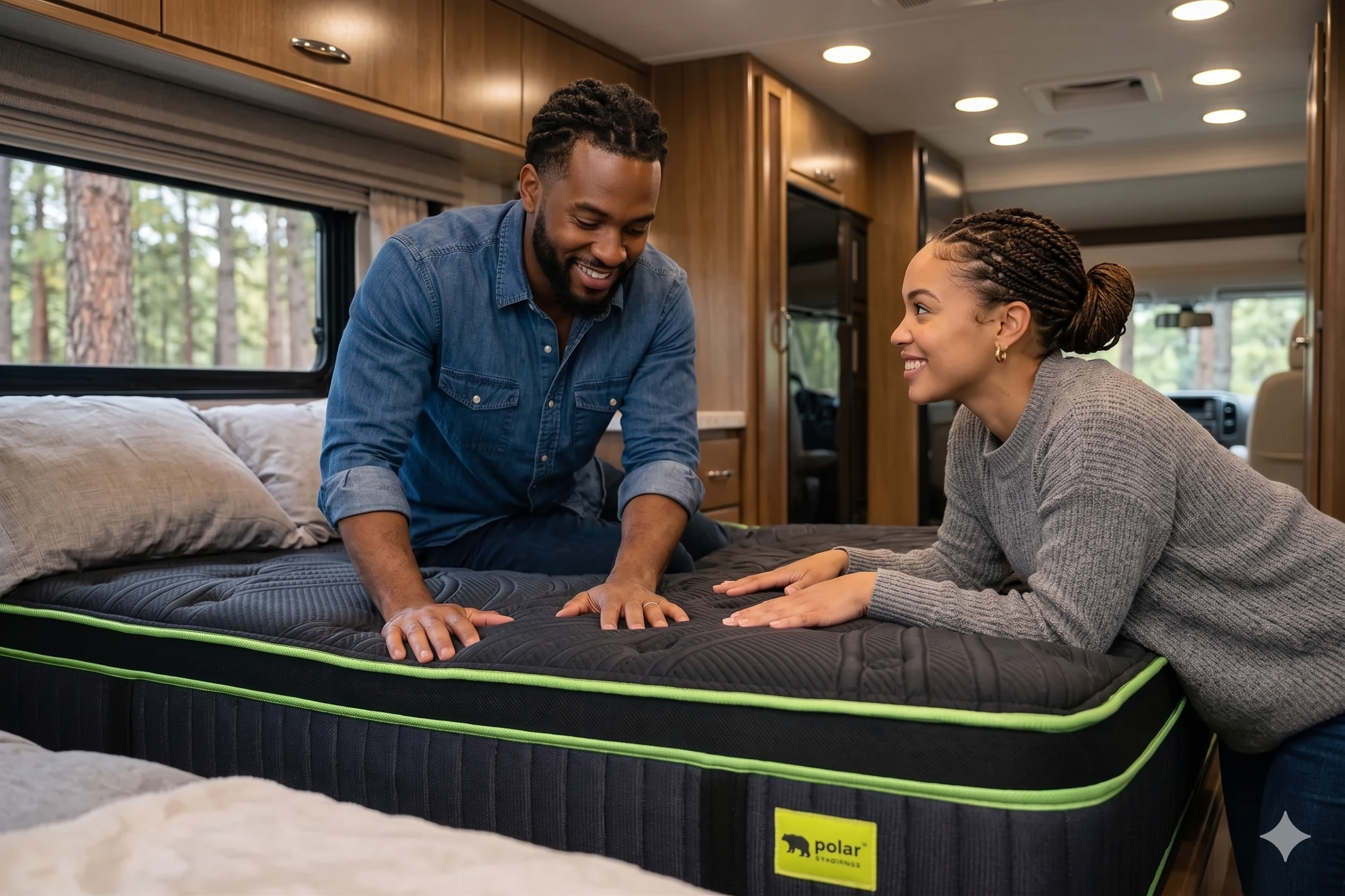
If you have ever climbed into bed in your RV and felt the plywood base through the mattress, you already know why people ask, how thick should an RV mattress be? Thickness affects more than comfort. It changes support, cooling, ease of movement, overhead clearance, fitted sheet fit, and whether your mattress actually works in a compact RV layout.
The short answer is that most RV owners do best with a mattress between 8 and 12 inches thick. But that range is only useful if it matches your RV type, your sleeping position, your body weight, and the space around the bed. A thicker mattress is not automatically better. In an RV, the right mattress is the one that delivers real support without creating fit problems inside a tighter sleep environment.
How thick should an RV mattress be for most sleepers?
For most RVs, 10 to 12 inches is the sweet spot if your platform and surrounding space can handle it. That thickness usually gives enough room for better comfort layers, stronger support systems, and improved pressure relief than the thin factory mattresses that come with many campers and motorhomes.
An 8-inch mattress can still work well, especially in bunks, pop-ups, truck campers, and other setups where vertical space is limited. The key is construction. A well-built 8-inch mattress can outperform a poorly made 10-inch one if it uses better foam, better coils, and smarter support zoning.
Once you drop below 6 to 7 inches, comfort becomes much harder to maintain for adults, especially side sleepers and anyone with hip, shoulder, or back pain. Thin stock mattresses often bottom out because they simply do not have enough material to absorb pressure and keep the spine aligned.
Why thickness matters in an RV more than at home
In a house, mattress thickness is mostly about feel and support preference. In an RV, it is also a fit issue. A mattress that is too tall can interfere with overhead cabinets, bed lifts, slide-outs, Murphy bed closures, or getting in and out of bed comfortably.
This is where many shoppers make the wrong move. They buy a residential mattress thinking more height means more luxury, then realize the bed is now awkward to access or the platform no longer closes properly. RV mattresses need to perform like premium home mattresses, but they also need to respect the layout of the coach.
That is why thickness should never be chosen in isolation. The real question is not just how thick should an RV mattress be. It is how thick can your RV mattress be before it starts working against the space.
The best thickness by RV type
Different RVs have different limits, and the bed area often decides the practical thickness range before comfort preferences do.
Travel trailers and fifth wheels
These usually offer the most flexibility. If you have a standard walk-around bed with decent overhead clearance, a 10-inch or 12-inch mattress is often the strongest upgrade. It gives you more room for pressure relief, cooling layers, and stronger support cores.
Motorhomes
Motorhomes vary more. Some have generous bedroom layouts, while others place the bed in tighter rear corners or slides. In many Class A and Class C models, 8 to 10 inches is a safe range, with 12 inches possible if clearance allows.
Truck campers and pop-ups
These spaces are tighter, and mattress thickness matters more. A lower-profile mattress, usually 6 to 8 inches, is often the right call to preserve headroom and keep the sleeping area usable.
Bunk areas
Bunks are almost always better with a thinner mattress, often around 5 to 8 inches depending on the safety rail height and available clearance. Kids may tolerate thinner beds more easily, but adult bunks still need enough support to avoid pressure buildup.
Sleeping position changes the answer
The right thickness also depends on how you sleep. Not every sleeper needs the same amount of comfort material.
Side sleepers
Side sleepers usually need more pressure relief at the shoulders and hips. That often means 10 to 12 inches is ideal, especially for couples who want a more residential feel. If the mattress is too thin, side sleepers feel sharp pressure points faster.
Back sleepers
Back sleepers often do well in the 8 to 10-inch range as long as the support core is strong enough to keep the midsection from sinking too far. The focus here is balanced support, not just softness.
Stomach sleepers
Stomach sleepers usually need a firmer feel and less sink. They may not need as much thickness as side sleepers, but they still need support that prevents the lower back from bowing. A well-built 8 to 10-inch mattress can work very well.
Combination sleepers
If you move around a lot at night, mattress design matters as much as thickness. Around 10 inches is often the best middle ground because it can blend pressure relief with easier repositioning.
Body weight matters too
A mattress that feels supportive for one sleeper can feel too thin for another. Heavier sleepers generally need more substantial support layers and stronger base systems to avoid bottoming out.
For lighter sleepers, an 8-inch mattress can sometimes feel comfortable and supportive if the materials are high quality. Average-weight sleepers often land in the 8 to 10-inch range. Heavier sleepers and couples usually benefit from 10 to 12 inches because extra depth allows for stronger support, better durability, and less compression over time.
This is one reason factory RV mattresses disappoint so many people. They are not just thin. They are also built with lower-grade materials that break down quickly under regular use.
Thickness alone does not tell you if a mattress is good
A 12-inch mattress sounds impressive, but height by itself is not a quality metric. You need to know what is inside that height.
A better RV mattress uses thickness wisely. That may mean zoned support, pocketed coils, gel memory foam, conductive cooling materials, or layered foam that relieves pressure without trapping heat. Stronger construction matters because RV owners are often dealing with hot sleeping, motion transfer, sore backs, and long stretches on the road.
A thinner premium mattress can outperform a taller budget mattress if the support system is stronger and the comfort layers are better engineered. That is why serious RV shoppers should evaluate thickness together with support, cooling, and fit, not as a standalone spec.
Watch these clearance issues before you buy
Before choosing thickness, measure the full sleep space. Do not just measure the platform.
Check the distance from the top of your current mattress to any overhead cabinet. Measure whether the bed base lifts for storage and how much extra height it can tolerate. Look at nearby windows, trim, and walls if your bed is tucked into a corner. If your mattress sits inside a slide, make sure a thicker profile will not interfere when the slide retracts.
This is also a good time to think about who is sleeping there. If one partner already struggles getting in and out of bed, adding too much height may make access worse. A mattress should improve sleep, not make the bedroom harder to use.
When a thicker RV mattress is worth it
A thicker RV mattress is usually worth the investment if you travel frequently, sleep hot, wake up sore, or want your RV bed to feel closer to what you have at home. Full-timers and extended-trip travelers often notice the biggest difference because small comfort issues become major problems after repeated nights.
If your current mattress is around 4 to 6 inches thick and feels flat, hard, or unstable, moving into an 8 to 12-inch range is often a dramatic upgrade. This is especially true for couples who need better motion isolation and support that holds up over time.
For many RV owners, the best answer is not the absolute thickest mattress that fits. It is the thickest mattress that still preserves function in the space while delivering premium support and cooling.
So, what thickness should you choose?
If you want a strong default answer, start here. Choose 10 to 12 inches for primary RV bedrooms with enough clearance. Choose 8 to 10 inches for tighter layouts or back and stomach sleepers who want solid support without too much height. Choose 5 to 8 inches for bunks, truck campers, and compact setups where every inch matters.
That range covers most RV owners, but the smartest purchase comes down to construction quality and correct sizing. A mattress built specifically for RV dimensions and real RV sleep conditions will usually outperform a generic residential option that merely happens to fit.
At Polar RV Mattress, that is exactly the point of a true RV-specific upgrade. You want cooling, pressure relief, support, and the right profile for your floorplan - not another compromise disguised as a replacement.
If you are replacing a thin stock mattress, think beyond the number on the spec sheet. The right thickness should make your RV bed feel easier to sleep on, easier to move on, and easier to live with night after night.

Share:
How to Buy a Custom Size RV Mattress
RV Mattress Motion Isolation Explained