


A bad RV mattress has a way of becoming the loudest part of a trip. You may have a great campsite, a well-planned route, and everything you need for a relaxing weekend, yet still wake up stiff, overheated, and ready to head home. This travel trailer mattress upgrade example shows what changes when a couple replaces the thin factory bed with a mattress built for real support and an actual RV fit.
A travel trailer mattress upgrade example: from tolerable to restorative
Picture a couple traveling in a 30-foot trailer with a walk-around RV Queen bed. Their original mattress was roughly six inches thick, light enough to lift with one hand, and included with the trailer for one reason: it kept the manufacturer’s cost down. After several trips, both sleepers noticed the same problems. One woke with lower-back tightness. The other slept hot and could feel every position change across the bed.
Their first instinct was to add a foam topper. It helped for a few nights, but it did not correct the problem underneath. The topper added softness, not structure. It also made the bed taller, which reduced clearance under the overhead cabinets and made the fitted sheets harder to manage. By midseason, the mattress still sagged at the hips and trapped heat.
The better decision was to replace the entire mattress with an RV-specific model. They chose an 8-inch RV Queen with pressure-relieving foam, a cooling cover, and individually pocketed coils. The result was not merely a softer bed. It was a sleep system that held their bodies in a more neutral position, reduced motion transfer, and fit the platform without hanging over the edges.
That distinction matters. An RV mattress upgrade should solve the reasons you are sleeping poorly, not simply add another layer to an already weak foundation.
Start with the dimensions that actually fit your trailer
The word “queen” causes more buying mistakes in RV bedrooms than almost any other label. A standard residential queen is generally 60 by 80 inches. An RV Queen is often 60 by 75 inches, though trailer layouts and model years vary. RV King, RV Full/3/4, and bunk sizes can vary even more.
In this example, the owners measured the existing mattress rather than relying on the trailer brochure. They measured length, width, and usable height at the bed platform. They also checked the route from the entry door to the bedroom, the space around the bed, and the overhead clearance when seated.
The old mattress measured 60 by 75 inches. A standard queen would have extended five inches beyond the platform, blocked a small portion of the walkway, and made it harder to tuck bedding. A correctly sized RV Queen kept the installation clean and the bedroom functional.
Measure the platform, not just the old mattress
Factory mattresses can be undersized, compressed, or cut in unusual shapes. Measure the platform from edge to edge and note any corners that are rounded, angled, or cut away. If the mattress sits inside a framed recess, account for the interior dimensions, not the outside edge of the frame.
Height deserves equal attention. A thicker mattress can be a major comfort upgrade, but only if it does not interfere with cabinets, windows, slide mechanisms, or the ability to sit up in bed. For most travel trailers, an 8- to 10-inch mattress offers a meaningful improvement without overwhelming the room. The best thickness depends on the available clearance and the level of support the sleepers need.
Choose support before chasing softness
The couple in this example did not need the plushest mattress available. They needed better spinal support. That is a common difference between a residential bedroom purchase and an RV mattress decision: available height is limited, and the stock mattress is usually too thin to provide a stable support core.
A premium hybrid design is often a strong answer for couples and full-time RVers. Pocketed coils respond independently instead of moving as one connected unit. When one person turns or gets out of bed early, the other is less likely to feel the disturbance. Zoned coils can provide firmer reinforcement through the lumbar area while allowing more give around shoulders and hips.
Foam still has an important role. Gel memory foam and comfort foams can reduce pressure points, especially for side sleepers. The trade-off is that some all-foam mattresses feel warmer or make it harder for certain sleepers to change positions. Cooling materials and a breathable construction help, but a responsive coil system often gives combination sleepers a more balanced feel.
For a solo traveler, a quality foam mattress may be the right fit, particularly in a lightweight bunk or compact trailer. For two adults sharing a main bedroom, stronger edge support, motion isolation, and durable coils are usually worth prioritizing.
Cooling is not a luxury in a travel trailer
RV bedrooms can heat up quickly. Sun hits the sidewall, airflow is limited, and the bed may be positioned against an exterior wall. If your factory mattress uses dense, low-cost foam, it can hold onto body heat night after night.
In this upgrade example, cooling was one of the couple’s non-negotiables because one sleeper routinely woke up warm. They selected a mattress with conductive cooling materials designed to pull heat away from the body, paired with breathable comfort layers. That changed the sleep experience even on nights when the trailer’s air conditioning had to work hard.
Cooling technology is most useful when it supports the whole mattress design. A cool-touch cover alone may feel pleasant at first contact, but the deeper layers still determine whether heat can dissipate over several hours. Look for cooling features paired with airflow through the support system and foam that is designed to resist heat buildup.
Installation is easier when you plan for it
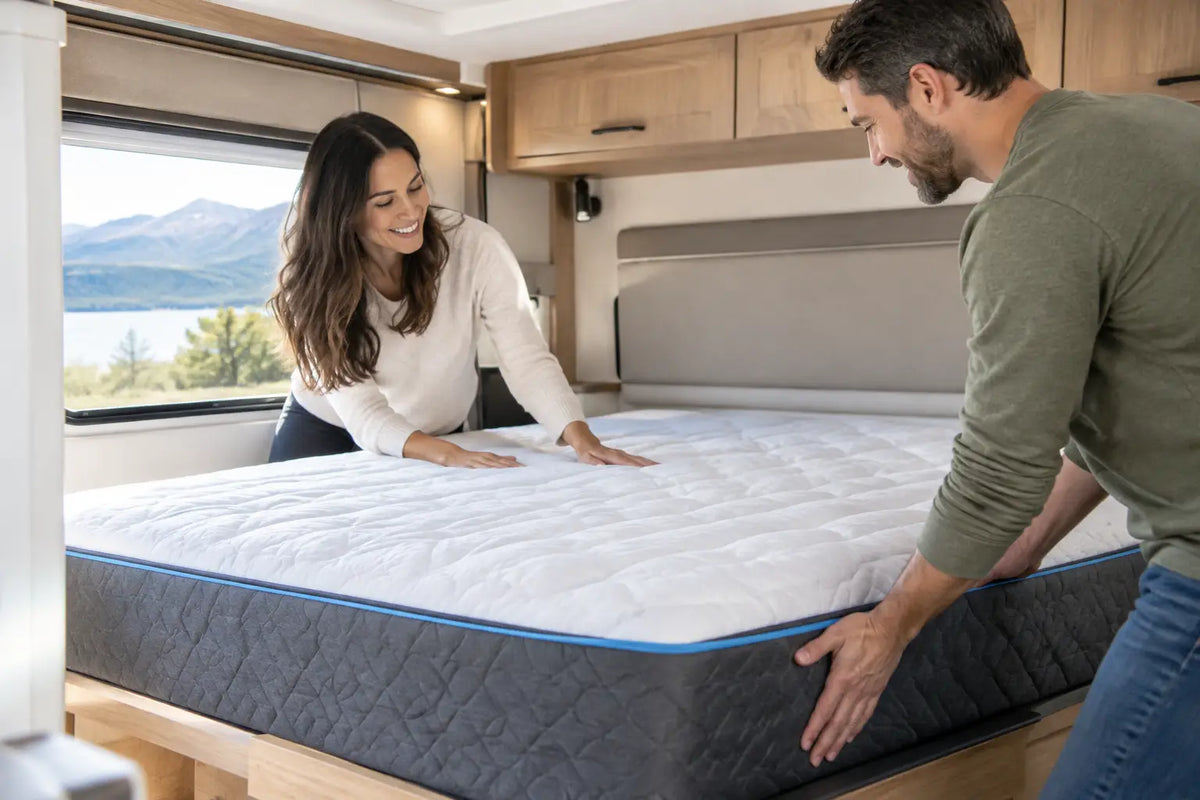
A boxed RV mattress is much easier to maneuver through a trailer than a fully expanded mattress. Still, installation should not be an afterthought. Clear the bedroom, remove the old mattress, and vacuum the platform before bringing in the replacement. Inspect for loose screws, sharp edges, or uneven boards that could damage the cover over time.
Place the boxed mattress on the bed platform before opening it when possible. Once the plastic is cut, the mattress begins expanding and becomes harder to reposition in a narrow room. Open the package carefully, avoiding blades near the mattress fabric.
Most mattresses become usable quickly, though full expansion can take longer depending on the model, temperature, and time spent compressed in transit. Give it room to breathe and avoid making a final comfort judgment in the first hour. The couple in this example let their new mattress expand through the afternoon, then made the bed and slept on it that evening.
What changed after the upgrade
The most noticeable improvement was not that the mattress felt dramatically soft. It was that neither person woke up fighting the bed. The side sleeper had less pressure at the shoulder and hip. The back sleeper no longer felt the midsection dipping lower than the chest and legs. Motion from late-night bathroom trips was less disruptive.
There was also a practical benefit the couple had not expected: they stayed longer. A two-night weekend did not leave them feeling like they needed to recover at home. That matters for retirees, frequent travelers, and full-time RVers. If your bed leaves you sore, your trailer becomes a place you tolerate. If it supports restorative sleep, it becomes a place you genuinely want to use.
Polar RV Mattress focuses on this difference with RV-specific sizes and constructions designed for cooling, comfort, and stronger support than the typical factory mattress. The right model depends on your sleeping position, trailer dimensions, and whether you share the bed, but specialized sizing removes the guesswork that comes with forcing a residential mattress into an RV bedroom.
When a topper is enough, and when it is not
A topper can be worthwhile if your current mattress is structurally sound but slightly too firm, or if you need a short-term comfort adjustment. It is also a lower-cost option for a guest bunk that is rarely used.
But a topper cannot repair sagging foam, weak support, poor edge stability, or a mattress that is simply too thin for your body. It may even worsen heat retention and make the bed inconveniently tall. If you wake with back pain, feel the platform beneath you, or see visible impressions in the mattress, replacement is usually the smarter investment.
A travel trailer is built around compromises in space and weight. Your sleep does not have to be one of them. Measure carefully, choose support that matches your body, and give cooling the attention it deserves. The next time you park beneath the trees or along the coast, a good night’s sleep should be the part of the trip you can count on.

Share:
RV Mattress Setup for Better Sleep on the Road