

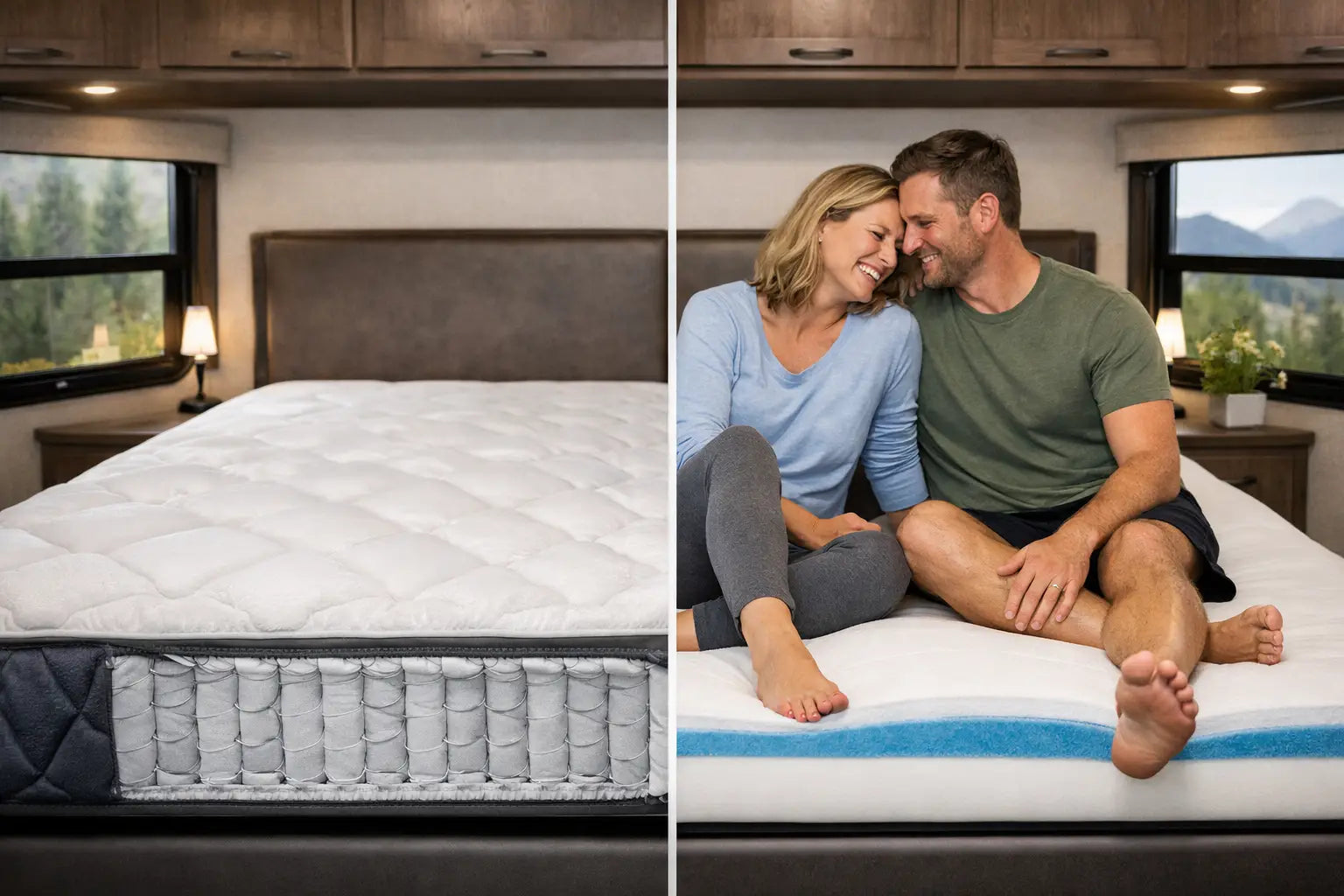
If your current RV bed leaves you stiff, sweaty, or wide awake every time your partner rolls over, the innerspring vs foam RV mattress question is not academic. It is the difference between waking up ready to drive and waking up already done with the day. In an RV, mattress construction matters more because you are dealing with tighter spaces, non-standard sizes, changing temperatures, and a sleep surface that often starts out far below residential quality.
For most RV owners, the right choice comes down to how you sleep, how often you travel, and what you want to fix first. Some people need stronger lift and airflow. Others need pressure relief and less motion transfer. The best answer is not always foam or always springs. It depends on what your body is asking for at night.
Innerspring vs foam RV mattress: what really changes?
At a glance, these mattresses seem easy to separate. Innerspring models use coils for support. Foam models rely on layers of poly foam, memory foam, latex-like foam, or gel-infused foam. But in real RV sleep, the more useful question is how those materials perform in four areas that matter most - support, cooling, motion isolation, and long-term comfort.
An innerspring RV mattress usually feels more lifted and responsive. You lie on it more than in it. That can be a major upgrade if your stock mattress sags, traps heat, or makes changing positions feel like work. Coils also allow more airflow through the core, which helps hot sleepers.
A foam RV mattress usually feels more contouring and pressure relieving. It can cushion shoulders, hips, and lower back more evenly, especially for side sleepers or anyone dealing with joint sensitivity. Good foam also does a better job absorbing movement, which matters in tight RV sleeping quarters.
The problem is that many shoppers compare cheap versions of both and assume that tells the whole story. It does not. A low-grade open coil mattress and a basic slab of foam are not the benchmark for what a premium RV mattress can do.
Support and spinal alignment
Support is where most RV owners start, because back pain tends to get your attention fast.
Innerspring mattresses have a natural advantage in structural support. A quality coil system creates pushback under the body, helps keep the spine level, and resists the hammock effect that shows up in thin RV beds. This can be especially valuable for back and stomach sleepers, heavier sleepers, and couples who need a mattress that stays stable across the whole surface.
That said, not all spring systems perform the same. Traditional connected coils can feel bouncy and less precise. Pocketed coils are a clear step up because they respond more independently and reduce pressure buildup better than old-school spring construction.
Foam mattresses approach support differently. Instead of pushing back with steel, they distribute body weight across multiple comfort and support layers. A well-built foam RV mattress can absolutely support healthy alignment, but density and layer design matter. Cheap foam softens too quickly, and once it does, support drops off fast.
If your top priority is a stronger, more lifted feel, innerspring often wins. If your top priority is contouring pressure relief with a smoother surface feel, foam can be the better fit.
Who usually prefers each feel?
Back sleepers often do well on a firmer foam build or a supportive innerspring. Side sleepers tend to appreciate foam because it cushions pressure points more effectively. Combination sleepers can go either way, but many prefer innerspring or hybrid-style designs because they make repositioning easier.
For heavier sleepers, support systems become even more important. Foam can work, but it needs to be high quality and substantial enough to resist deep sink. Stronger coil support tends to hold its shape and feel more consistent over time.
Cooling is a bigger deal in an RV
Heat retention is one of the biggest complaints with factory RV mattresses, and this is where innerspring vs foam RV mattress comparisons become very practical.
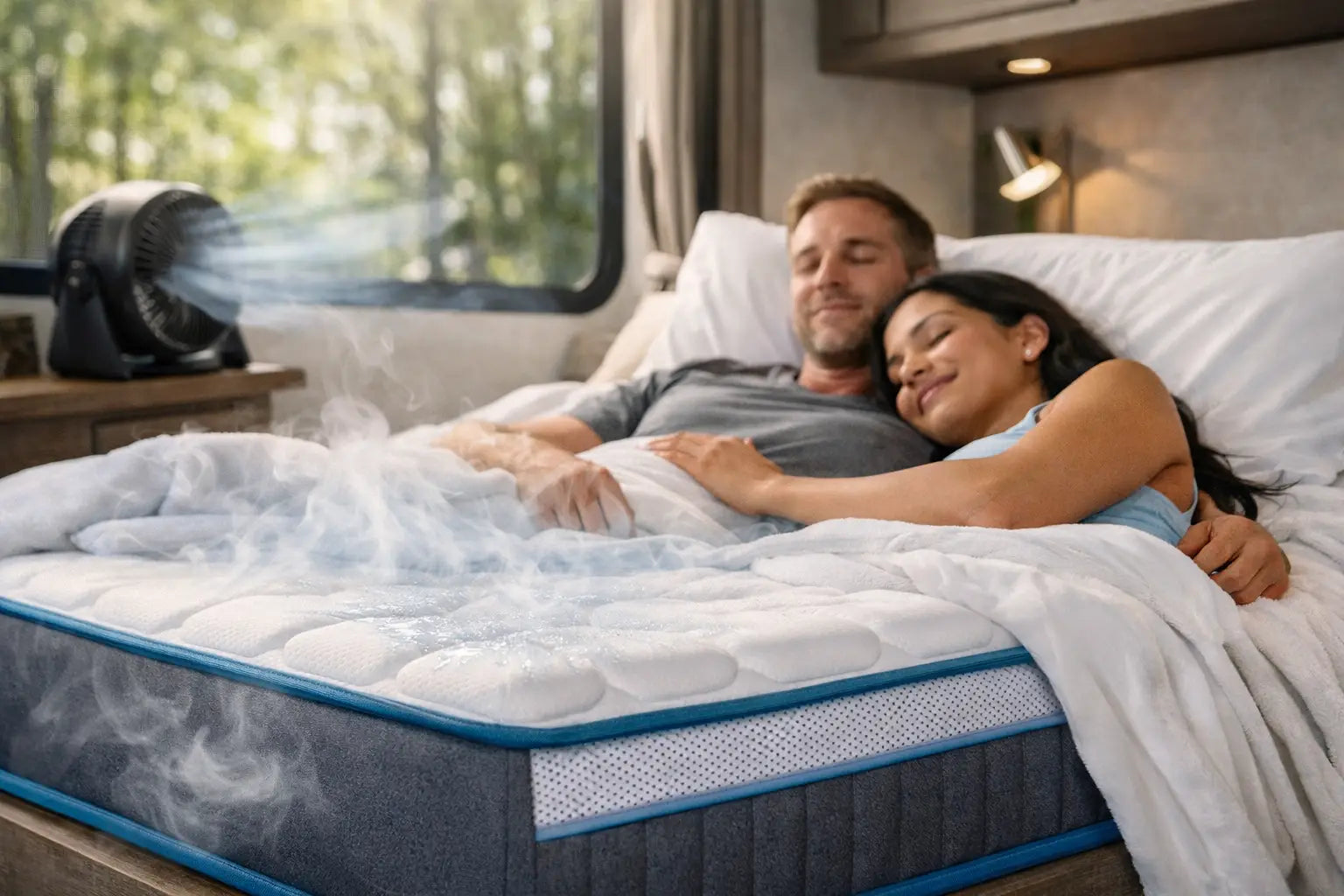
Innerspring mattresses generally sleep cooler because air can move through the coil core. If you camp in warm climates, sleep hot, or deal with limited overnight climate control, that airflow can make a noticeable difference.
Foam mattresses are more variable. Traditional memory foam is known for trapping heat, especially lower-end versions. Newer foams perform better, particularly when they use gel infusions, open-cell structures, phase-change materials, or conductive cooling covers. But even with those upgrades, foam usually does not move air as freely as a coil system.
This does not mean foam is always too hot for RV use. It means cooling technology matters more. If you are leaning foam, look beyond the word memory foam and pay attention to how the mattress is actually built to handle heat.
For many RV shoppers, the best cooling performance comes from advanced hybrid construction that pairs coils with specialized cooling foams. That gives you airflow from below and pressure relief from above instead of forcing a hard choice between the two.
Motion isolation and partner disturbance
RV bedrooms are compact. When one person gets up early, changes position, or shifts around after a long drive, the other person feels it.
Foam mattresses are usually stronger in motion isolation. They absorb movement instead of transferring it across the surface. For couples, that can mean fewer nighttime interruptions and deeper sleep.
Innerspring mattresses can transfer more motion, especially if they use connected coils. Pocketed coils improve this a lot, but foam still tends to come out ahead if your main goal is reducing partner disturbance.
This is one of those areas where personal priorities matter. Some sleepers are happy to trade a little more movement for better airflow and stronger lift. Others want the quietest, least disruptive sleep surface possible. If you are a light sleeper sharing an RV bed, motion control deserves real weight in your decision.
Durability in mobile living
An RV mattress deals with a different kind of life than a bedroom mattress. It may be exposed to shifting temperatures, seasonal use, storage conditions, and more movement overall. Durability is not just about surviving nightly sleep. It is about holding comfort and support through real RV use.
Innerspring mattresses often hold up well structurally, especially when built with quality steel coils and reinforced support layers. They tend to keep their shape better than low-density foam beds. But they can also become noisy, uneven, or less comfortable if the comfort layers above the coils are thin or low quality.
Foam mattresses avoid squeaks and can be very durable when made with high-density materials. The risk is premature softening in lower-grade foam, which shows up as body impressions, sagging, and reduced support.
This is why mattress specs matter more than mattress category alone. A premium foam mattress can outlast a cheap innerspring. A premium innerspring can outperform a bargain foam bed. Construction quality decides the winner.
Sizing and fit matter more in RVs than homes
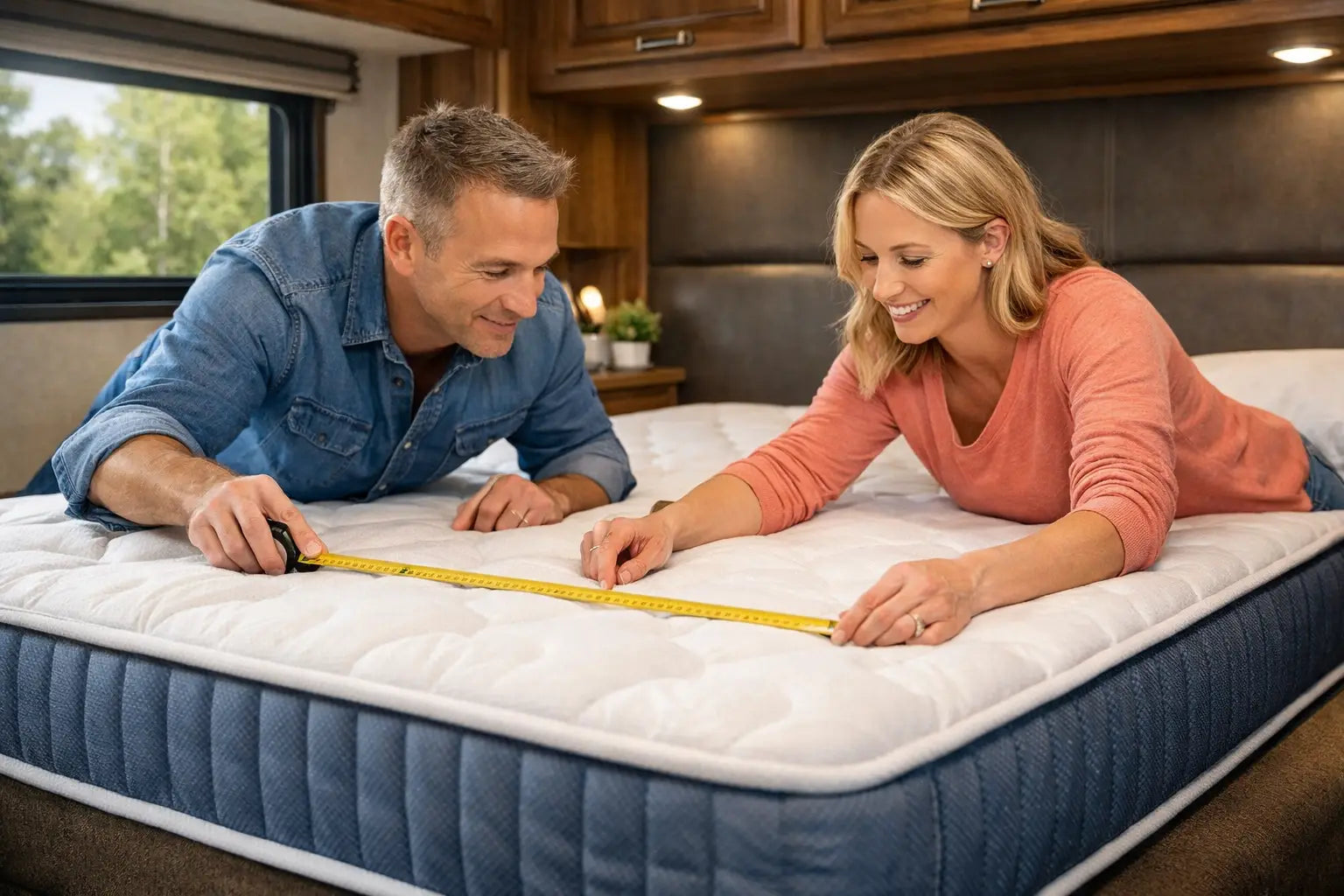
One mistake RV owners make is focusing only on feel and forgetting fit. An RV mattress has to match your space correctly. That sounds obvious, but RV sizes are not standard, and even small measurement errors create real problems.
Foam mattresses are often easier to maneuver through tight doorways, corners, and bunks because they can be compressed and boxed more easily. That can simplify delivery and setup, especially in smaller rigs.
Innerspring mattresses are less flexible to move, though many RV owners still prefer them once installed because of the support and airflow they provide. If your layout is tight or your mattress platform has unusual dimensions, custom sizing becomes a serious advantage no matter which construction you choose.
A specialty RV brand has an edge here because correct sizing is not a side offering. It is the product category.
So which one should you choose?
Choose an innerspring RV mattress if you want a cooler, more responsive sleep surface with stronger lift and easier movement. It is often the better fit for back sleepers, hot sleepers, heavier sleepers, and anyone who wants their mattress to feel more supportive than enveloping.
Choose a foam RV mattress if you want deeper pressure relief, quieter sleep, and better motion isolation. It is often the better fit for side sleepers, light sleepers, and couples bothered by movement transfer.
But if you are reading this because you are tired of choosing between cooling and contouring, there is a reason so many serious RV mattress upgrades now use hybrid construction. A well-designed hybrid can give you coil support, airflow, pressure relief, and better motion control in one build. For many RV owners, that is where the comparison ends - not with foam or springs alone, but with a smarter combination of both.
That is also why premium RV mattress brands like Polar focus on construction details instead of broad labels. Zoned support, cooling materials, and the right RV-specific size will affect your sleep more than a simple foam-versus-spring checkbox.
The better question is not which material wins. It is which mattress solves the problem you feel every morning. Start there, and the right choice gets much clearer.
Share:
How to Cool RV Mattress Heat Fast