

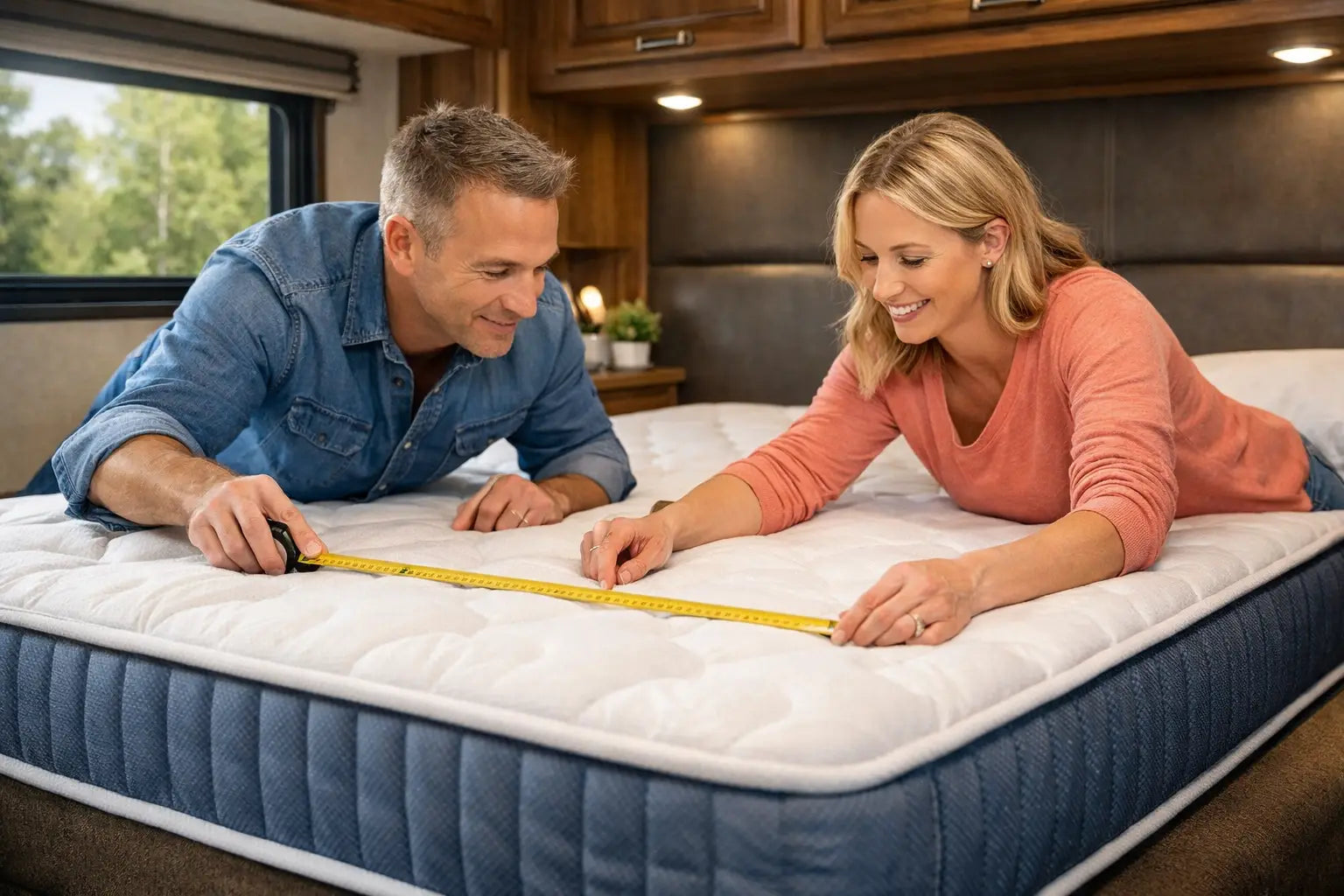
You do not notice how wrong an RV mattress is until the third bad night in a row. Your hips ache, your partner’s movement wakes you up, and the corners of the mattress do not even sit right on the platform. A good rv mattress size guide fixes the first mistake most RV owners make - assuming an RV bed uses standard residential dimensions.
That assumption is expensive. RV manufacturers work around slide-outs, wardrobes, wheel wells, and tight bedroom layouts, so mattress sizes often look familiar but run shorter, narrower, or both. If you want real comfort in a camper, fifth wheel, travel trailer, or motorhome, getting the size right comes before you compare foam, coils, cooling features, or firmness.
Why an RV mattress size guide matters
Stock RV mattresses are usually built to meet a price point, not a sleep standard. Even when the size is technically correct, the mattress itself is often thin, heat-retaining, and weak on support. But fit still comes first. If the dimensions are off, even a premium mattress will create problems.
A mattress that is too long can block a door, press into cabinetry, or keep a slide from operating properly. One that is too wide can buckle at the edges or sit unevenly on the base. Too small, and you end up with shifting, gaps around the perimeter, and a bed that feels unfinished. In a moving vehicle where every inch matters, close enough is usually not good enough.
The other reason size matters is sleep position. Many RV owners are trying to improve more than fit. They want better pressure relief, less motion transfer, and cooler sleep than the original mattress delivered. That upgrade only works when the dimensions match the platform and the way the room actually functions.
Common RV mattress sizes
The fastest way to narrow your options is to understand the most common RV dimensions. This is where any reliable rv mattress size guide should start, but these labels are only a reference point. Actual measurements can vary by manufacturer.
RV Twin and RV Bunk
These are usually used in bunks, smaller campers, and compact sleeping spaces. A common RV bunk size is 28 inches by 75 inches, while RV twin sizes often land around 38 inches by 75 inches. Some bunks are narrower or shorter, especially in family travel trailers.
This category demands precise measuring because bunk spaces are often boxed in by walls or rails. If the mattress is even slightly oversized, installation gets frustrating fast.
RV Full or Three-Quarter
This size is common in older campers, smaller couples’ layouts, and some space-saving bedroom designs. A typical RV full or three-quarter mattress measures around 48 inches by 75 inches.
It is a practical option when the floorplan cannot accommodate a queen, but it can feel tight for two adults. For solo sleepers, it often offers a strong balance of space efficiency and comfort.
RV Queen
RV Queen is one of the most common sizes, but it is also one of the most misunderstood. A standard residential queen is 60 inches by 80 inches. An RV Queen is often 60 inches by 75 inches, though some variations exist.
That missing five inches matters. If you order a regular queen without measuring first, you may end up with a mattress that physically will not fit the room or interferes with access around the bed.
RV King
RV King mattresses usually measure around 72 inches by 80 inches, compared with a residential king at 76 inches by 80 inches. Some RV king layouts also use other custom widths depending on the bedroom design.
This size is ideal for couples who want more personal space, but it also requires extra attention to corner clearance and walking room. A larger mattress can make the room feel dramatically tighter if the platform is surrounded by cabinetry.
How to measure your RV mattress correctly
If there is one part of this process worth slowing down for, it is measuring. Labels help, but tape-measure numbers matter more.
Start by removing bedding and measuring the sleeping platform itself, not just the old mattress. Measure width from side to side and length from head to foot. Then measure the height of surrounding obstacles such as bed lifts, side cabinets, trim pieces, and overhead storage if access is tight.
Next, check the shape. Some RV mattresses have rounded corners, notched cutouts, or angled edges to fit a custom floorplan. If that applies to your setup, document it clearly. A simple rectangle measurement will not tell the whole story.
It is also smart to measure available clearance around the bed. Ask yourself whether a thicker replacement mattress will affect cabinet access, bed lifts, or the ability to sit up comfortably. A mattress can fit the platform and still create usability problems if the profile is too tall.
Standard RV size vs custom size
Many RV owners fall into one of two camps. The first group has a common RV size and can shop confidently within that category. The second has a platform that is close to standard but not exact, and that is where frustration starts.
If your measurements match a common RV size, replacement is simpler. You can focus on sleep feel, cooling, support, and construction quality. If your platform runs even an inch or two off, custom sizing may be the better move. That is especially true in older rigs, upgraded camper vans, and renovated RV interiors where the original sleeping area has been modified.
Custom sizing is not just about convenience. It protects the comfort upgrade you are paying for. Premium support systems, pressure-relieving foams, and advanced cooling materials work best when the mattress sits flat and fully supported. A forced fit can compromise both comfort and durability.
Thickness matters more than most buyers expect
An RV mattress size guide should not stop at width and length. Height changes how the mattress performs in the space.
Thicker mattresses often feel more substantial and can offer stronger pressure relief and deeper support systems, especially when they include quality foam layers or pocketed coils. But thicker is not always better in an RV. If the bed sits under a low cabinet or inside a slide, too much height can become a daily annoyance.
A lower-profile mattress may be the smarter fit in bunks, pop-ups, or compact bedrooms. In larger RV master setups, you typically have more flexibility to choose extra cushioning and stronger support without sacrificing function. It depends on your layout, your sleep style, and how much room you truly have around the bed.
Fit is only step one - comfort is the real upgrade
Once the size is correct, the real question is how the mattress sleeps. This is where many factory-installed RV mattresses fall short. They tend to trap heat, compress too quickly, and transfer movement across the bed.
For couples, motion isolation matters. For side sleepers and anyone with shoulder or hip pressure, contouring matters. For back sleepers and heavier body types, support matters even more. And for RV owners traveling through warm climates or camping in summer, cooling is not a luxury feature. It can be the difference between sleeping through the night and constantly waking up overheated.
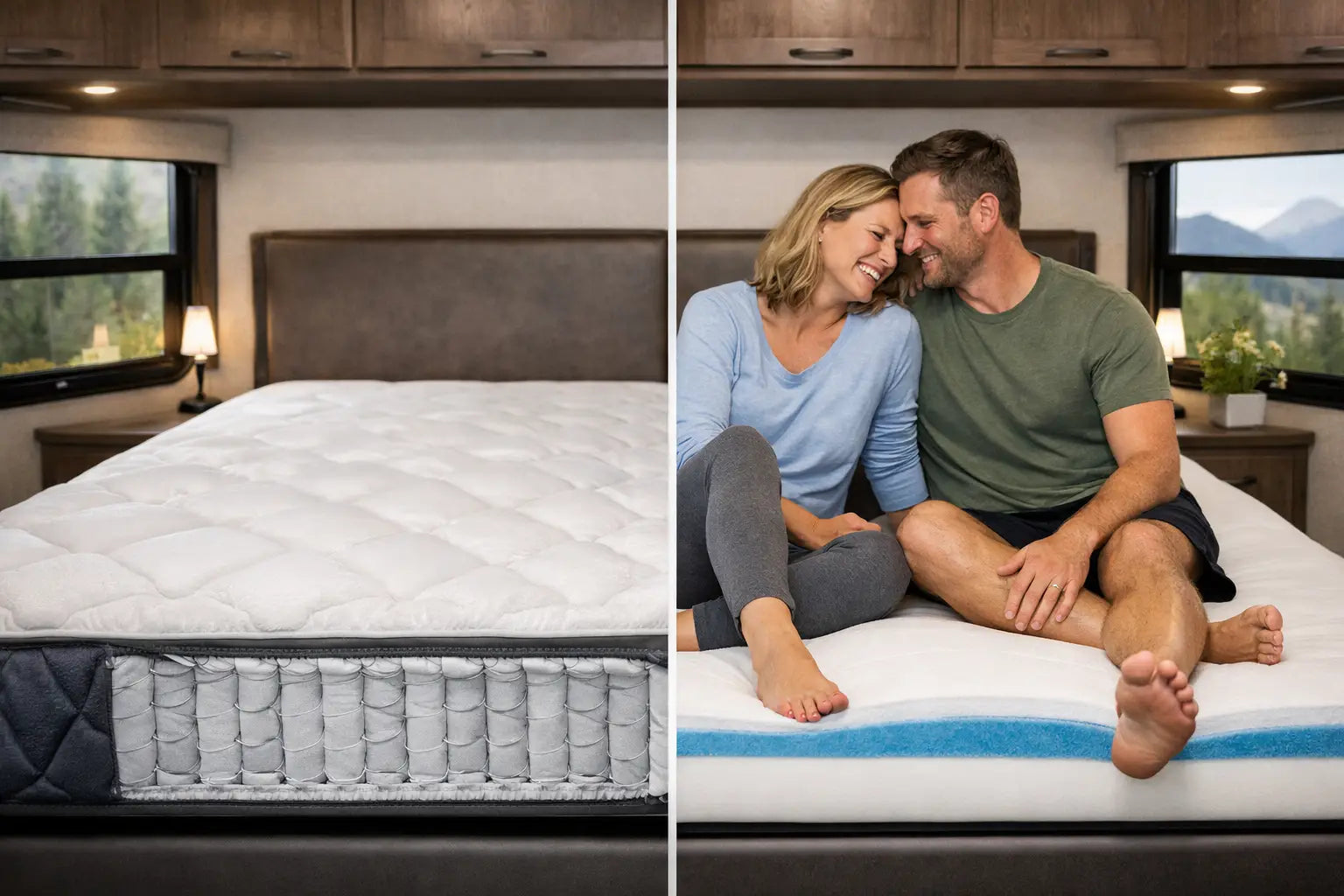
That is why a serious RV mattress should do more than match dimensions. It should also bring residential-level comfort into a mobile space through stronger support, better pressure relief, and cooling materials that outperform the basic foam found in many stock beds.
Mistakes to avoid when buying by size
The biggest mistake is ordering based on the RV model name alone. Floorplans can vary, and previous owners may have already replaced the mattress with something non-original. Always measure.
The second mistake is assuming all RV queens or RV kings are identical. They are not. Use the label as a starting point, then confirm the actual dimensions.
The third is ignoring corner shape and access. In tight RV bedrooms, a square-corner mattress may be harder to maneuver than you expect, even if the platform dimensions look correct on paper.
Finally, do not overlook build quality once the size is confirmed. A correctly sized mattress that sleeps hot or sags early is still the wrong mattress.
Choosing the right size with confidence
The best RV mattress purchase usually comes down to three things: exact measurements, realistic clearance checks, and an honest look at how you sleep. If you are tall, share the bed, or spend weeks at a time on the road, getting those details right matters even more.
For many RV owners, the right answer is not the cheapest mattress that fits. It is the one that fits correctly and delivers the cooling, comfort, and support your factory mattress never did. That is the standard comfort-focused travelers should expect, whether they are weekend campers or full-timers.
If your current mattress leaves you sore, overheated, or short on space, take ten minutes with a tape measure before you shop. That small step is what turns an RV bed from a compromise into a place you actually look forward to sleeping in.

Share:
RV Hybrid Mattress Review: What Actually Matters
How to Cool RV Mattress Heat Fast