


A camper mattress trial should be long enough to tell you what one night at a campground never can: whether your back feels supported after a week of travel, whether the mattress sleeps cool during a humid summer stop, and whether you still sleep soundly when your partner turns over at 3 a.m. For RV owners replacing a thin factory mattress, that time matters. Comfort is not a showroom impression. It is a pattern you feel over real nights in your own rig.
A 365-night trial removes much of the risk from making a serious RV sleep upgrade. It gives your body time to adjust, lets you test the mattress across seasons, and confirms that the size and height work in the space where you actually sleep. The right decision is not simply about choosing a softer or firmer feel. It is about finding cooling, pressure relief, stable support, and an RV-specific fit that holds up to the way you travel.
Why a Camper Mattress Trial Needs More Than a Few Nights
The first night on a new mattress can be misleading. A mattress that initially feels firm may provide the support your hips and lower back have been missing. Another may feel plush at first, then leave you waking up stiff once the comfort layers compress under your body night after night.
Your old mattress has also trained your body to compensate. If it sags, traps heat, or allows you to sink too deeply, your muscles may have adapted without you realizing it. Moving to a better support system can feel different before it feels better. A meaningful trial period gives you room to distinguish normal adjustment from a mattress that is simply not right for your sleep position or comfort needs.
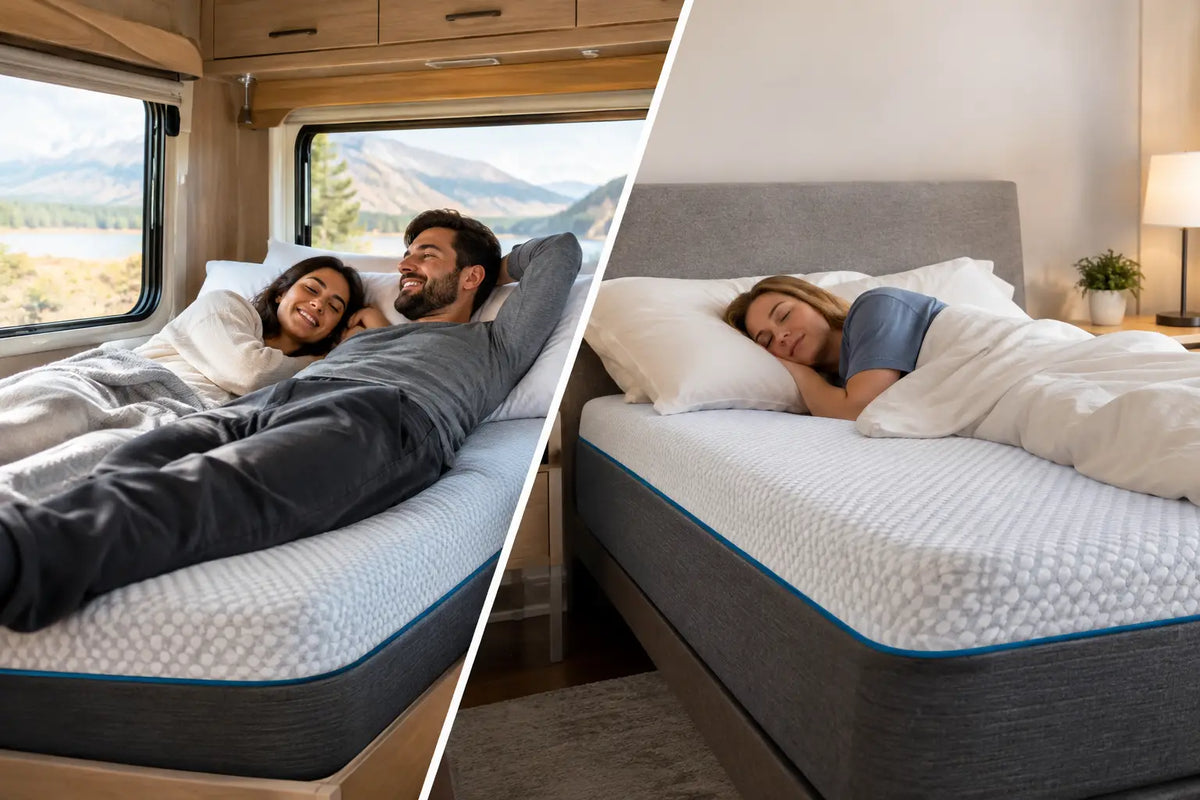
Travel adds another layer. Conditions inside an RV change fast. You may sleep with the windows open in the mountains, run the air conditioning in the Southwest, or deal with warm, still air at a crowded campground. A mattress that performs well only in ideal bedroom conditions is not necessarily a good RV mattress.
What to Test During Your Camper Mattress Trial
A trial is most useful when you pay attention to the factors that affect sleep every night. You do not need to keep a complicated sleep journal, but checking in after several nights can make your decision clearer.
Support where your body needs it
For side sleepers, the shoulder and hip should receive enough pressure relief to prevent numbness and soreness. At the same time, the waist should not collapse into the mattress. Back sleepers generally need steady lumbar support that keeps the spine from bowing. Stomach sleepers usually need a flatter, more supportive surface to avoid excessive hip sink.
A premium RV mattress should feel supportive without feeling hard. Zoned pocketed coils can help by providing stronger reinforcement through the middle of the mattress, where much of your weight rests, while allowing more give around the shoulders and legs. That targeted support is a major step up from the basic foam and open-coil constructions common in factory-installed RV mattresses.
If you wake with new soreness for a few mornings, give your body time to adapt. If you are still consistently waking with lower-back pain, hip pressure, or a feeling that you are rolling toward the center after a reasonable adjustment period, that is useful feedback.
Temperature through the night
Heat is one of the most common reasons RV owners replace their original mattress. Dense, inexpensive foam can hold onto body heat, and RV bedrooms often have less airflow than a residential room. If you are repeatedly pushing off blankets, waking sweaty, or sleeping closer to the edge just to find a cooler spot, the mattress may be contributing to the problem.
During a trial, evaluate how the mattress performs after several hours, not just when you first lie down. Cooling materials, gel memory foam, conductive cooling technology, and a breathable coil system can make a measurable difference. Coils allow more air to move through the mattress than a solid block of foam, while advanced comfort layers can pull heat away from the sleep surface.
No mattress can overcome an RV parked in direct sun with limited ventilation. But your mattress should not add unnecessary heat to an already warm night.
Motion isolation for shared RV beds
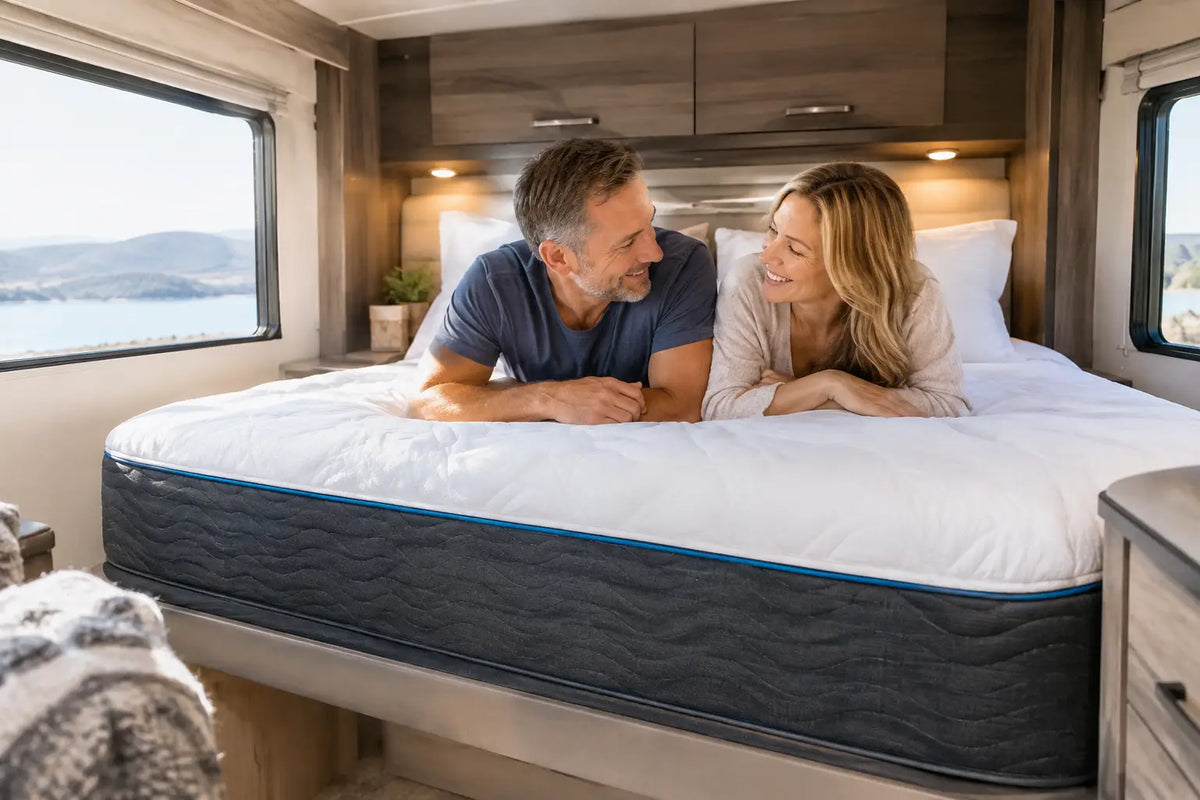
An RV bedroom is compact, but that does not mean couples should settle for disrupted sleep. Test motion isolation the practical way: notice what happens when one person gets up early, changes position, or climbs into bed after the other is already asleep.
Pocketed coils work independently rather than transferring movement across the entire mattress. Quality foam layers can further absorb motion at the surface. The result should be a more stable sleep environment, especially in RV Queen and RV King sizes where couples need every inch of usable comfort.
There is a trade-off worth understanding. Highly responsive coil systems often make movement easier and improve airflow, while all-foam mattresses can sometimes feel more motion-dampening. For many RV couples, a well-designed hybrid offers the stronger balance: support, cooling, easier movement, and less partner disturbance than a basic RV mattress.
Fit, height, and daily function
A mattress can feel excellent and still be wrong for your RV if the dimensions are off. RV Queen, RV King, RV Full/3/4, and bunk sizes do not always match standard residential measurements. Even a few inches can affect walkways, cabinetry, slide clearances, or the ability to make the bed without a fight.
Use your trial to confirm that the mattress fits the platform cleanly and that its height works with surrounding furniture. A thicker mattress may provide more comfort layers and support, but it can also make it harder to access overhead cabinets or close a bed slide. The best choice depends on your rig, your mobility needs, and how much clearance you have around the bed.
Before buying, measure the mattress platform itself rather than relying only on the label attached to the old mattress. Corners, radius cuts, and custom dimensions are common in RVs. Proper fit is not a small detail. It is part of what makes a replacement mattress feel like it was built for the space.
How to Give a New RV Mattress a Fair Test
Start by setting it up correctly. Allow the mattress to fully expand if it arrives compressed, then use a breathable protector and sheets that fit without pulling tightly at the corners. An overly tight fitted sheet can change how the surface feels, particularly on thicker mattresses.
Sleep on it consistently for at least several weeks unless there is a clear fit issue or a serious comfort problem. Switching back and forth between the old mattress and the new one makes it harder to judge either. If you travel seasonally, a longer trial is especially valuable because you can test the mattress at home, on weekend trips, and during extended travel.
Pay attention to the pattern, not a single rough night. A late dinner, a long drive, campground noise, or an unfamiliar pillow can all affect sleep. What matters is whether you are waking more rested, moving more easily in the morning, and experiencing fewer pressure points over time.
Questions to Ask Before Relying on a Trial Offer
Not all mattress trials are built the same. The headline number matters, but the details matter more. Before ordering, understand when the trial begins, whether there is a required break-in period, what condition the mattress must be in, and how a return is handled from an RV location.
Ask whether shipping is included and whether the company has real expertise in RV sizing. A generic mattress seller may offer a trial but still leave you guessing about dimensions, construction, or whether the bed will work in a slide-out. Specialized RV mattress support reduces those avoidable mistakes before the box ever arrives.
Polar RV Mattress backs its RV-specific sleep systems with a 365-night satisfaction guarantee, giving owners the time to test a genuine upgrade beyond a quick first impression. That kind of coverage is most valuable when it is paired with accurate sizing guidance, fast delivery, and knowledgeable help from people who understand the difference between a residential bed frame and an RV platform.
A camper mattress trial is not permission to overthink every night of sleep. It is the confidence to choose a better mattress, use it in the real conditions of your travels, and let your body tell you whether the support, cooling, and comfort are finally doing their job.

Share:
RV Mattress Topper Review: Is It Enough for You?
How to Reduce Partner Movement in an RV Bed