


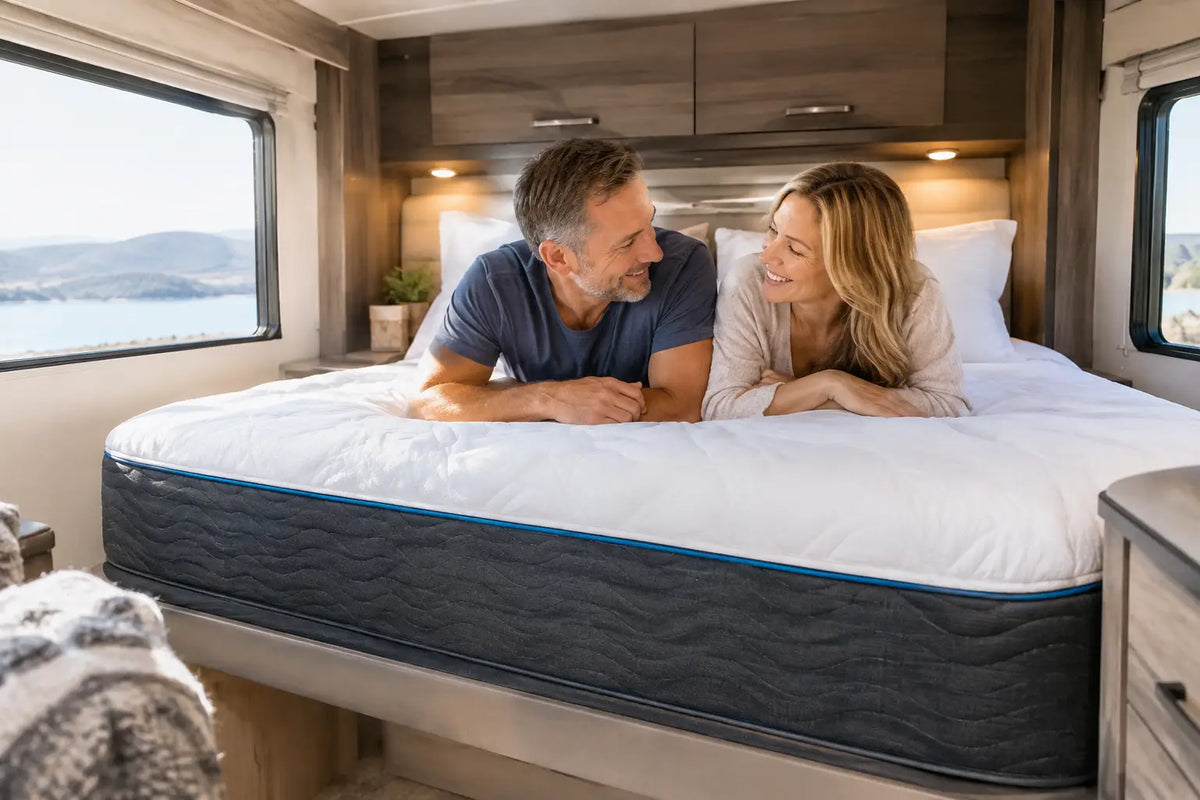
A midnight bathroom trip should not wake the person beside you. Yet on a typical factory RV mattress, one partner rolling over, sitting up, or getting out of bed can send movement straight across the sleep surface. If you are researching how to reduce partner movement in an RV bed, the answer is not simply buying a thicker mattress. It is choosing the right construction, the right fit, and a foundation that does not add unnecessary bounce.
For couples, especially full-time RVers and frequent travelers, motion isolation is one of the biggest differences between merely replacing an RV mattress and making a meaningful sleep upgrade.
Why Partner Movement Feels Worse in an RV
Most stock RV mattresses are built to meet a price point, not to protect sleep. They are often thin, lightweight, and made with basic foam or interconnected innersprings. Those materials can react as one broad surface: when weight shifts on one side, the other side feels it.
An RV bedroom can make the issue more noticeable. Beds may sit on lightweight plywood platforms, storage bases, slide-out mechanisms, or uneven supports that amplify vibration. Space is also tighter than in a residential bedroom, so couples may sleep closer together on an RV Queen, RV Full/3/4, or other compact RV size.
Movement is normal. The goal is not to create a bed that feels stiff and unresponsive. The goal is to keep one sleeper's movement contained to their side so the other person can stay asleep.
How to Reduce Partner Movement With the Right Mattress
The mattress is the most effective place to start. A mattress with true motion isolation absorbs energy instead of passing it across the bed.
Choose individually responsive support
Pocketed coils are a strong choice for couples because each coil moves independently. Unlike a traditional connected coil system, where springs are linked and movement can travel across the mattress, pocketed coils respond mainly where pressure is applied. When one partner changes position, the other side remains more stable.
This construction also gives many RV sleepers a better balance of pressure relief and support than all-foam options. You get contouring comfort at the surface, along with more stable reinforcement underneath. For couples with different body weights, that balance matters. A mattress should support the heavier sleeper without making the lighter sleeper feel every adjustment.
Not all coil mattresses perform the same way. Look for a thoughtfully designed coil system and supportive perimeter construction, not simply a mattress that happens to contain springs. Better support keeps the surface more level and reduces the rolling-toward-the-middle feeling that can put partners in each other's sleep zone.
Use comfort layers that absorb energy
Foam layers play a major role in motion control. Gel memory foam and quality pressure-relieving foams compress under the body and help dampen movement before it reaches the other side of the bed.
The trade-off is feel. Deep memory foam can be excellent at absorbing motion, but some sleepers find very soft, slow-moving foam harder to change positions on - especially in a warm RV. The best solution for many couples is a hybrid design: responsive pocketed coils for stable support, paired with comfort foams that cushion pressure points and reduce motion transfer.
Cooling materials matter here, too. A mattress that sleeps hot can cause more tossing and turning, which creates more disturbance in the first place. Conductive cooling layers and breathable construction can help both partners sleep more comfortably through warm nights without constantly shifting to find a cooler spot.
Avoid overly thin mattresses
A thin mattress has less material available to absorb movement and pressure. It can also allow sleepers to feel the firmness, flex, or unevenness of the platform below. That does not mean the tallest mattress is automatically best for every RV. Height must work with your bed frame, slide clearance, overhead cabinets, and sheets.
Still, if your current mattress is only a few inches thick and you wake up when your partner moves, more substantial comfort and support layers are likely part of the solution. Measure carefully before ordering so your upgrade fits the RV as well as it fits your body.
Make Sure the Mattress Fits the RV Frame Correctly
A mattress that is too small for the platform can shift or knock against the bed frame when a partner moves. One that is too large may buckle at the edges or sit unevenly against walls and cabinets. Neither creates a stable sleep surface.
RV mattresses are not always the same dimensions as residential mattresses, even when they share a familiar name. An RV Queen may be shorter than a standard Queen, while an RV King can vary significantly by manufacturer and floor plan. Measure the length and width of the usable platform, then account for corner cuts, radius corners, wheel wells, and tight bedroom access.
A correct RV-specific fit gives the mattress even support and helps prevent side-to-side shifting. It also prevents the frustration of forcing a residential mattress into a space where it does not belong.
At Polar RV Mattress, specialized RV sizes are designed for the realities of mobile bedrooms, helping owners upgrade sleep without guessing whether the mattress will fit through the door or onto the platform.
Check What Is Under the Mattress
Even a premium mattress cannot fully compensate for a weak or unstable foundation. Before blaming the mattress for every disturbance, inspect the bed base.
Start with the platform. It should be level, solid, and supported across the areas where both sleepers rest. Loose plywood, cracked slats, flexing storage lids, or an unsecured slide-out base can create extra movement every time someone turns over. Tighten accessible hardware and replace damaged components before installing a new mattress.
If your RV uses slats, make sure they are evenly spaced and strong enough for the combined weight of the mattress and sleepers. Widely spaced or flexible slats can make the bed feel bouncy and may shorten mattress life. A supportive deck or closely spaced, rigid slats generally provides a more stable result.
Keep ventilation in mind. RV mattresses need airflow below them to manage moisture, particularly in humid or cold conditions. Do not solve motion issues by placing a mattress directly on an unventilated surface for long periods if condensation is a concern. Stability and airflow should work together.
Reduce the Movements That Interrupt Sleep
The right bed does most of the work, but a few practical adjustments can make a noticeable difference.
First, give each sleeper enough usable width. If you are sharing an RV Full/3/4 and frequently wake each other, no material can entirely replace physical space. Moving up to an RV Queen or RV King, when your floor plan allows, creates more separation between sleep zones.
Second, consider your sleep environment. Heat, poor pillows, back discomfort, and noise all lead to frequent repositioning. A supportive pillow and a mattress that relieves pressure at the shoulders, hips, and lower back can reduce restless movement for both people.
Finally, make the bed easier to enter and exit. Keep a clear path on the side used for nighttime bathroom trips, and avoid loose blankets that pull across the entire mattress when one person moves. Separate lightweight blankets can be surprisingly effective for couples who disturb each other by tugging bedding, not just by shifting body weight.
Do You Need a Mattress Topper?
A topper can soften a firm mattress and add a little motion absorption, but it is not a full cure for poor support or excessive bounce. If the mattress underneath has worn-out foam, connected coils, deep sagging, or a weak edge, a topper may only mask the problem temporarily.
Use a topper when your current mattress is structurally sound but slightly too firm. Replace the mattress when movement, sagging, heat retention, and discomfort are all part of the same nightly pattern. For serious motion isolation, the support system underneath the comfort layer matters as much as the topper on top.
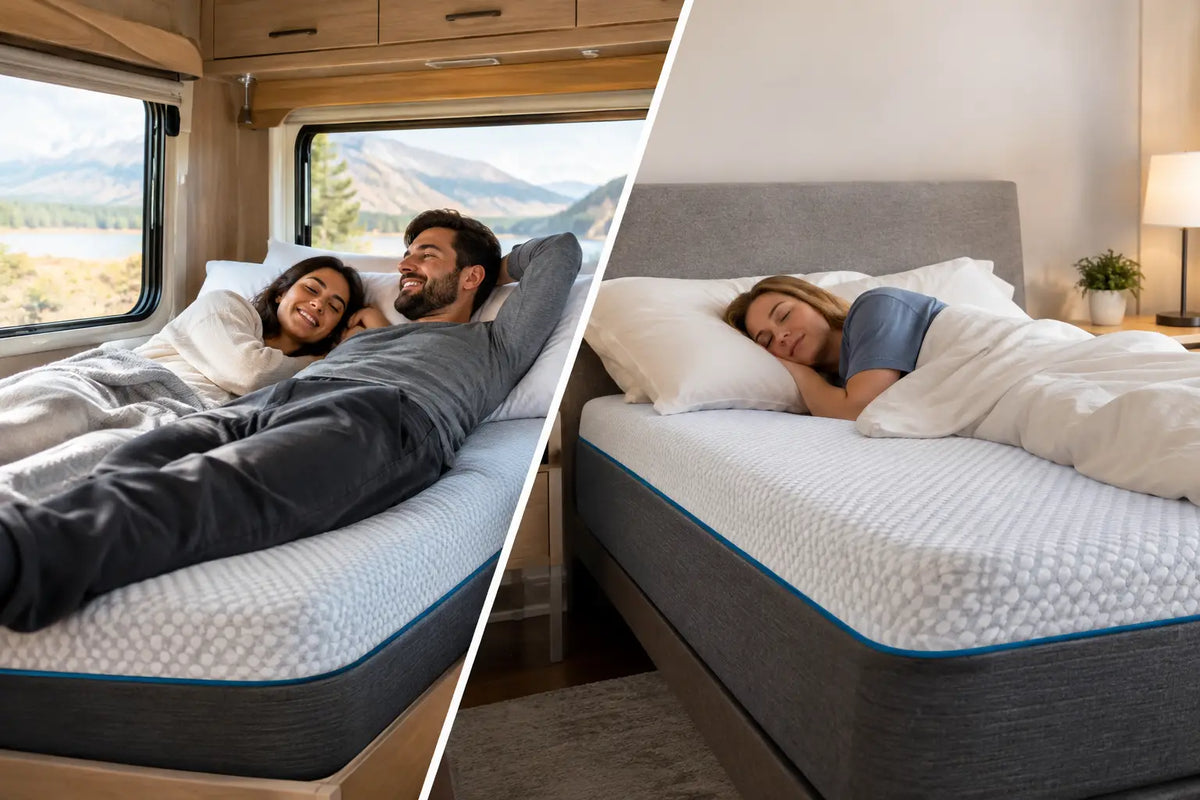
Better sleep in an RV should not depend on who goes to bed first or who wakes up during the night. A properly fitted mattress with responsive coils, pressure-relieving comfort layers, cooling performance, and a stable foundation lets each partner move naturally while the other keeps resting.

Share:
Camper Mattress Trial: What 365 Nights Prove
Do Hybrid Mattresses Fit Motorhomes? What to Check