

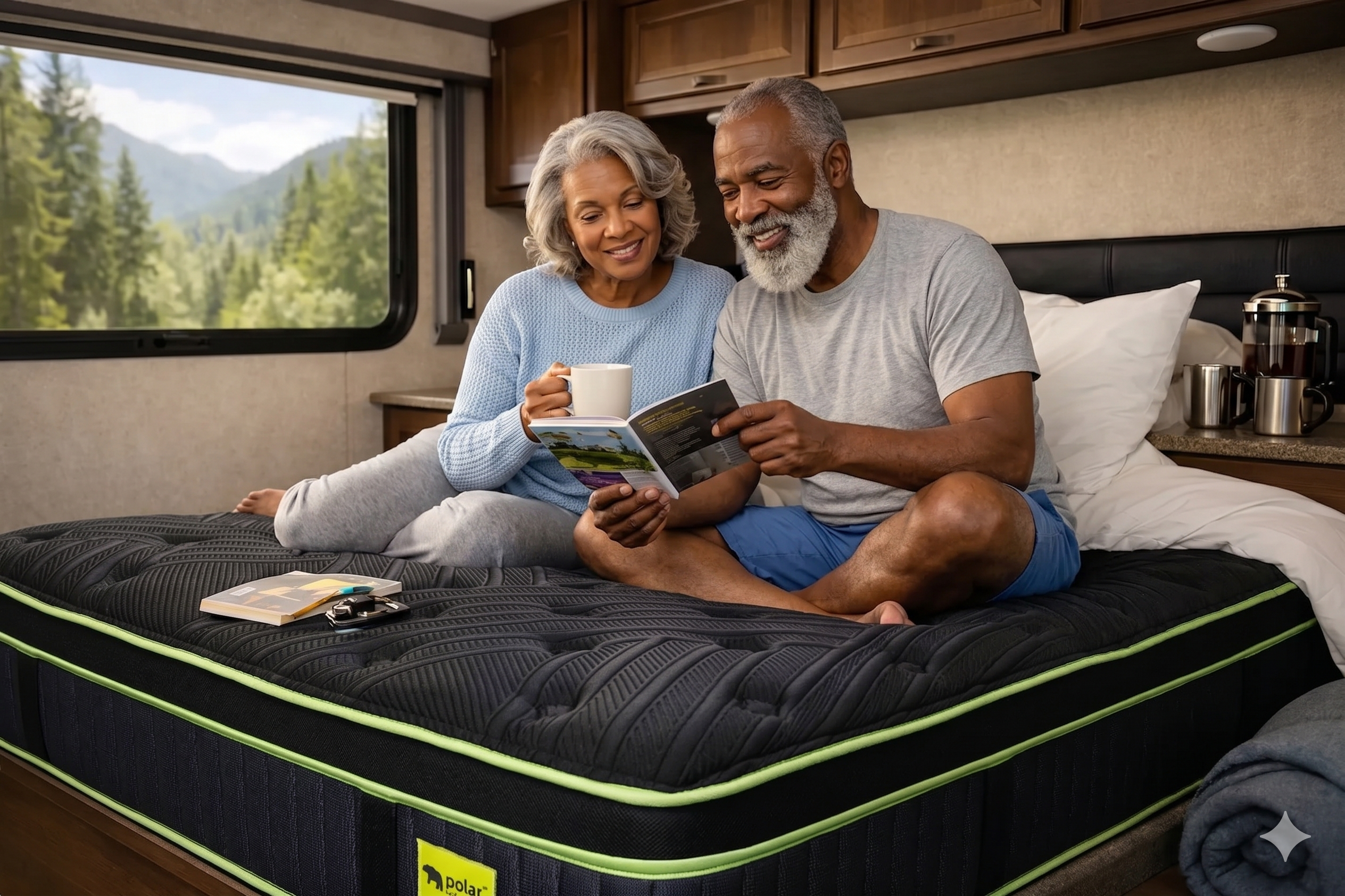
That stock RV mattress usually gives up fast. It sleeps hot, compresses under the hips and shoulders, and turns every overnight stop into a reminder that RV beds are often built to hit a price point, not to deliver real recovery. A gel memory foam RV mattress is one of the most common upgrades for a reason - it can bring better pressure relief, better motion control, and a noticeably cooler sleep surface than the thin factory bed you started with.
But not every gel foam mattress is worth loading into your rig. Some rely on gel beads as a marketing line and still trap heat. Others feel comfortable for a few weeks, then soften too quickly or lack the support needed for regular travel. If you want a real upgrade, the right question is not just whether gel memory foam sounds good. It is whether the mattress is built for RV use, your sleep position, your body type, and the exact dimensions of your coach.
What a gel memory foam RV mattress actually does
Memory foam is popular because it responds to pressure and contours around the body. That contouring can reduce the pushback that creates numb shoulders, sore hips, and lower back tension. In an RV, where many sleepers are trying to improve on a thin, stiff original mattress, that change can feel dramatic on the first night.
The gel component is meant to address one of traditional memory foam's biggest complaints - heat retention. Gel can help disperse heat and make the surface feel less stuffy, especially when paired with more breathable foams and a cooling cover. That said, gel alone is not a magic fix. If the mattress has poor airflow, low-quality foam, or an overly dense comfort stack with no cooling system behind it, it can still sleep warm.
This is where construction matters more than labels. A well-built gel memory foam RV mattress should balance contouring with airflow and support. You want enough pressure relief to reduce aches, but not so much sink that rolling over feels like work or your spine drops out of alignment.
Why RV owners choose gel memory foam
For many RV owners, the first reason is pressure relief. Side sleepers often feel immediate improvement because foam cushions the shoulders and hips better than basic innerspring or low-profile stock mattresses. Couples also tend to like memory foam because it isolates motion well. If your partner gets up early for coffee or shifts positions all night, you are less likely to feel every movement.
The second reason is comfort in a compact sleep space. RV bedrooms do not always allow much room around the bed, so a mattress that feels stable and comfortable matters more. If the bed is tucked into a corner or sits on a platform with limited ventilation, every weakness in the mattress becomes more obvious.
The third reason is noise reduction. Foam is quiet. In an RV, where road vibration, leveling, and movement already affect comfort, many people prefer a mattress with less bounce and less transfer.
Where a gel memory foam RV mattress can fall short
This is the part many shoppers skip, and it is where expensive mistakes happen.
A fully foam mattress can be excellent for some RV sleepers, but it is not automatically the best choice for everyone. Heavier sleepers may find that softer all-foam builds compress too deeply over time, especially in the center third of the bed. Stomach sleepers often need firmer support to keep the hips from sinking. And hot sleepers may still feel warm if the mattress lacks real airflow beyond a thin gel-infused layer.
Thickness is another trade-off. In a house, a taller mattress can feel more substantial. In an RV, extra height can interfere with bed lifts, window lines, cabinetry, or fitted sheets in a tight sleeping space. A mattress that looks luxurious on paper is not helpful if it makes the room harder to use.
Then there is the fit issue. Residential mattresses are rarely a clean solution for RVs. RV Queen, RV King, RV Full, and bunk sizes often differ from standard home dimensions. Even being off by a few inches can create gaps, make the mattress hard to install, or affect access around the bed.
How to tell if a gel memory foam RV mattress is high quality
Start with support, not softness. Comfort gets attention, but support determines whether the mattress still feels good after six months of travel. Look for a build that has a serious support core under the comfort layers. In premium RV mattresses, that may mean denser base foam, zoned support, or a hybrid design that combines gel memory foam with coils for better structure and airflow.
Next, pay attention to cooling beyond the word gel. Better cooling usually comes from a system, not a single material. Breathable covers, conductive cooling fabric, open-cell foams, and coil airflow all make a bigger difference than gel alone. If you are replacing a heat-trapping RV mattress, this matters more than almost any marketing phrase on the product page.
Durability is just as important. RV mattresses deal with repeated use, seasonal storage, and movement on the road. Lower-density foams can feel plush at first and break down faster than expected. A mattress built specifically for RV use should be able to handle regular compression without developing body impressions too quickly.
Finally, the company should know RV sizing well. That sounds basic, but it is one of the biggest differences between a general mattress seller and an RV specialist. Correct fit saves time, prevents return headaches, and gives you confidence that the mattress was designed for mobile living instead of adapted from a residential catalog.
Is gel memory foam enough, or should you consider a hybrid?
It depends on what you are trying to fix.
If your main problem is pressure points and partner movement, a gel memory foam RV mattress may be exactly what you need. It can deliver a softer, more conforming feel and reduce the jarring pushback that comes from cheap spring systems.
If your main problems are overheating, deeper body compression, or support for two adults sleeping on the mattress night after night, a hybrid often has the edge. The addition of coils improves airflow, reinforces support, and can keep the mattress feeling more stable over time. That is especially relevant for full-time RVers, larger sleepers, and anyone who wants a more residential sleep experience on the road.
This is why many premium RV brands do not stop at foam alone. They use gel memory foam as part of a broader comfort system, then add stronger support layers underneath. Polar RV Mattress, for example, builds around the idea that cooling, comfort, and support have to work together. That is the difference between a mattress that sounds upgraded and one that actually sleeps like it.
How firm should your RV mattress be?
Most shoppers do best in the medium to medium-firm range. That balance usually gives enough contouring for pressure relief without sacrificing support. But body type and sleep position still matter.
Side sleepers usually need more cushioning at the shoulders and hips. Back sleepers generally need a more balanced feel that supports the lumbar area without too much sink. Stomach sleepers often need a firmer surface to avoid strain through the lower back.
Couples should think about the combined load on the mattress, not just individual preferences. A bed that feels plush to one sleeper may feel under-supported once both people are on it. In an RV, where mattress dimensions may already be tighter than at home, support becomes even more important.
Sizing matters more in an RV than in a house
A mattress can have excellent materials and still be the wrong buy if the fit is off. RVs use shorter, narrower, and custom-cut dimensions all the time. Measure the sleeping platform carefully and account for corners, trim, lifts, and access paths before you order.
Also consider how the mattress will be delivered and installed. A compressed bed-in-a-box can make setup easier in tight RV interiors, but once it expands, the true dimensions need to be accurate. A specialized RV mattress company usually reduces the guesswork because RV sizes are already part of the product design, not an afterthought.
Who should buy a gel memory foam RV mattress?
It is a strong choice for RV owners who want better pressure relief, less motion transfer, and a calmer sleep surface than a traditional stock bed provides. It is especially appealing for side sleepers, couples, and anyone waking up sore on a thin factory mattress.
If you sleep very hot, need extra support, or are replacing the mattress for full-time use, look closely at the full construction. In those cases, gel memory foam can still be the right comfort layer, but it performs best when paired with stronger cooling materials and a serious support system underneath.
A better RV mattress should do more than feel softer in the showroom. It should keep you cooler through the night, support you after long miles, and fit your RV without compromise. If a gel memory foam model checks those boxes, it is not just an upgrade. It is a better way to travel and sleep.
Share:
Coil on Coil Mattress RV: Is It Worth It?
When to Replace a Camper Mattress