

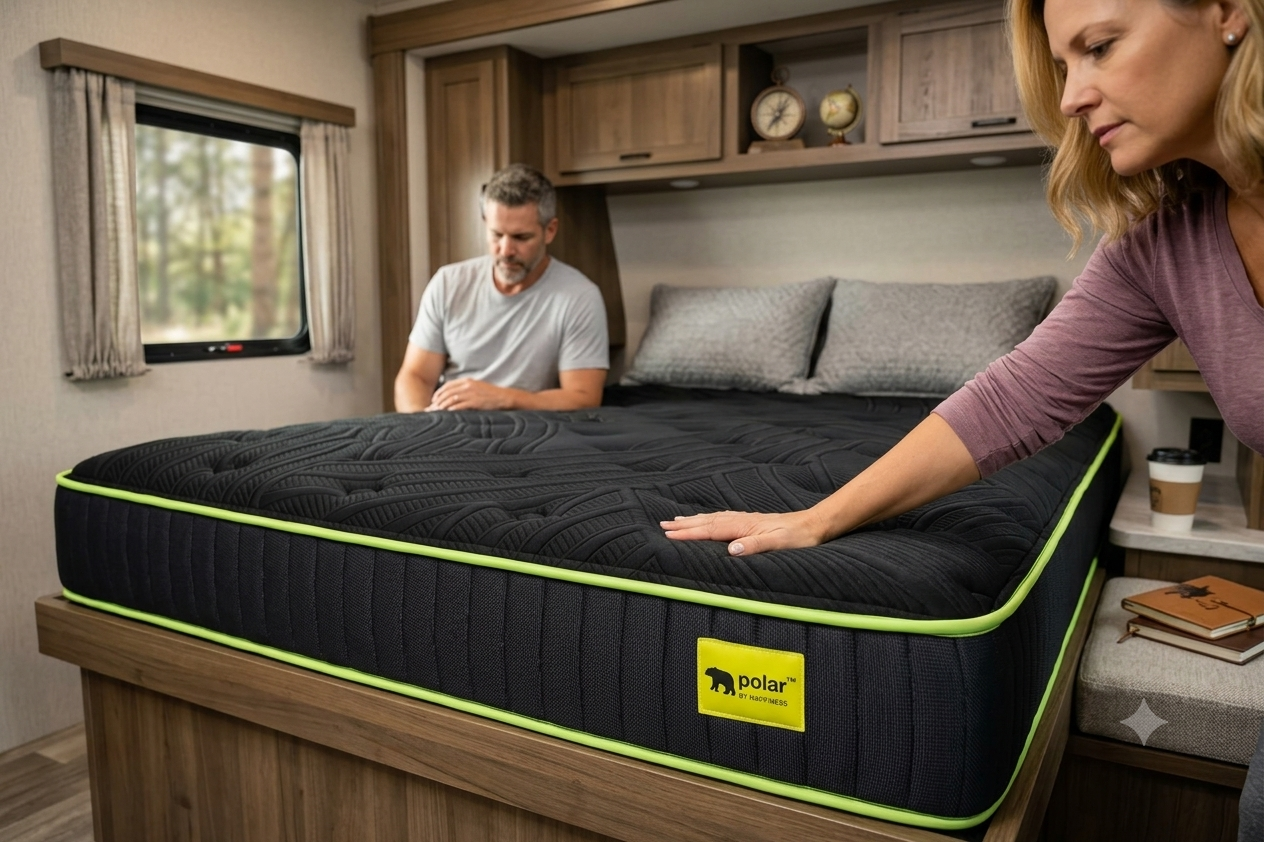
A bad RV mattress usually fails in two ways at once - it feels too hard in your shoulders and too soft under your hips. That is why a real guide to RV mattress firmness has to go beyond simple labels like plush, medium, or firm. In an RV, your mattress has to manage support, pressure relief, heat, motion transfer, and a non-standard sleeping space that often leaves no room for mistakes.
If you are replacing a thin stock mattress, firmness can be the difference between waking up ready to drive and waking up stiff, sore, and tired. The right feel depends on your body type, sleep position, health needs, and the way your RV is used. Weekend trips, full-time travel, and shared sleeping all change what “right” looks like.

What RV mattress firmness actually means
Firmness is simply how soft or firm a mattress feels when you lie down. It is not the same thing as support. A mattress can feel plush on top and still hold your spine in a better position than a cheap firm mattress that compresses unevenly.
That distinction matters because many RV owners assume they need the firmest bed available for back pain. In practice, too much firmness often creates pressure points in the shoulders, hips, and lower back. Too little firmness lets heavier parts of the body sink too far, which can throw your alignment off and make back pain worse by morning.
For most RV sleepers, the sweet spot lands somewhere in the medium to medium-firm range. That is usually where you get enough cushioning for comfort and enough pushback for proper support. But “usually” is not “always,” and that is where a better buying decision starts.
A practical guide to RV mattress firmness by sleep position
Your sleep position is one of the clearest predictors of what firmness will feel best.
Side sleepers typically need more pressure relief. If you spend most of the night on your side, your shoulders and hips press more deeply into the mattress. A mattress that is too firm can create sharp pressure buildup and cause numbness or soreness. Medium or medium-soft often works better, especially for lighter and average-weight sleepers.
Back sleepers usually do best with balanced support. You want enough contouring to support the curve of your lower back, but not so much softness that your hips dip below the rest of your body. Medium to medium-firm is often the safest range here.
Stomach sleepers usually need a firmer feel. This position puts more risk on the lower back if the midsection sinks too much. A firmer mattress can help keep the torso more level, although many combination sleepers still prefer a medium-firm model so the bed does not feel overly rigid in other positions.
Combination sleepers need versatility more than a single extreme. If you rotate between side, back, and stomach sleeping, a mattress in the middle range is often the best compromise. It is easier to move on, tends to isolate motion better than very bouncy designs, and usually works for more than one position.
Body weight changes how firmness feels
The same mattress will not feel the same to every person. Body weight changes how deeply you compress the comfort layers and support core.
Lighter sleepers often experience mattresses as firmer than advertised because they do not sink as far into the surface. If you are under roughly 130 pounds, a medium mattress may feel closer to medium-firm, and a truly firm mattress can feel uncomfortably hard.
Average-weight sleepers generally experience firmness close to the intended design. If you fall in the middle range, your sleeping position will matter more than anything else.
Heavier sleepers usually need stronger support systems and often a firmer overall feel. If you are over roughly 230 pounds, soft foam can let you sink too far, trap heat, and break down faster. This is where premium construction matters. Zoned coils, denser foams, and stronger edge support can give you firmness that feels supportive instead of flat and unforgiving.
Why couples should choose firmness differently
In RVs, sleep gets more complicated when two people share a tighter space. If one person wants plush comfort and the other wants firmer support, the answer is not always to split the difference blindly.
Start with the heavier sleeper and the person with stronger support needs. If a mattress is too soft for one partner, alignment problems usually show up quickly. Then consider pressure relief for the lighter sleeper. This is where layered construction helps. A mattress with responsive support coils and pressure-relieving foam on top can feel more balanced for both people than a basic all-foam bed that bottoms out or traps heat.
Motion isolation matters too. In a short queen or RV king, movement is more noticeable because the sleep surface is compact. If one partner is a light sleeper, a mattress that combines quality foam with pocketed coils will usually perform better than a cheap innerspring that transfers every turn.
Firmness, cooling, and pressure relief are connected
Many RV owners focus on firmness first and only think about cooling later. That is a mistake. A mattress that feels fine for ten minutes can feel much firmer after a hot night because heat buildup changes your comfort quickly.
Very soft foam tends to cradle the body more closely, which can increase heat retention. Very firm mattresses can reduce sink, but they may create pressure points if the comfort layers are too thin. The best RV mattress for real-world comfort usually balances contouring with breathable construction.
That is why advanced cooling materials, gel-infused foams, and coil systems are not just premium extras. They directly affect how the firmness feels across a full night of sleep. A well-built medium mattress with better airflow often sleeps more comfortably than a cheap firm foam mattress that traps body heat.
Common RV mattress firmness mistakes
The biggest mistake is choosing firmness based on what you had at home ten years ago. Bodies change, travel routines change, and RV sleep surfaces are different from residential setups.
Another common mistake is assuming firm equals durable. Cheap firm mattresses often feel supportive in the showroom or right after unboxing, but without strong internal construction they can still sag, compress unevenly, or lose comfort fast. Durability comes from the quality of the support system and materials, not just a hard initial feel.
Sizing mistakes also affect firmness perception. If an RV mattress is the wrong size, bends into cabinetry, or fits too tightly into a platform, it can feel firmer than designed. Proper RV sizing is not a minor detail. It is part of how the mattress performs.
How to choose the right firmness for your RV
If you want the most reliable starting point, choose based on these three questions. First, what position do you sleep in most of the night? Second, do you run hot or wake with pressure point pain? Third, do you need stronger support because of body weight or back issues?
If you are a side sleeper or have shoulder and hip pain, lean medium rather than firm. If you are a back sleeper or combination sleeper, medium-firm is usually a strong choice. If you are a stomach sleeper or need maximum pushback under the hips, firm may be the better fit - but only if the mattress still has enough comfort on top to prevent pressure buildup.
For many RV shoppers, medium-firm ends up being the best overall category because it covers the widest range of sleepers. But broad averages only go so far. Construction quality decides whether medium-firm feels stable and restorative or just stiff and generic.
That is where specialized RV brands have an advantage. A mattress built specifically for RV sizes and sleep conditions can deliver better firmness consistency, better cooling, and stronger support than a stock replacement or an off-the-shelf residential mattress forced into a tight fit. Polar RV Mattress, for example, focuses on RV-specific sizing and more advanced support and cooling systems because RV owners need more than basic comfort foam in a camper box.
When to go softer or firmer than average
There are times when the “safe” middle is not your best option. If you have sharp pressure point pain, a history of shoulder numbness, or a very lightweight build, going slightly softer can improve sleep quality fast. If you have lower back pain that worsens on soft beds, a heavier build, or stomach-sleeping habits, going firmer may give you better alignment.
It also depends on how often you use the RV. Occasional campers sometimes tolerate a broader range of firmness because they are not sleeping on the mattress every night. Full-time RVers should be much more selective. Small comfort issues become major fatigue problems when the bed is your primary sleep surface for months at a time.
The right firmness should make your body feel level, supported, and relaxed - not pinned on top of the mattress and not swallowed by it. If you keep that standard in mind, you will make a better decision than if you shop by firmness label alone.
A better RV mattress does more than fit the platform. It should help you recover, sleep cooler, and feel steady enough to enjoy the miles ahead.


Share:
RV Mattress vs Regular Mattress
Fifth Wheel Mattress Guide for Better RV Sleep