

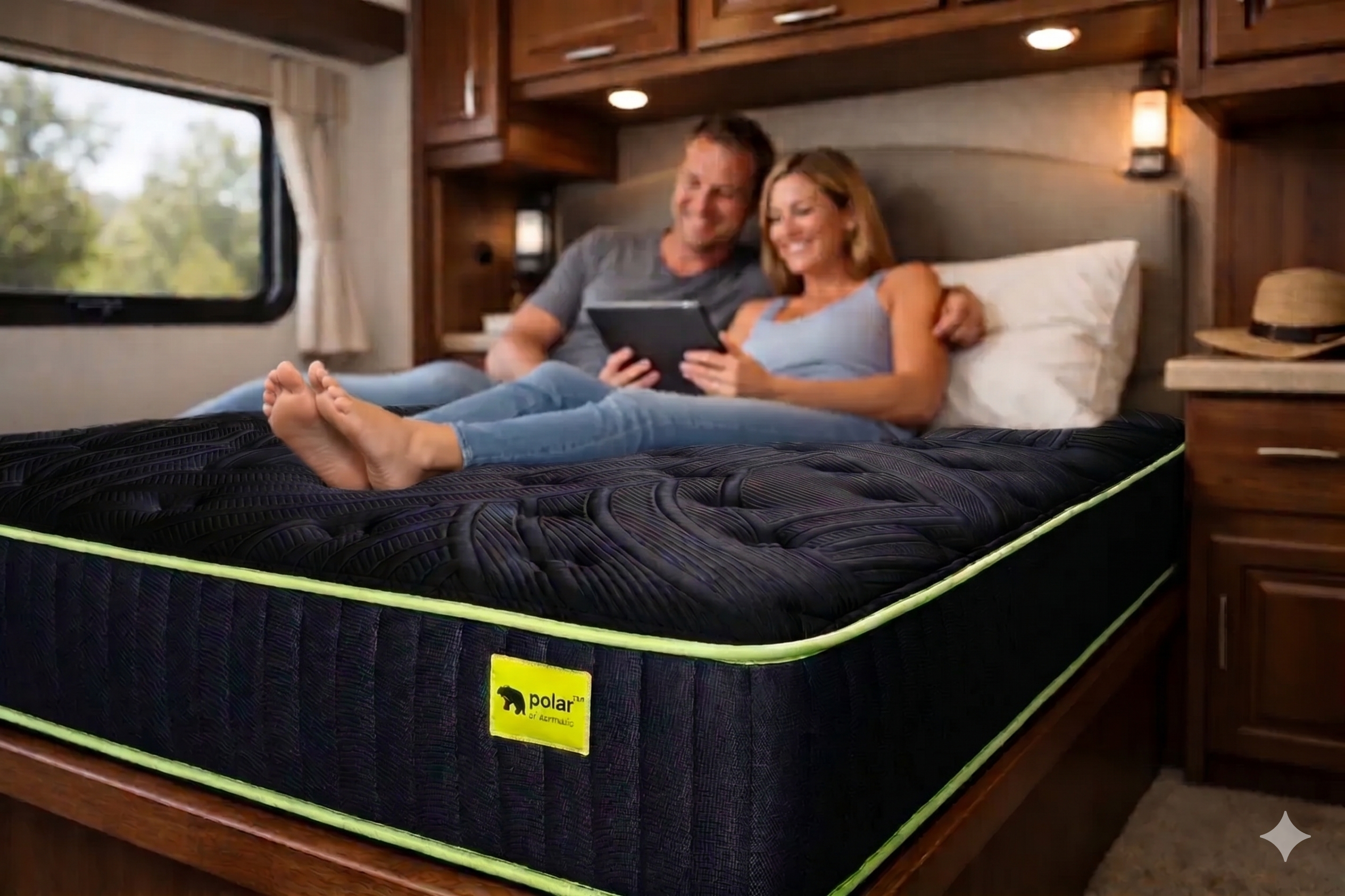
A bad RV bed usually gives itself away fast. You wake up hot, your hips ache, your partner rolls over and you feel all of it, and by morning that "good enough for camping" mattress starts to feel like the weakest part of the rig. If you're shopping for an rv queen mattress, the goal is not just replacing what came from the factory. It is getting real support, real cooling, and a fit that actually works inside an RV bedroom.

What makes an RV queen mattress different?
An RV queen is not always the same as a standard residential queen. That is where many buyers get tripped up.
A standard queen mattress is typically 60 inches wide by 80 inches long. An RV queen mattress is most often 60 inches wide by 75 inches long, although some RVs use slightly different dimensions depending on the floorplan and manufacturer. That missing five inches matters more than people expect. If you force a residential queen into a platform built for an RV queen, it can block storage access, crowd a slide, or make it harder to move around the bed.
This is why RV mattress shopping starts with measurement, not material. Width, length, corner shape, bed platform clearance, and overhead space all affect what will work. A mattress can be comfortable in theory and still be wrong for your coach.
Why stock RV mattresses fall short
Most factory RV mattresses are built to hit a cost target, not a sleep standard. They tend to be thin, light, and lacking in serious support. For occasional weekend use, some owners tolerate that. For longer trips, full-time travel, or anyone with back or shoulder pain, the weaknesses show up quickly.
Heat retention is one of the biggest complaints. Basic foam layers can trap body heat, especially in small RV sleeping spaces where airflow is already limited. Pressure relief is another issue. If the comfort layers are too thin or too dense in the wrong way, shoulders and hips take the load. And motion isolation matters more than many couples realize until one sleeper gets up early and the other feels every shift.
An upgrade should solve those problems, not just look better on paper. That means focusing on sleep performance first.

The best choice depends on how you travel, how you sleep, and how long you stay on the road. There is no single mattress that wins for everyone. But there are clear buying priorities that separate a real upgrade from another compromise.
Start with fit and height
Measure your existing mattress and the bed platform before doing anything else. Confirm the exact width and length, then check for tight corners, cabinetry, and whether your bed lifts for storage. Mattress height matters in RVs more than it does at home. A taller profile can feel more luxurious, but if it interferes with overhead cabinets or makes the bed awkward to enter, that extra thickness becomes a daily annoyance.
For many RV owners, the sweet spot is a mattress substantial enough to provide real support without overwhelming the room. It depends on your rig and how much clearance you have.
Decide what problem you need to fix
If you sleep hot, cooling should be near the top of the list. If your lower back is the issue, support and alignment matter most. If your partner's movement wakes you up, you need stronger motion control.
This sounds obvious, but many buyers shop by mattress type alone. Foam, hybrid, and coil systems all have strengths. What matters is whether the build addresses your specific complaint.
Don’t underestimate support
Support is what keeps your body aligned through the night. It is not the same as firmness. A mattress can feel soft on top and still hold your spine in a better position than a hard, flat slab of low-quality foam.
For many RV sleepers, stronger support cores, zoned designs, and well-built coil systems outperform the basic all-foam beds that often come standard. That is especially true for side sleepers with pressure points, back sleepers who need lumbar stability, and couples with different body types.

Foam vs hybrid in an RV queen mattress
This is usually the biggest decision, and the right answer depends on your priorities.
Memory foam
A foam RV queen mattress can work well if you want contouring pressure relief and a quieter, lighter build. Good foam absorbs movement well, which helps couples. But not all foam is equal. Lower-grade foam tends to sleep warmer and break down faster. If you choose foam, look for better cooling design and enough structural support underneath the comfort layers.
Hybrid construction
A hybrid combines foam comfort layers with a coil support system. For many RV owners, this is the best balance of comfort, airflow, and support. Coils help improve breathability, and a more advanced spring unit can deliver better pushback under heavier areas of the body.
The trade-off is that hybrids are usually heavier and more premium-priced than entry-level foam options. Still, if your current mattress feels hot, flat, or unsupportive, a well-built hybrid is often the clearest step up.
Premium support systems
Some RV mattresses now use zoned pocketed coils, gel memory foam, conductive cooling materials, and even coil-on-coil constructions. Those features are not just marketing if they are executed well. Zoned support can help with alignment. Better cooling materials can reduce overnight heat buildup. Pocketed coils can isolate motion better than older interconnected spring systems.
For RV owners who want residential-style comfort without sacrificing RV fit, these details matter.

Cooling matters more in an RV bedroom
An RV sleeping space behaves differently than a large bedroom in a house. It is tighter, often warmer, and more affected by outdoor conditions. That means mattresses that sleep warm at home can feel even warmer on the road.
If overheating is part of the reason you're replacing your bed, pay attention to cooling features that actually address heat. Open airflow through coil systems helps. Gel-infused foams may help somewhat, but they are not all the same. Conductive cooling materials and covers designed to pull heat away from the body tend to be more effective than vague "cool sleep" claims.
The key is not one buzzword. It is how the mattress manages heat as a whole.

The best RV queen mattress is not always the firmest
A lot of RV owners assume firm equals supportive. That can be true in some cases, but firmness alone is a poor shortcut.
Side sleepers usually need enough cushioning for shoulders and hips. Back sleepers often do best on a mattress with balanced contouring and strong underlying support. Stomach sleepers may prefer a firmer feel to avoid too much sink. Couples often need something in the middle - enough pressure relief for one person, enough support for the other, and good motion isolation for both.
Body weight matters too. A mattress that feels supportive to one sleeper may feel too soft or too hard to another. That is why trial periods are valuable. Sleep comfort is personal, even when the construction quality is easy to compare.
What to look for beyond the mattress itself
A mattress purchase is not just about specs. Service matters, especially with RV sizing.
Fast shipping is a real advantage if you are trying to replace a mattress before a trip or while traveling. Expert sizing help reduces the risk of ordering the wrong dimensions. A solid sleep trial gives you time to know whether the mattress actually solves your comfort issues. Warranty coverage matters too, but the bigger trust signal is whether the company clearly specializes in RV mattresses rather than treating them like an afterthought.
That specialization is where brands like Polar RV Mattress stand out. When a company builds around RV-specific sizes and sleep problems, the buying process gets simpler and the product fit tends to be better.
When a custom RV queen mattress makes sense
Some RVs have unusual dimensions, rounded corners, or platform layouts that make standard sizing difficult. In those cases, custom sizing is worth considering.
Custom is also useful if you are replacing a mattress in an older rig where original specs are unclear, or if you have modified the sleeping area. It may cost more, but it can save you from forcing a near-match into a space where precision matters.
For many RV owners, that is the difference between a mattress that works and one that constantly reminds you it does not.

Treat this like a sleep upgrade, not a simple replacement. Measure carefully. Focus on your real pain points. Compare cooling, support, pressure relief, and motion isolation before you compare price alone. A cheaper mattress that sleeps hot or loses support quickly is expensive in all the wrong ways.
The right rv queen mattress should make your RV feel more livable from the first night forward. Better rest changes the whole trip. You recover better, drive better, and enjoy the places you traveled to see instead of counting down to the next morning with a sore back.
Share:
How to Choose RV Mattress the Right Way
Can You Use Regular Mattress in RV?