

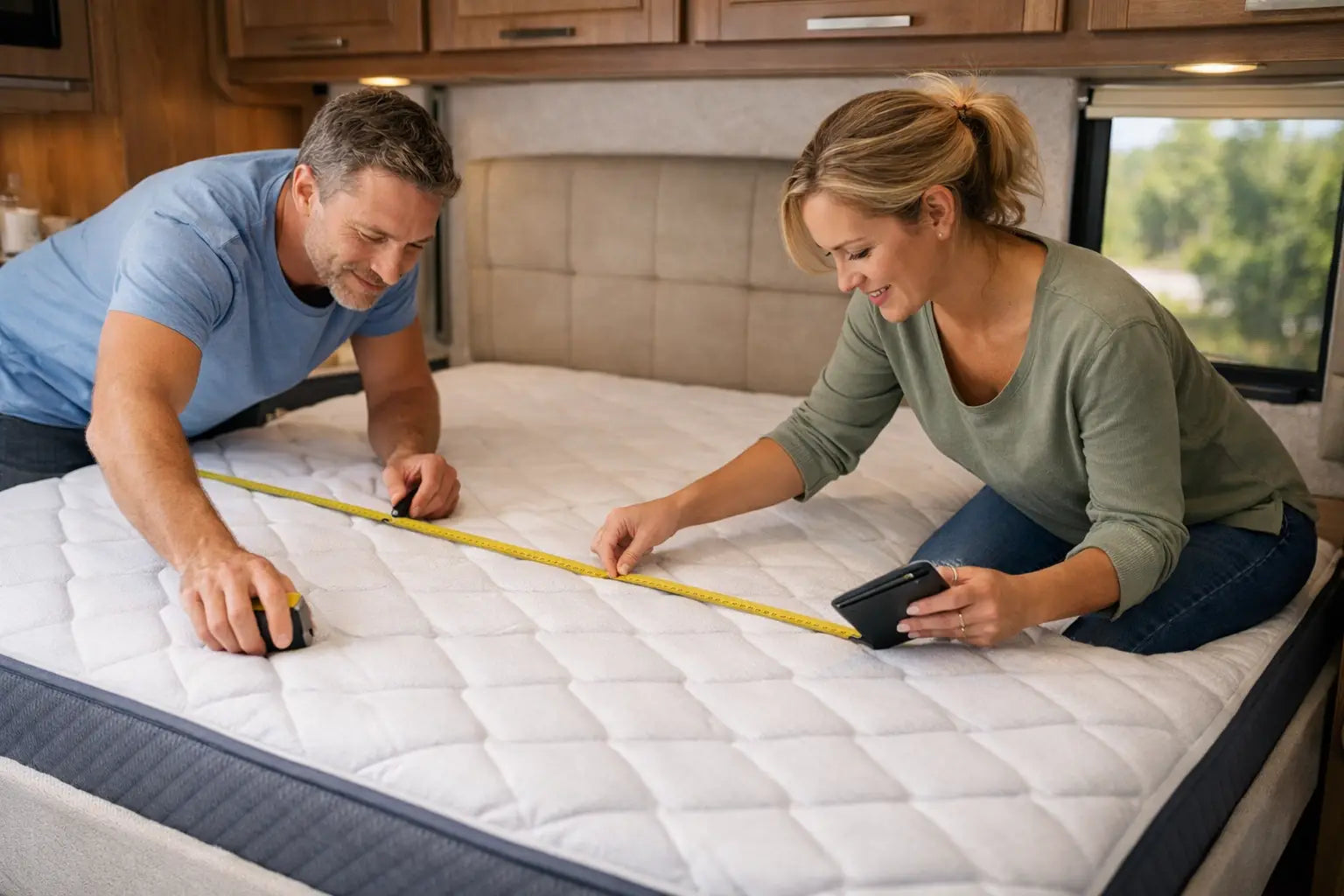
A mattress that is off by even an inch can turn an RV upgrade into a hassle. Too wide, and it binds against cabinetry or walls. Too long, and it crowds walkways or keeps storage platforms from closing properly. If you're wondering how to measure RV bed size correctly, the good news is that it only takes a few minutes - but the details matter.
RV beds are rarely as straightforward as residential beds. Many RVs use short queens, RV kings, three-quarter sizes, bunk layouts, and corner beds with cut corners or rounded edges. That means you cannot safely assume your mattress is a standard queen or king just because the label says so. The right fit starts with measuring the actual sleep platform, not guessing based on what the manufacturer may have called it.
How to measure RV bed without guessing
The best approach is simple. Measure the bed platform itself, then compare those numbers against the mattress shape and the space around it. In RVs, the platform is usually the most reliable reference point because stock mattresses are often undersized, misshapen, or compressed from years of use.
Start by removing all bedding, toppers, and pads. If the old mattress has rounded edges, sagging sides, or compressed corners, do not use it as your only guide. You want clean access to the platform or frame underneath.
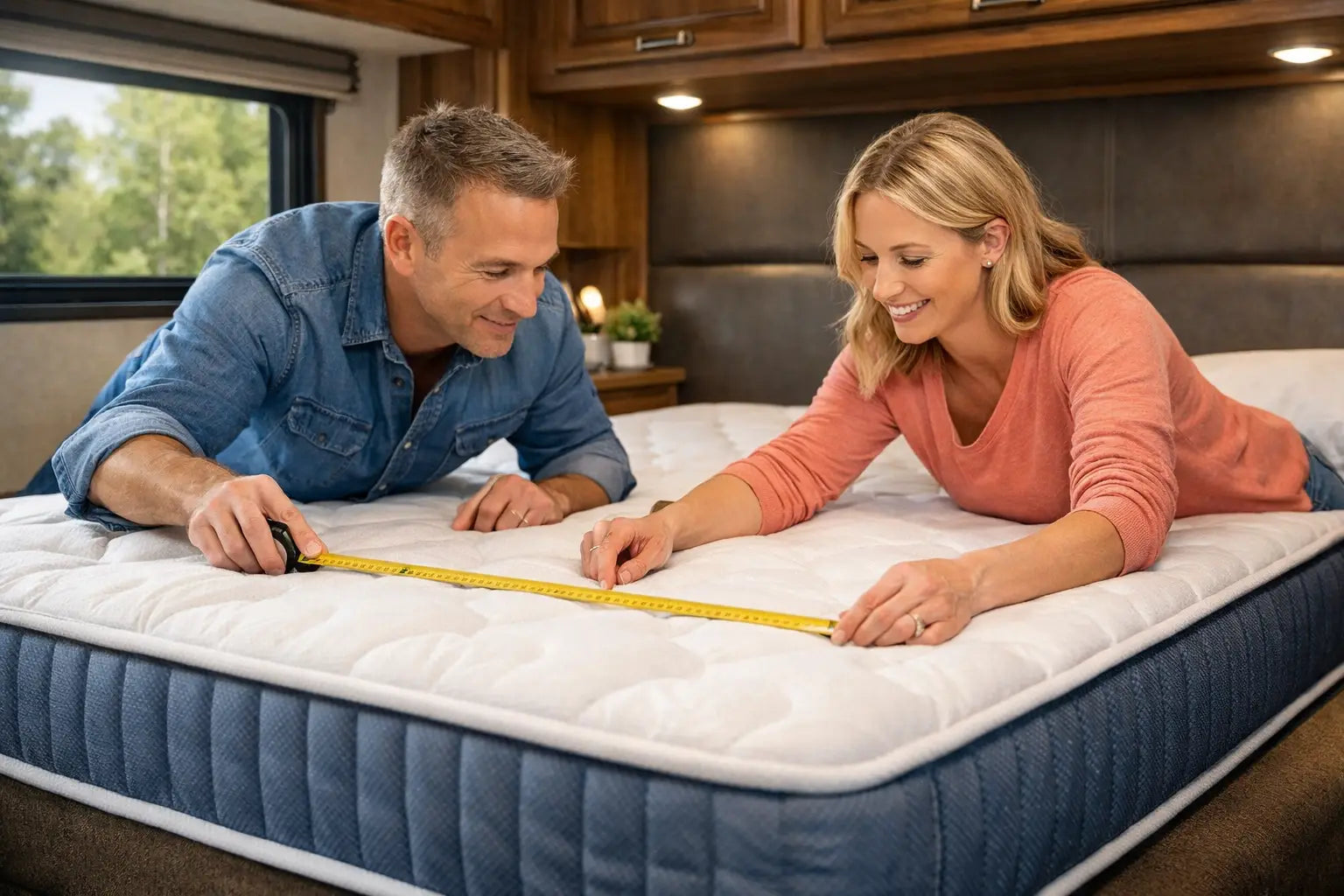
Use a metal tape measure rather than a cloth tape. A rigid tape gives more accurate numbers across wider spans, especially when you're measuring wall-to-wall or trying to reach into a corner bed area. Measure the width from side to side at the widest point, then measure the length from the head of the bed to the foot. Write both numbers down immediately.
If your bed sits in a tight compartment, measure more than once. RV interiors are not always perfectly square. It is common to find slight variation from one side to the other, especially in older units or slide-out rooms. If one side reads differently, use the tighter measurement. A mattress can flex slightly, but it should not be forced into the frame.
Measure the platform, then measure the space around it
A lot of RV owners stop after measuring width and length. That is where fit problems start.
The platform tells you the mattress footprint, but the surrounding space tells you whether the mattress will actually function well once installed. Check for nearby cabinets, nightstands, trim pieces, window ledges, and slide mechanisms. If the bed lifts for under-bed storage, note whether the mattress needs to bend slightly or stay within a certain thickness range so the platform can still open easily.
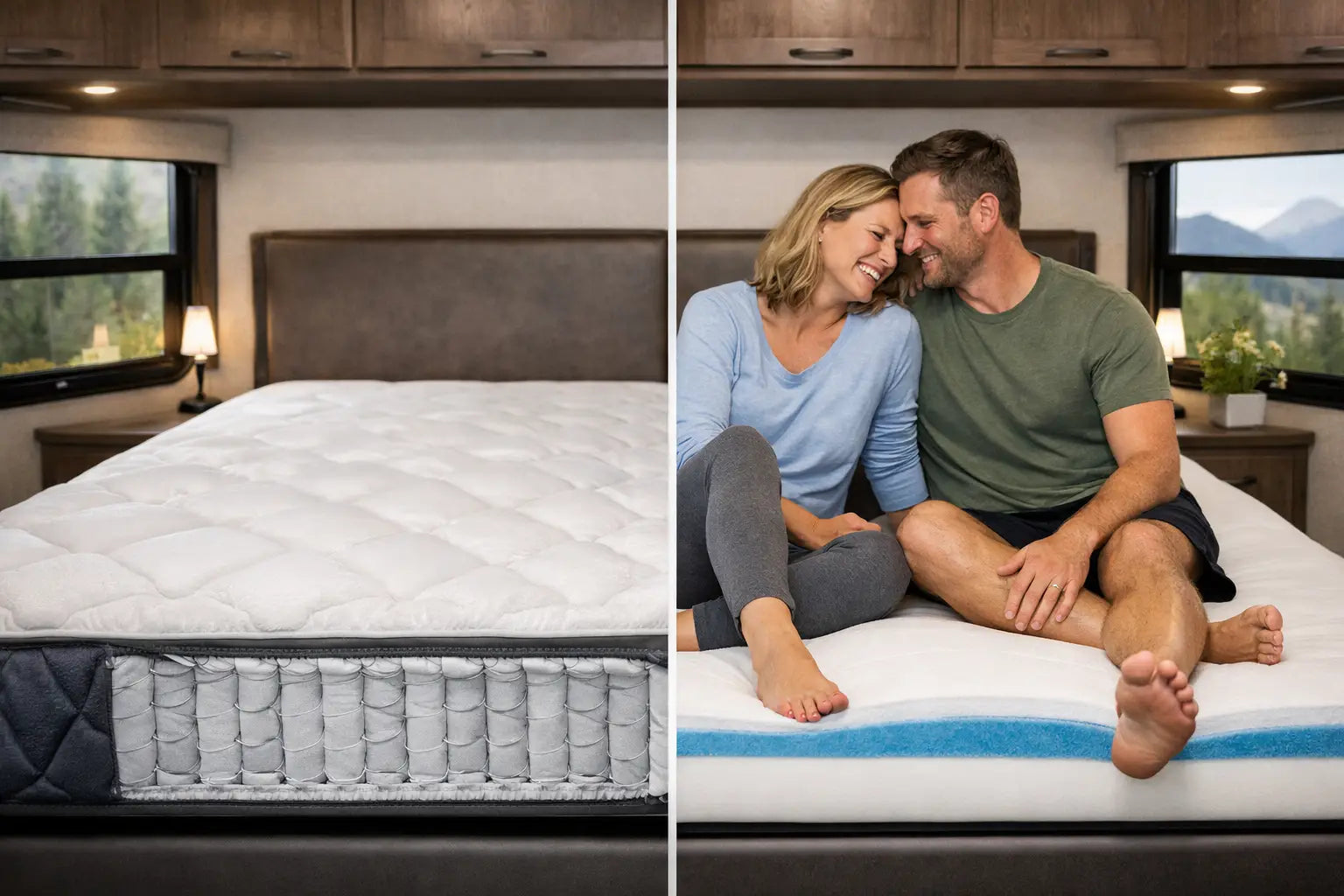
This is especially important with upgraded RV mattresses. Premium models often offer stronger support, better cooling materials, and thicker comfort layers than factory mattresses. That is a good thing for sleep quality, but it can change how the bed interacts with overhead cabinets, reading lights, or tight sheets. A thicker mattress can improve pressure relief and support, but only if your RV layout has room for it.
Don’t forget mattress height
Height is not part of size in the same way width and length are, but it still affects fit. Measure from the top of the platform to any obstacle above or beside the bed. That may include overhead storage, a slide topper edge, or a window frame.
If your current mattress is too thin and uncomfortable, you may be considering a significant upgrade. That makes sense. Most stock RV mattresses are built to meet a price point, not a comfort standard. Still, it pays to check how much vertical clearance you have before moving to a thicker, more supportive mattress.
Common RV bed shapes that need extra attention
Not every RV bed is a clean rectangle. In fact, many of the hardest sizing mistakes happen when the shape gets ignored.
Corner beds often have one or two cut corners to make it easier to walk around in a compact floor plan. Some have radius corners rather than sharp angles. Bunk mattresses can look standard at first glance but be shorter or narrower than expected. Certain trailer and motorhome layouts also use mattresses with notches, angled feet, or custom dimensions designed around cabinetry.
If your bed has any non-standard feature, measure each part separately. For a cut corner, measure the full width and length first, then measure the depth and width of the missing corner section. For rounded corners, note which corner is rounded and estimate the radius as closely as possible. For angled ends, measure the widest point, narrowest point, and total length.
A quick sketch helps. It does not need to be pretty. A simple drawing with dimensions is often the clearest way to avoid ordering the wrong shape.
Standard RV mattress sizes are helpful, but not enough
Many RV owners search for a mattress by name first - RV Queen, RV King, RV Full, RV Bunk. That is useful, but those categories are broader than most people realize.
For example, an RV Queen is commonly 60 inches wide by 75 inches long, while a residential queen is usually 60 by 80. An RV King may differ from a residential king in both width and length. RV Full or three-quarter sizes also vary by manufacturer and floor plan. Even when your bed seems to match a common RV size, it is still worth checking the platform yourself.
This is where specialized RV mattress brands have a real advantage. A company focused on RV sizing understands that one label can cover multiple real-world dimensions, and that shape details matter just as much as the headline size.
If your old mattress measures differently than the platform
Trust the platform first, then use judgment.
If the old mattress is slightly smaller than the base, that was often intentional from the factory to make installation easier. If it is larger and overhangs, that may have been a compromise or a poor replacement choice made by a previous owner. What you want is a mattress that fits the intended sleeping area securely without compressing into walls or leaving awkward gaps.
It depends on the bed layout. A small gap may be harmless in an open island bed. In a corner bed against two walls, too much extra room can cause shifting and make sheet fit annoying. A mattress that is made for RV use generally performs better when it is sized for the actual platform, not just close enough.
The most common measuring mistakes
The first mistake is measuring the old mattress instead of the bed base. Worn mattresses change shape. Foam rounds off, edges collapse, and fabric covers stretch.
The second is assuming all queens or kings are the same. In RVs, they are not.
The third is ignoring obstacles. A mattress can match the platform dimensions and still be wrong if it interferes with storage access, slide operation, or walking space.
The fourth is forgetting custom details like cut corners, rounded corners, or nose sections in bunks. These shapes are easy to miss until the new mattress arrives and will not sit flat.
The fifth is rounding too aggressively. Do not turn 74.5 inches into 75 without checking whether that half inch matters. In a tight RV frame, it often does.
What to do after you measure your RV bed
Once you have the dimensions, compare them against actual RV mattress specs rather than broad mattress categories. Look for exact width, exact length, and any shape customization if needed. If your setup is unusual, keep your sketch and photos handy before ordering.
This is also the moment to think beyond fit alone. The right dimensions solve one problem, but the right construction solves the sleep problem. If you deal with overheating, back pain, motion transfer, or pressure points, the upgrade should address those issues too. In other words, getting the size right is step one. Getting better sleep is the real goal.
For many RV owners, that means choosing a mattress built specifically for mobile living rather than settling for another thin stock replacement. A brand like Polar RV Mattress focuses on RV-specific sizing along with cooling, support, and pressure relief, which matters when your space is limited and your sleep quality cannot be an afterthought.
If you are still unsure, measure one more time before you buy. Those extra two minutes are cheaper than ordering the wrong mattress and starting over. A proper fit gives you a cleaner install, better function, and one less thing to think about before the next trip. The best RV upgrades are the ones you feel every night and never have to fight with again.

Share:
RV King Mattress: What Actually Matters
Best Mattress for Full Time RV Living