

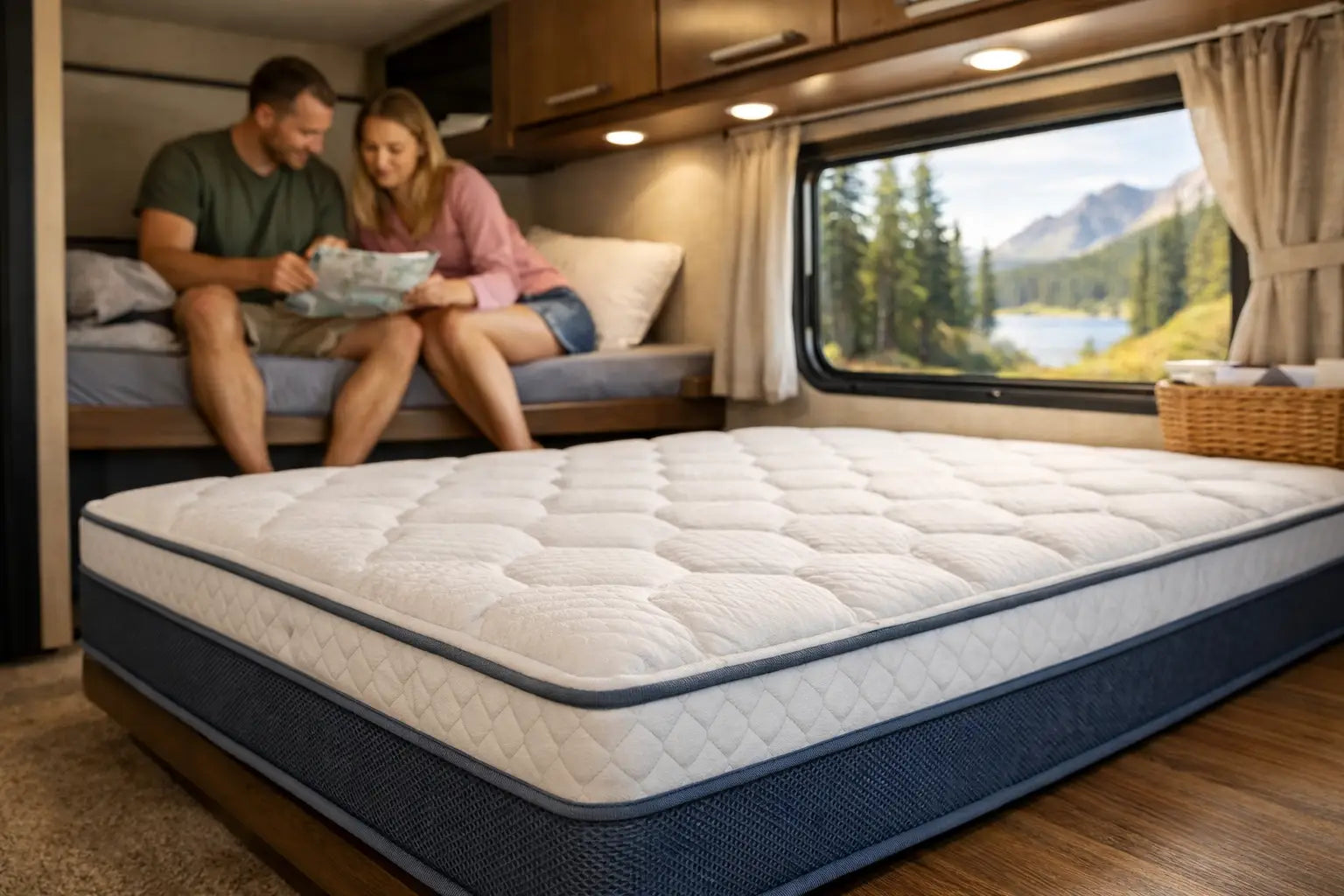
You do not notice how odd RV bed sizes are until you try replacing one. Then the question hits fast: what size mattress fits camper spaces, and why does nothing at the local mattress store seem to match? That confusion is common because camper beds often look like standard queen, full, or twin sizes at a glance, but many are shorter, narrower, rounded at the corners, or built into tight slide-outs and platforms.
The good news is that most campers do not require a mystery size. They usually fall into a handful of RV-specific categories. The key is measuring the sleeping platform correctly and understanding that the right fit is not just about length and width. Height, corner shape, bed access, and weight can matter just as much in an RV as comfort does.
What size mattress fits camper layouts most often?
In many campers, the right size is one of these: RV King, RV Queen, RV Short Queen, RV Full or three-quarter, RV Twin, or RV Bunk. Those names sound close to residential sizes because they are close, but close is where expensive mistakes happen.
An RV Queen is one of the most common examples. A standard residential queen is typically 60 inches by 80 inches. An RV Queen is often 60 inches by 75 inches, though some layouts vary. That five-inch difference matters when your mattress sits between cabinets, against a wall, or at the foot of a narrow walk-around bed.
RV King sizes also vary more than many shoppers expect. Some are narrower than a residential king, some are shorter, and some are built around the dimensions of a specific manufacturer platform. Bunk mattresses are even less standardized. In one camper, a bunk may be close to a narrow twin. In another, it may be shorter, thinner, or shaped to fit a built-in frame.
That is why the real answer to what size mattress fits camper beds is this: not the size label alone, but the exact measured space inside your RV.
Standard mattress names can mislead you
A lot of RV owners start with the sticker on the old mattress or the brochure for the camper. That can help, but it should not be your final answer. Manufacturers sometimes use broad labels that do not reflect the true usable dimensions of the bed platform.
For example, a camper may be listed as having a queen bed, but the platform may be designed for a short queen. Or the sleeping area may technically fit the width of a queen but leave no room for bedding if you use a thicker replacement mattress. That is a common issue in nose-cap bedrooms and corner beds where every inch counts.
Older RVs can add another wrinkle. Previous owners may have replaced the original mattress with whatever fit well enough. If that mattress hangs over the platform, leaves gaps, or rubs against cabinetry, it may not be the correct size even if it has been there for years.
How to measure before you buy
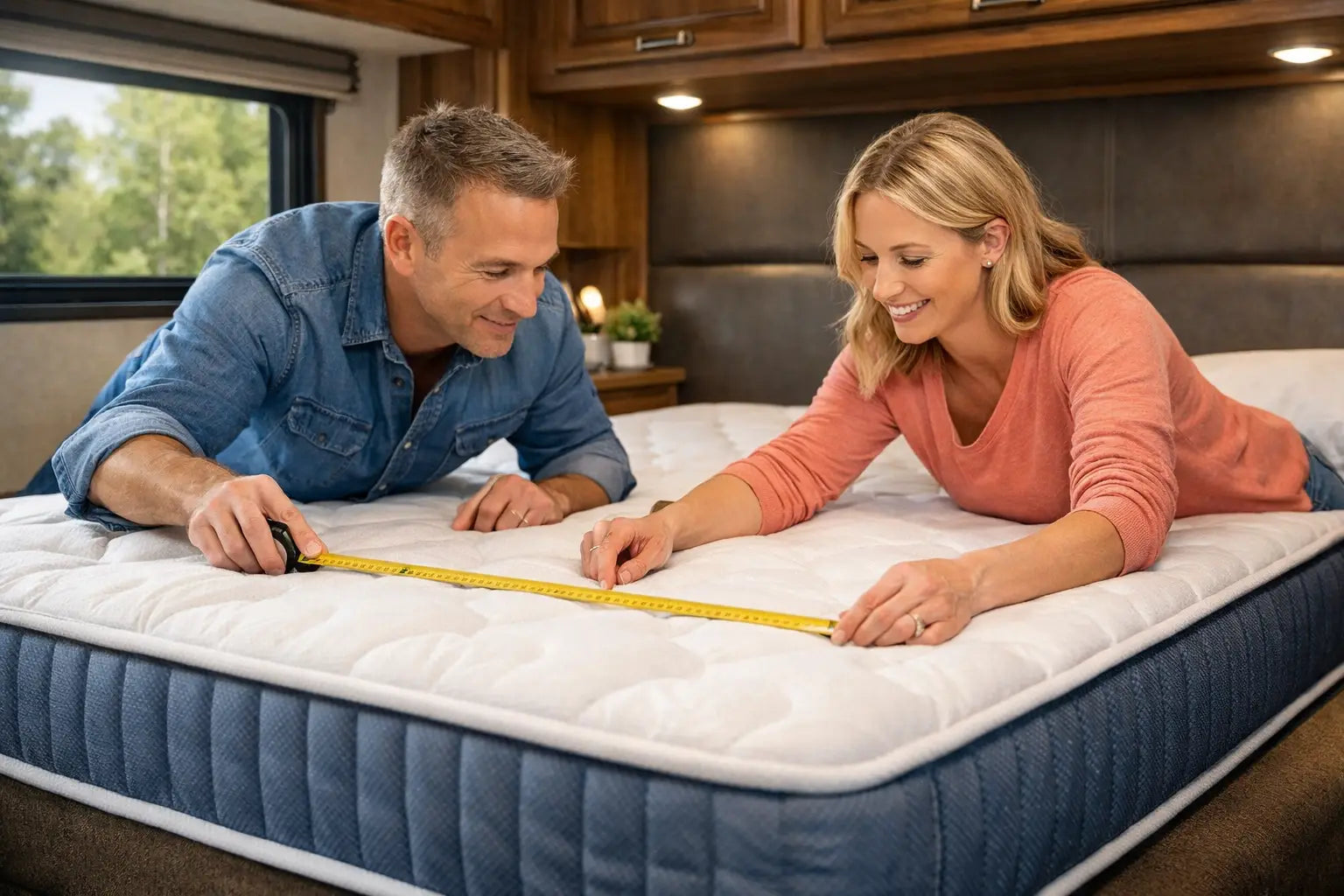
If you want the right fit the first time, measure the platform itself, not just the old mattress. Use a tape measure and record the widest points for width and the longest points for length. Measure twice because even small errors can create fit problems in a tight camper bedroom.
Then check the surrounding space. Measure how much clearance you have near wardrobes, walls, nightstands, windows, and slide-outs. In some campers, a mattress that is technically the right footprint can still be a poor choice if it is too tall and blocks storage access or makes it harder to sit up in bed.
Height matters more in RVs than in houses. A thick residential mattress may sound like an upgrade, but if it pushes you too close to overhead cabinets or makes climbing into bed awkward, it stops feeling premium fast. The best RV mattress is not just comfortable. It is sized for the realities of your layout.
Check for corners, cutouts, and odd shapes
Not every camper bed is a clean rectangle. Some have rounded corners, angled edges, or cut corners to improve walk-around space. Others sit on platforms with partial supports, hinged storage lids, or curved nose sections.
If your bed has a non-standard shape, measure each side and note any corner modifications. A custom-size RV mattress may be the right move if you want a proper fit without forcing a square mattress into an angled space. That becomes especially important in smaller travel trailers and truck campers where layout efficiency drives the bed shape.
Common camper mattress sizes to know
The most useful starting point is understanding the size family your RV likely uses. RV Twin and bunk sizes are common in bunks, single sleeper layouts, and some fold-out sections. RV Full or three-quarter sizes show up in compact trailers and select vintage units. RV Queen is one of the most common primary bed sizes in travel trailers, fifth wheels, and motorhomes. RV King is typically found in larger fifth wheels and premium motorhomes.
But there is a catch. There is no single universal RV size chart that every manufacturer follows exactly. Two brands may both call a mattress an RV Queen and still differ slightly in length or corner construction. That is why a specialty RV mattress brand is usually the safer path than trying to adapt a standard residential mattress and hoping it works.
Fit is only half the decision
Once you know what size mattress fits camper dimensions, the next question is what type of mattress actually performs well on the road. This is where many RV owners upgrade for the first time and realize that the stock mattress was the real problem all along.
Factory RV mattresses are often thin, basic, and built to hit a cost target rather than a comfort standard. They tend to trap heat, flatten early, and offer weak pressure relief. If you are waking up sore, tossing from motion transfer, or sleeping hot, replacing the mattress with the same low-grade construction will not solve much.
A better RV mattress should match your size needs and your sleep needs. For couples, motion isolation matters. For side sleepers, pressure relief matters. For travelers dealing with back pain, stronger support matters. For warm sleepers, cooling materials matter. In RV living, those features are not extras. They directly affect how rested you feel on the road.
Why thickness and support need balance
Many buyers assume thicker always means better. In a house, that can sometimes work. In a camper, it depends. You need enough comfort and support to outperform the original mattress, but not so much height or bulk that the bed becomes awkward to use.
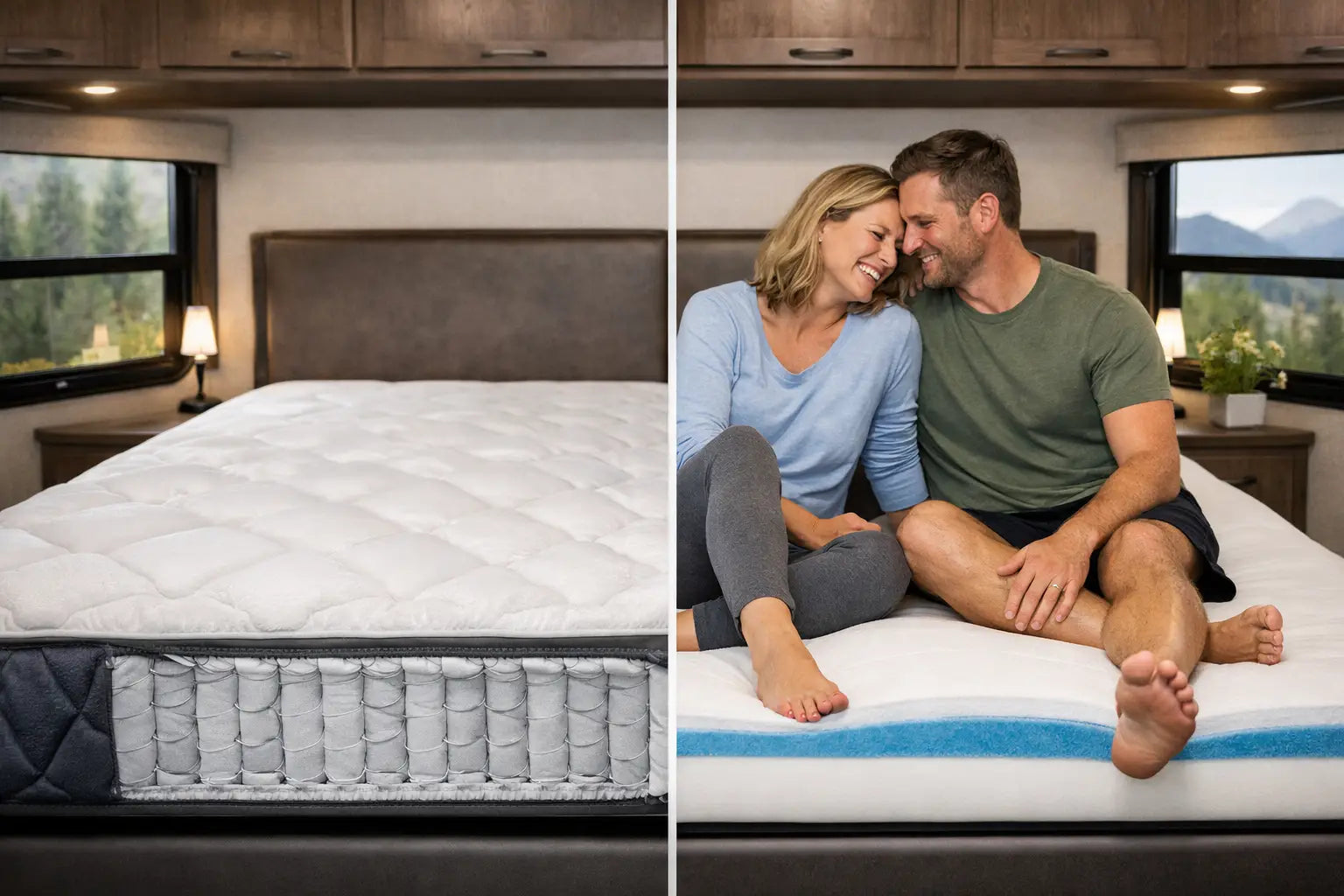
The right balance often comes from RV-specific construction rather than sheer thickness alone. Zoned support, quality foam layers, pocketed coils, and cooling materials can deliver a serious comfort upgrade without creating fit issues. That is one reason specialized RV mattresses outperform generic replacements so often. They are designed around mobile spaces instead of standard bedrooms.
When a custom size makes sense
If your measurements do not line up cleanly with an RV King, RV Queen, RV Full, or RV Twin, custom sizing is worth considering. This is especially true for older RVs, custom builds, renovated campers, and floorplans with clipped corners or unusual platforms.
A custom mattress is not just about precision. It can save you from the everyday irritation of a mattress that slides, bunches bedding, blocks storage, or leaves dead space around the frame. In an RV, small fit problems get magnified because the bedroom has less margin for error.
Brands that specialize in RV mattresses can usually guide this process faster and with fewer missteps than general mattress retailers. That matters when you want confidence before ordering, not a guessing game and a return headache.
The easiest way to avoid buying the wrong camper mattress
Do not shop by label first. Shop by measurement, layout, and sleep priorities. If your current mattress says queen but your platform measures 60 by 75, you need an RV Queen or short queen style fit, not a residential queen. If the bed has a corner cut, document it. If overhead clearance is tight, factor in mattress height before you order.
Then think beyond fit. Ask whether you want better cooling, stronger support, less partner motion, or more durable construction than the stock mattress offered. That is where a true upgrade begins. A company like Polar RV Mattress focuses on exactly that gap between basic fit and real sleep performance.
A camper mattress should do two jobs at once. It has to fit the RV correctly, and it has to help you sleep like you are not in an RV at all. Get both right, and your next trip feels a lot better before the coffee is even on.

Share:
Camper Mattress Buying Guide That Gets It Right
Best Mattress for Hot Sleepers in an RV